Department of Medical Insurance, School of Public Health, Southeast University, Nanjing, China.
Guangdong Provincial Geriatrics Institute, Guangdong Provincial People's Hospital, Guangdong Academy of Medical Sciences, Guangzhou, China.
JAMA Netw Open. 2021 Sep 1;4(9):e2125577. doi: 10.1001/jamanetworkopen.2021.25577.
Functional limitation is increasingly common as people age and is often associated with negative consequences. Evidence of the dynamics of functional limitation within couples in China is still inadequate.
To examine whether functional limitation was associated within middle-aged and older couples and to explore sex differences in spousal associations.
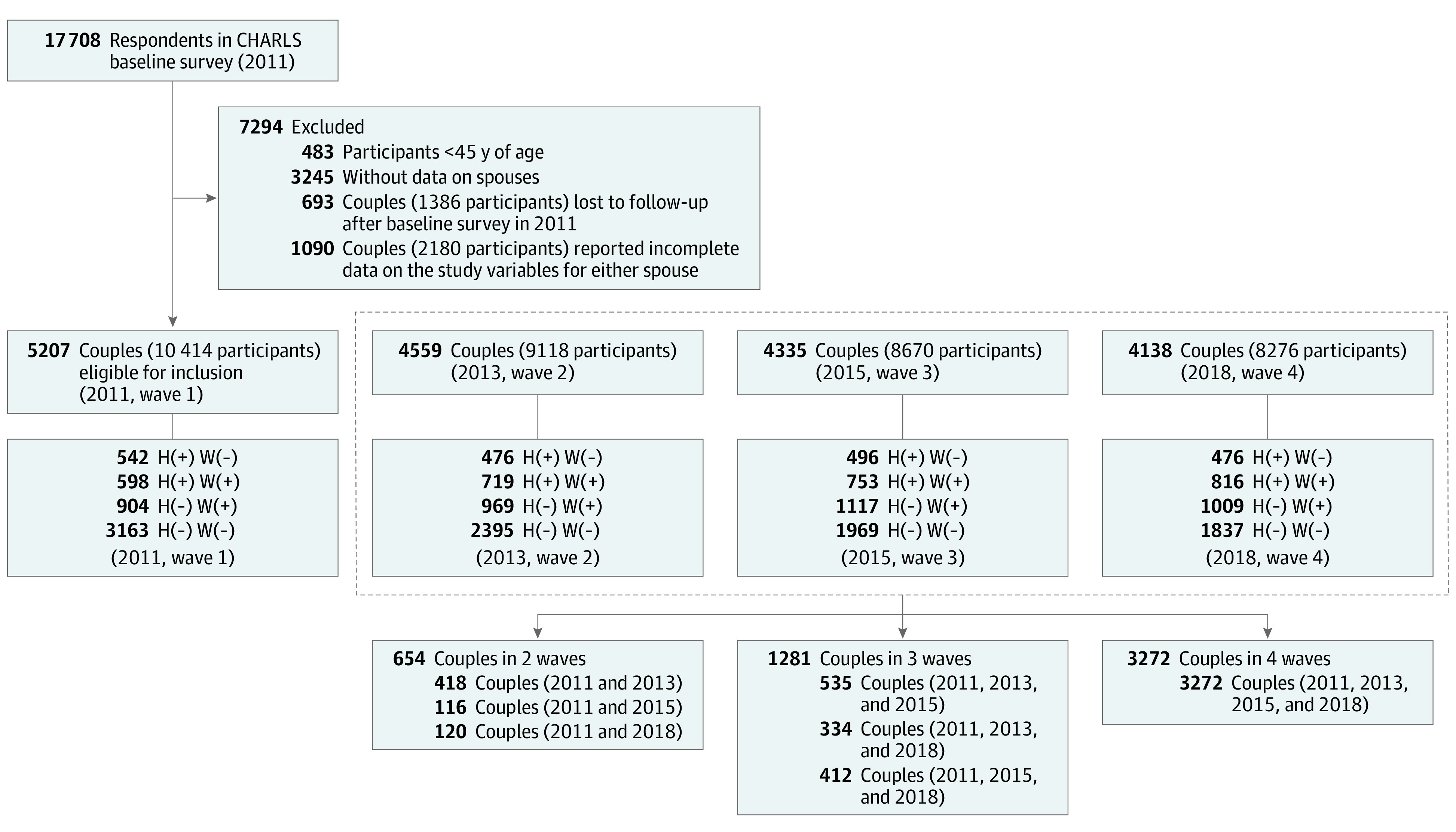
DESIGN, SETTING, AND PARTICIPANTS: In this nationwide, population-based cohort study performed from January 1, 2011, to December 31, 2018, participants were selected using multistage probability sampling, and 5207 community-dwelling couples (10 414 individuals) 45 years or older were included in the nationally representative China Health and Retirement Longitudinal Study. Data analysis was performed from January 1 to February 28, 2021.
The exposure variable was the presence of functional limitation in spouses. Functional limitation was measured by the activities of daily living (ADLs) and instrumental activities of daily living (IADLs) scales and was defined as having difficulty in independently performing at least 1 ADL or IADL item.
The main outcome was functional limitation in index participants. Multivariable logistic regression with generalized estimating equations was used to estimate the reciprocal association of functional limitation within couples over time.
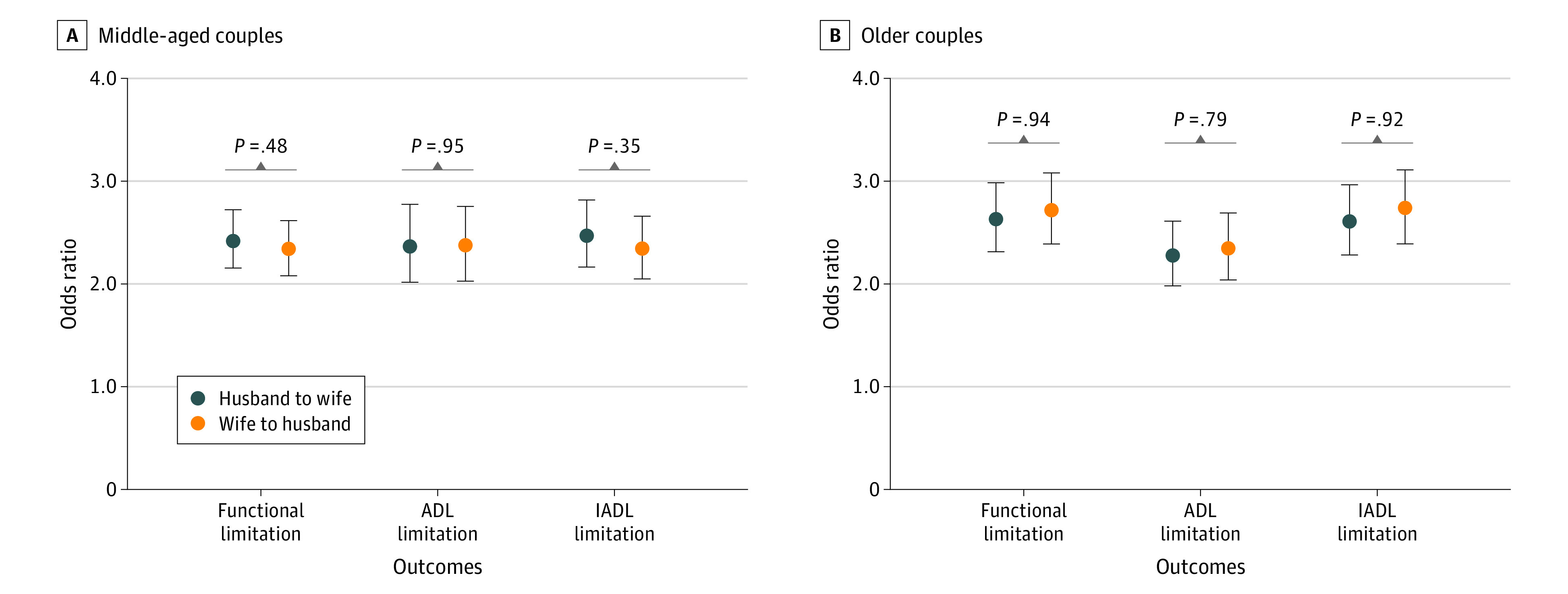
A total of 5207 married, different-sex couples (mean [SD] age, 59.1 [8.8] years for husbands and 57.0 [8.2] years for wives) were included in the study. For husbands, the number (percentage) of participants classified with baseline functional limitation was 1140 (21.9%), the number (percentage) with ADL limitation was 684 (13.1%), and the number (percentage) with IADL limitation was 834 (16.0%). For wives, the number (percentage) of participants classified with baseline functional limitation was 1502 (28.8%), the number (percentage) with ADL limitation was 887 (17.0%), and the number (percentage) with IADL limitation was 1183 (22.7%). Longitudinal results demonstrated an association in spouses developing functional limitation (adjusted odds ratio [OR], 2.55; 95% CI, 2.41-2.69; P < .001), ADL limitation (adjusted OR, 2.26; 95% CI, 2.11-2.41; P < .001), and IADL limitation (adjusted OR, 2.58; 95% CI, 2.43-2.73; P < .001). Subgroup analyses by sex revealed similar patterns of spousal health concordance in terms of all studied outcomes, indicating no sex specificity.
This population-based cohort study suggests that among Chinese middle-aged and older couples there is significant concordance in the development of functional limitation. This study of spousal functional ability from a dyadic perspective may help in the understanding of health risks within a wider familial context and offers novel insights for prioritizing policy focus from individual centered to couple based.
随着人们年龄的增长,功能障碍越来越普遍,并且通常与负面后果相关。目前在中国,关于中年和老年夫妇之间功能障碍动态的证据仍然不足。
检验中年和老年夫妇中功能障碍是否存在相关性,并探讨配偶间关联的性别差异。
设计、设置和参与者:这是一项全国性的、基于人群的队列研究,于 2011 年 1 月 1 日至 2018 年 12 月 31 日进行,使用多阶段概率抽样选择参与者,包括 5207 对 45 岁及以上的社区居住夫妇(共 10414 人),纳入全国代表性的中国健康与退休纵向研究。数据分析于 2021 年 1 月 1 日至 2 月 28 日进行。
暴露变量为配偶中存在功能障碍。功能障碍通过日常生活活动(ADL)和工具性日常生活活动(IADL)量表来衡量,定义为在独立进行至少 1 项 ADL 或 IADL 项目方面存在困难。
主要结局是指数参与者的功能障碍。使用广义估计方程的多变量逻辑回归来估计夫妻之间功能障碍随时间的相互关联。
共纳入 5207 对已婚、不同性别的夫妇(丈夫的平均[标准差]年龄为 59.1[8.8]岁,妻子的平均[标准差]年龄为 57.0[8.2]岁)。对于丈夫,基线时被归类为功能障碍的参与者数量(百分比)为 1140(21.9%),ADL 受限的参与者数量(百分比)为 684(13.1%),IADL 受限的参与者数量(百分比)为 834(16.0%)。对于妻子,基线时被归类为功能障碍的参与者数量(百分比)为 1502(28.8%),ADL 受限的参与者数量(百分比)为 887(17.0%),IADL 受限的参与者数量(百分比)为 1183(22.7%)。纵向结果表明,配偶中功能障碍(调整后的优势比[OR],2.55;95%CI,2.41-2.69;P<0.001)、ADL 受限(调整后的 OR,2.26;95%CI,2.11-2.41;P<0.001)和 IADL 受限(调整后的 OR,2.58;95%CI,2.43-2.73;P<0.001)的发展存在关联。按性别进行的亚组分析显示,所有研究结果均表明配偶健康一致性存在相似模式,表明不存在性别特异性。
这项基于人群的队列研究表明,在中国中年和老年夫妇中,功能障碍的发展具有显著的一致性。从二元角度研究配偶的功能能力,可能有助于在更广泛的家庭背景下理解健康风险,并为从个体为中心到夫妻为中心的政策重点提供新的见解。