Instituto de Ciencias Humanas, Sociales y Ambientales CONICET Mendoza Technological Scientific Center, Mendoza M5500, Argentina.
Division of Solid-State Electronics, Department of Electrical Engineering, Uppsala University, SE-751 03 Uppsala, Sweden.
ACS Nano. 2021 Sep 28;15(9):14419-14429. doi: 10.1021/acsnano.1c03842. Epub 2021 Aug 17.
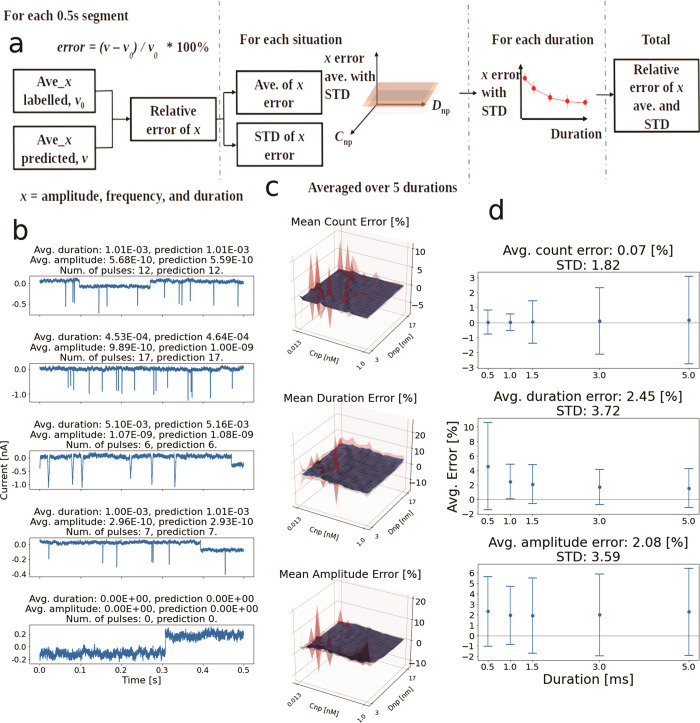
Temporal changes in electrical resistance of a nanopore sensor caused by translocating target analytes are recorded as a sequence of pulses on current traces. Prevalent algorithms for feature extraction in pulse-like signals lack objectivity because empirical amplitude thresholds are user-defined to single out the pulses from the noisy background. Here, we use deep learning for feature extraction based on a bi-path network (B-Net). After training, the B-Net acquires the prototypical pulses and the ability of both pulse recognition and feature extraction without assigned parameters. The B-Net is evaluated on simulated data sets and further applied to experimental data of DNA and protein translocation. The B-Net results are characterized by small relative errors and stable trends. The B-Net is further shown capable of processing data with a signal-to-noise ratio equal to 1, an impossibility for threshold-based algorithms. The B-Net presents a generic architecture applicable to pulse-like signals beyond nanopore currents.
纳米孔传感器中由于目标分析物的转位而引起的电阻的瞬时变化被记录为电流迹线上的一系列脉冲。在脉冲信号的特征提取中常用的算法缺乏客观性,因为经验幅度阈值是用户定义的,以将脉冲从噪声背景中单独挑出。在这里,我们使用基于双路径网络(B-Net)的深度学习进行特征提取。经过训练,B-Net 获得了典型的脉冲,以及无需分配参数即可进行脉冲识别和特征提取的能力。B-Net 在模拟数据集上进行了评估,并进一步应用于 DNA 和蛋白质转位的实验数据。B-Net 的结果具有较小的相对误差和稳定的趋势。B-Net 还能够处理信噪比等于 1 的数据,这是基于阈值的算法不可能实现的。B-Net 提出了一种通用架构,适用于纳米孔电流以外的脉冲信号。