Human Microbiome Research Program, Faculty of Medicine, University of Helsinki, Helsinki, Finland.
Meilahti Infectious Diseases and Vaccine Research Center, MeiVac, University of Helsinki and Helsinki University Hospital, Helsinki, Finland.
PLoS Negl Trop Dis. 2021 Sep 29;15(9):e0009709. doi: 10.1371/journal.pntd.0009709. eCollection 2021 Sep.
Childhood diarrhoea, a major cause of morbidity and mortality in low-income regions, remains scarcely studied in many countries, such as Guinea-Bissau. Stool sample drying enables later qPCR analyses of pathogens without concern about electricity shortages.
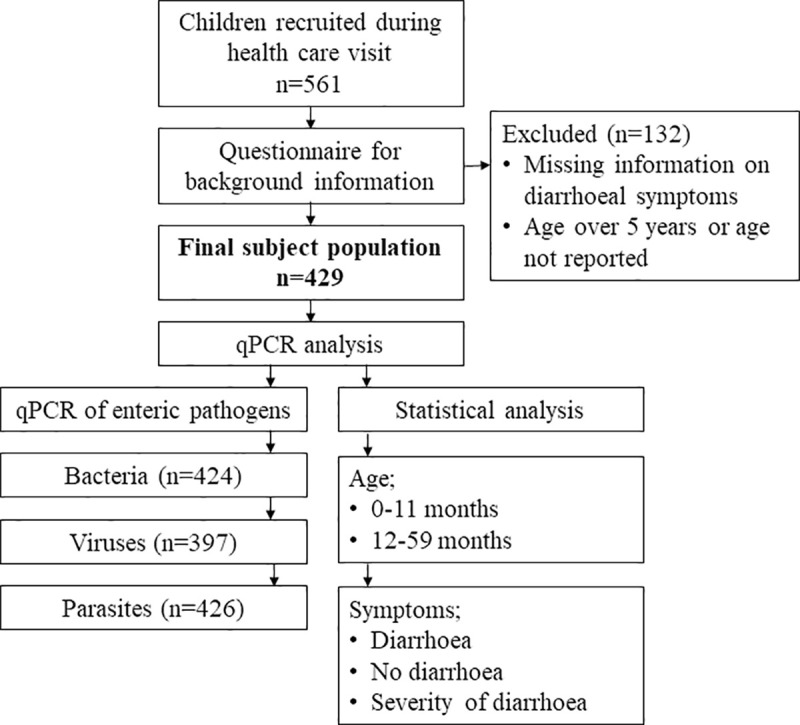
Dried stool samples of children under five years treated at the Bandim Health Centre in Bissau, Guinea-Bissau were screened by qPCR for nine enteric bacteria, five viruses, and four parasites. The findings of children having and not having diarrhoea were compared in age groups 0-11 and 12-59 months.
Of the 429 children- 228 with and 201 without diarrhoea- 96.9% and 93.5% had bacterial, 62.7% and 44.3% viral, and 52.6% and 48.3% parasitic pathogen findings, respectively. Enteroaggregarive Escherichia coli (EAEC; 60.5% versus 66.7%), enteropathogenic E. coli (EPEC; 61.4% versus 62.7%), Campylobacter (53.2% versus 51.8%), and enterotoxigenic E. coli (ETEC; 54.4% versus 44.3%) were the most common bacterial pathogens. Diarrhoea was associated with enteroinvasive E. coli (EIEC)/Shigella (63.3%), ETEC (54.4%), astrovirus (75.0%), norovirus GII (72.6%) and Cryptosporidium (71.2%). The only pathogen associated with severe diarrhoea was EIEC/Shigella (p<0.001). EAEC was found more frequent among the infants, and EIEC/Shigella, Giardia duodenalis and Dientamoeba fragilis among the older children.
Stool pathogens proved common among all the children regardless of them having diarrhoea or not.
在许多国家,如几内亚比绍,儿童腹泻仍然是一个发病率和死亡率的主要原因,但在这些国家,对儿童腹泻的研究很少。粪便样本干燥后可用于以后的 qPCR 分析,而无需担心电力短缺。
在几内亚比绍比绍的班迪姆健康中心接受治疗的五岁以下儿童的干燥粪便样本通过 qPCR 检测了 9 种肠细菌、5 种病毒和 4 种寄生虫。比较了有腹泻和无腹泻儿童在 0-11 个月和 12-59 个月年龄组之间的发现。
在 429 名儿童中,有 228 名有腹泻,201 名无腹泻,分别有 96.9%和 93.5%有细菌、62.7%和 44.3%有病毒、52.6%和 48.3%有寄生虫病原体发现。肠聚集性大肠杆菌(EAEC;60.5%比 66.7%)、肠致病性大肠杆菌(EPEC;61.4%比 62.7%)、弯曲菌(53.2%比 51.8%)和肠产毒性大肠杆菌(ETEC;54.4%比 44.3%)是最常见的细菌病原体。腹泻与肠侵袭性大肠杆菌(EIEC)/志贺氏菌(63.3%)、ETEC(54.4%)、星状病毒(75.0%)、诺如病毒 GII(72.6%)和隐孢子虫(71.2%)有关。唯一与严重腹泻相关的病原体是 EIEC/志贺氏菌(p<0.001)。EAEC 在婴儿中更为常见,而 EIEC/志贺氏菌、十二指肠贾第鞭毛虫和脆弱双核阿米巴在年龄较大的儿童中更为常见。
无论儿童是否腹泻,粪便病原体在所有儿童中都很常见。