Department of Rheumatology and Immunology, Nanjing Drum Tower Hospital, The Affiliated Hospital of Nanjing University Medical School, No. 321 Zhongshan Road, Nanjing, 210008, Jiangsu, China.
Department of Clinical Nutrition, Nanjing Drum Tower Hospital, The Affiliated Hospital of Nanjing University Medical School, No. 321 Zhongshan Road, Nanjing, 210008, Jiangsu, China.
Arthritis Res Ther. 2021 Sep 29;23(1):250. doi: 10.1186/s13075-021-02624-6.
Patients with autoimmune diseases often present with olfactory impairment. The aim of the study was to assess the olfactory functions of patients with primary Sjögren's syndrome and to correlate these findings with their disease activity.
Fifty-two patients with primary SS and 52 sex- and age-matched healthy control subjects were included. All of them underwent clinical and laboratory examination. Olfactory functions were evaluated using olfactory function assessment by computerized testing including the three stages of smell: threshold, identification, and memory of the different odors.
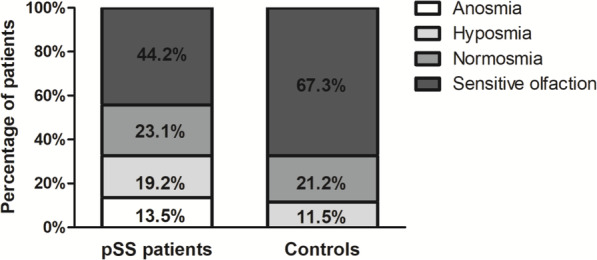
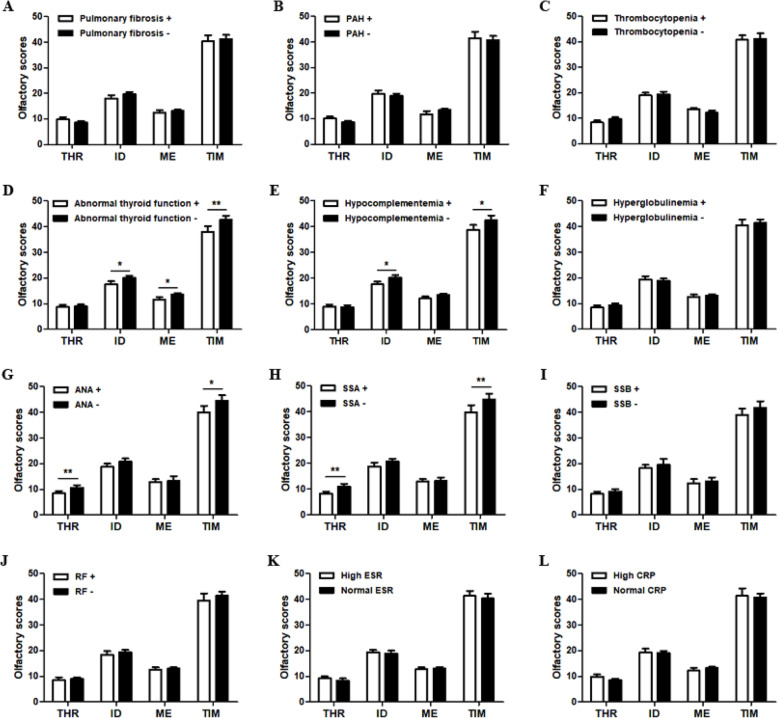
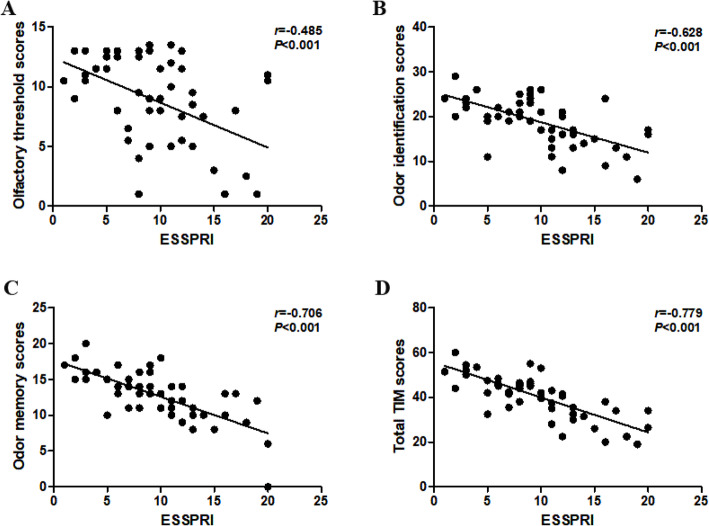
All the olfactory scores (olfactory threshold, identification, and memory) in patients with pSS were significantly decreased than the control group (all P < 0.01). Patients had higher proportion of anosmia (13.5% vs 0%) and hyposmia (19.2% vs 11.5%) than controls (χ = 10.526, P < 0.01). Multivariable regression analysis revealed that ESSDAI and the symptoms of dryness, fatigue, and limb pain had negative influence on olfactory function (adjusted R = 0.381, 0.387, 0.513, and 0.614, respectively). ESSPRI showed significantly negative association with olfactory threshold, identification, memory, and total scores. Olfactory identification and memory scores were decreased in pSS patients with thyroid dysfunction or hypocomplementemia (P < 0.05). Smell threshold scores were decreased in pSS patients with anti-SSA antibody or anti-nuclear antibody compared with those without those autoantibodies (P < 0.01).
Our findings indicate that olfactory functions are impaired in pSS patients. There was a close correlation between olfactory dysfunction and disease severity and immunological abnormalities. Immune and systemic inflammation dysregulation might play a role in the mechanism of this defect.
自身免疫性疾病患者常伴有嗅觉障碍。本研究旨在评估原发性干燥综合征(pSS)患者的嗅觉功能,并将这些发现与疾病活动度相关联。
纳入 52 例 pSS 患者和 52 名性别和年龄匹配的健康对照者。所有患者均接受临床和实验室检查。嗅觉功能采用计算机嗅觉功能评估测试进行评估,包括嗅觉的三个阶段:阈值、识别和不同气味的记忆。
所有 pSS 患者的嗅觉评分(嗅觉阈值、识别和记忆)均显著低于对照组(均 P < 0.01)。与对照组相比,pSS 患者的嗅觉障碍(13.5%比 0%)和嗅觉减退(19.2%比 11.5%)发生率更高(χ = 10.526,P < 0.01)。多变量回归分析显示 ESSDAI 以及干燥、疲劳和肢体疼痛的症状对嗅觉功能有负面影响(调整 R 分别为 0.381、0.387、0.513 和 0.614)。ESSPRI 与嗅觉阈值、识别、记忆和总分均呈显著负相关。甲状腺功能障碍或低补体血症的 pSS 患者嗅觉识别和记忆评分降低(P < 0.05)。与无自身抗体的 pSS 患者相比,抗 SSA 抗体或抗核抗体阳性的 pSS 患者的嗅觉阈值评分降低(P < 0.01)。
我们的研究结果表明,pSS 患者的嗅觉功能受损。嗅觉功能障碍与疾病严重程度和免疫异常密切相关。免疫和全身炎症失调可能在这一缺陷的机制中发挥作用。