Wang Zhe, Lin Shenghong, Liu Xinrong, Yu Aizhi, Li Ruiqing, Zheng Guoxing, Liang Xinwang, Fan Xiaoling, Hou Biqiao, Fan Xiaolong, Shi Lusha, Zhang Cuihong, Wang Yifei, Ning Pengjing, Liu Caixiong, Li Zhongjie, Wang Liping
Hangzhou Center for Disease Control and Prevention, Hangzhou, Zhejiang, China.
Division of Infectious Disease, Key Laboratory of Surveillance and Early Warning on Infectious Disease, Chinese Center for Disease Control and Prevention, Beijing China.
China CDC Wkly. 2021 Feb 5;3(6):106-109. doi: 10.46234/ccdcw2021.028.
WHAT IS ALREADY KNOWN ABOUT THIS TOPIC?: According to the National Brucellosis Prevention and Control Plan (2016-2020) (NBPCP), the awareness rate of high-risk populations in brucellosis-endemic areas should reach 90% by 2020. But the updated results have not been reported.
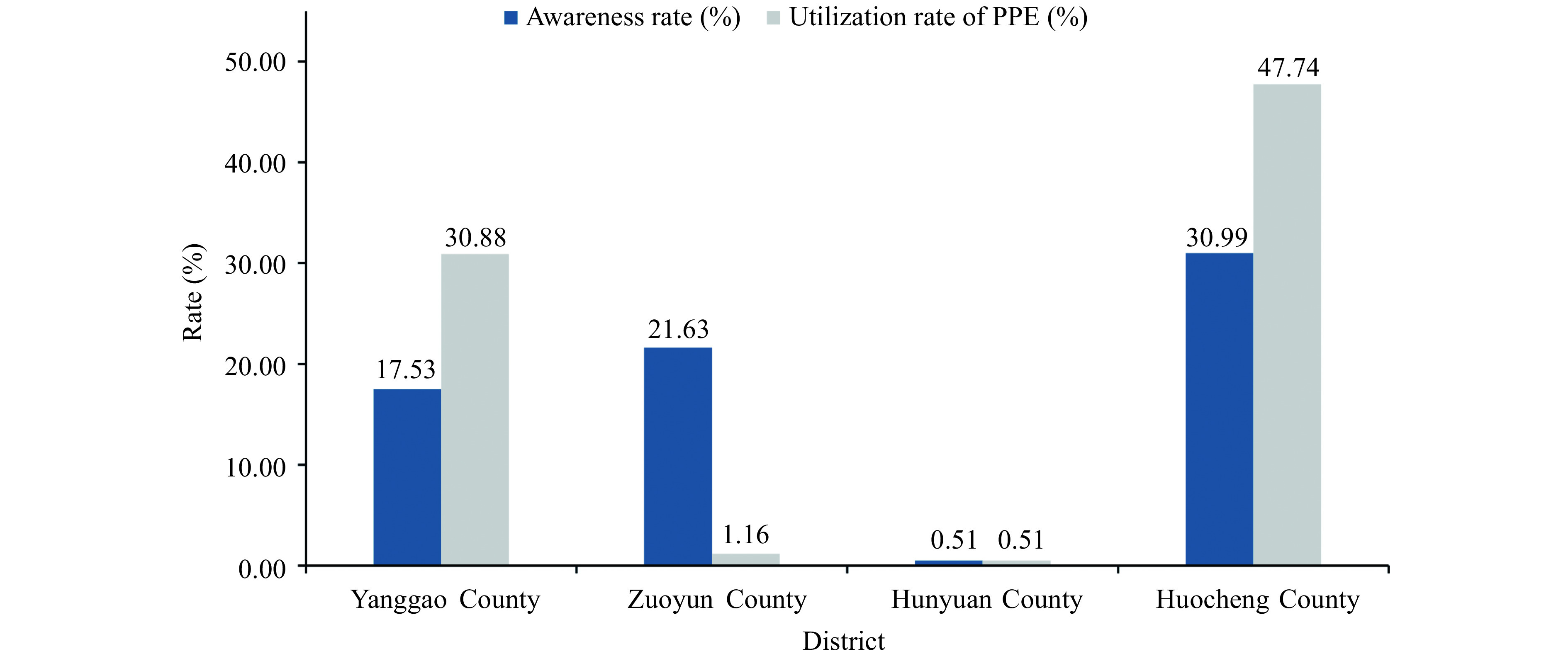
WHAT IS ADDED BY THIS REPORT?: This report determined the awareness rate of brucellosis (17.74%), utilization of personal protective equipment (PPE) (20.13%), and their relationship with seroprevalence, which provides evidence for the effectiveness of the implementation of NBPCP.
WHAT ARE THE IMPLICATIONS FOR PUBLIC HEALTH PRACTICE?: The results suggest that health education should be conducted for high-risk populations to improve their brucellosis and protection knowledge.
关于该主题已知的信息有哪些?:根据《国家布鲁氏菌病防治规划(2016 - 2020年)》,到2020年布鲁氏菌病流行地区高危人群的知晓率应达到90%。但尚未报告更新后的结果。
本报告新增了哪些内容?:本报告确定了布鲁氏菌病知晓率(17.74%)、个人防护用品(PPE)的使用率(20.13%)及其与血清阳性率的关系,为《国家布鲁氏菌病防治规划》实施的有效性提供了证据。
对公共卫生实践有哪些启示?:结果表明,应对高危人群开展健康教育,以提高他们对布鲁氏菌病及防护知识的了解。