Department of Preventive Medicine, School of Public Health, Chengdu Medical Collage, Chengdu, Sichuan, China.
Department of Disciplinary Inspection Office, West China Fourth Hospital, Sichuan University, Chengdu, Sichuan, China.
Int Arch Occup Environ Health. 2022 Mar;95(2):451-464. doi: 10.1007/s00420-021-01762-3. Epub 2021 Oct 1.
Occupational stress is considered a worldwide epidemic experienced by a large proportion of the working population. The identification of characteristics that place people at high risk for occupational stress is the basis of managing and intervening in this condition. In this study, we aimed to identify and validate the risk features for occupational stress among medical workers using a risk model and nomogram.
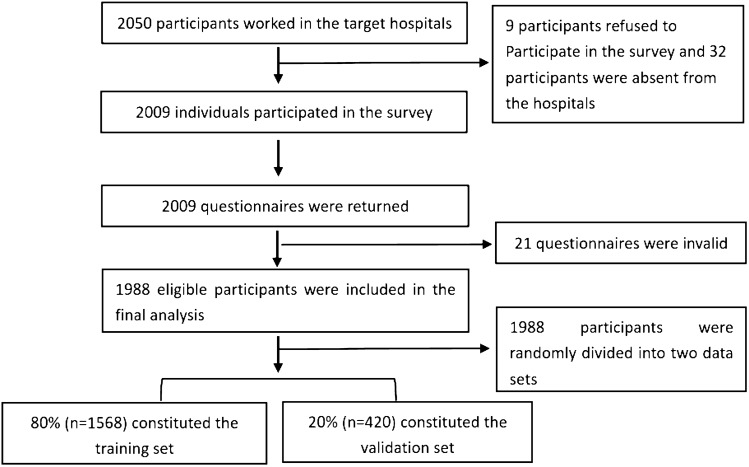
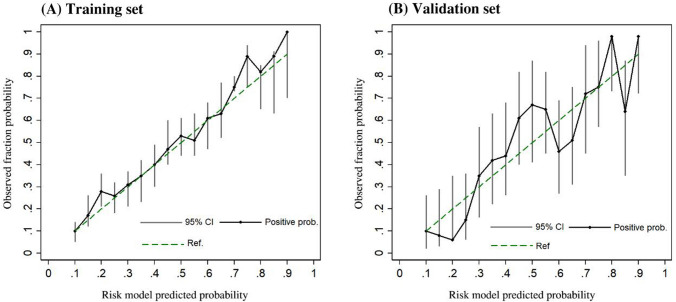
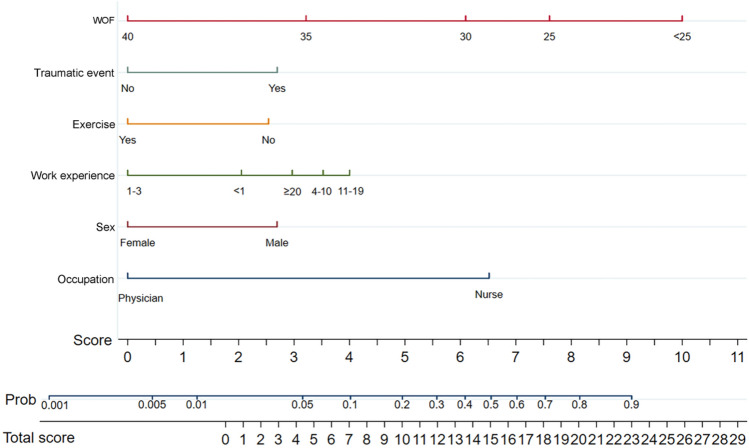
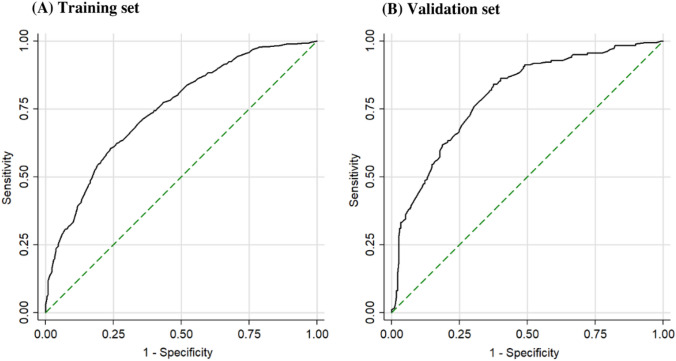
This cross-sectional study included 1988 eligible participants from Henan Province in China. Occupational stress and worker-occupation fit were measured with the Depression, Anxiety and Stress Scales (DASS-21) and Worker-Occupation Fit Inventory (WOFI). The identification of risk features was achieved through constructing multiple logistic regression model, and the risk features were used to develop the risk model and nomogram. Receiver operating characteristic (ROC) curves and calibration plots were generated to assess the effectiveness and calibration of the risk model.
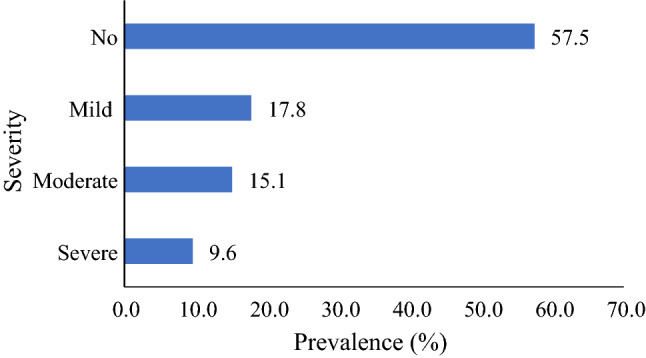
Among 1988 participants in our study, there were 42.5% (845/1988) medical workers experienced occupational stress. The risk features for occupational stress included poor work-occupation fit (WOF score < 25, expected risk: 77.3%), nurse population (expected risk: 63.1%), male sex (expected risk: 67.2%), work experience duration of 11-19 years (expected risk: 54.5%), experience of a traumatic event (expected risk: 65.3%) and the lack of a regular exercise habit (expected risk: 60.2%). For medical workers who have these risk features, the expected risk probability of occupational stress would be 90.2%.
The current data can be used to identify medical workers at risk of developing occupational stress. Identifying risk features for occupational stress and the work-occupation fit can support hierarchical stress management in hospitals.
职业压力被认为是全球范围内很大一部分劳动力所面临的一种普遍现象。识别使人们面临职业压力高风险的特征是管理和干预这种状况的基础。本研究旨在使用风险模型和诺模图,确定和验证医务人员职业压力的风险特征。
本横断面研究纳入了来自中国河南省的 1988 名合格参与者。使用抑郁、焦虑和压力量表(DASS-21)和工作者-职业匹配度量表(WOFI)测量职业压力和工作者-职业匹配度。通过构建多因素逻辑回归模型来识别风险特征,并使用风险特征构建风险模型和诺模图。绘制受试者工作特征(ROC)曲线和校准图来评估风险模型的有效性和校准度。
在我们的研究中,1988 名参与者中有 42.5%(845/1988)的医务人员经历了职业压力。职业压力的风险特征包括较差的工作-职业匹配度(WOF 得分<25,预期风险:77.3%)、护士人群(预期风险:63.1%)、男性(预期风险:67.2%)、工作经验 11-19 年(预期风险:54.5%)、经历创伤性事件(预期风险:65.3%)和缺乏规律的锻炼习惯(预期风险:60.2%)。对于具有这些风险特征的医务人员,职业压力的预期风险概率将为 90.2%。
目前的数据可用于识别易发生职业压力的医务人员。识别职业压力的风险特征和工作-职业匹配度可以支持医院的分层压力管理。