Directorate General for Disease Surveillance and Control, Ministry of Health Muscat, Oman.
Directorate General for Disease Surveillance and Control, Ministry of Health Muscat, Oman.
Int J Infect Dis. 2021 Nov;112:269-277. doi: 10.1016/j.ijid.2021.09.062. Epub 2021 Sep 30.
To assess the seroprevalence of severe acute respiratory syndrome coronavirus-2 (SARS-CoV-2) in Oman and longitudinal changes in antibody levels over time within the first 11 months of the coronavirus disease 2019 (COVID-19) pandemic.
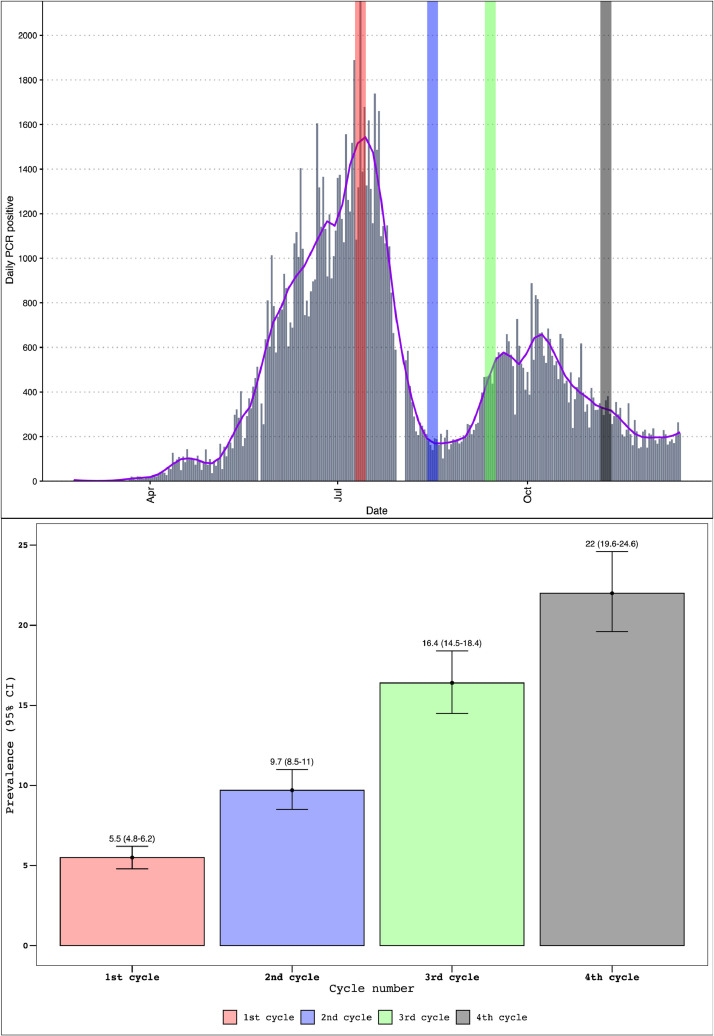
This nationwide cross-sectional study was conducted as a four-cycle serosurvey using a multi-stage stratified sampling method from July to November 2020. A questionnaire was used and included demographics, history of acute respiratory infection and list of symptoms, COVID-19 contact, previous diagnosis or admission, travel history and risk factors.
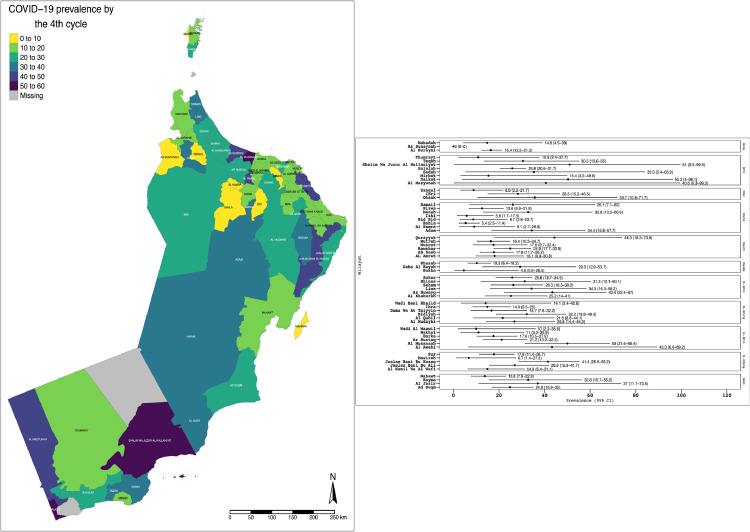
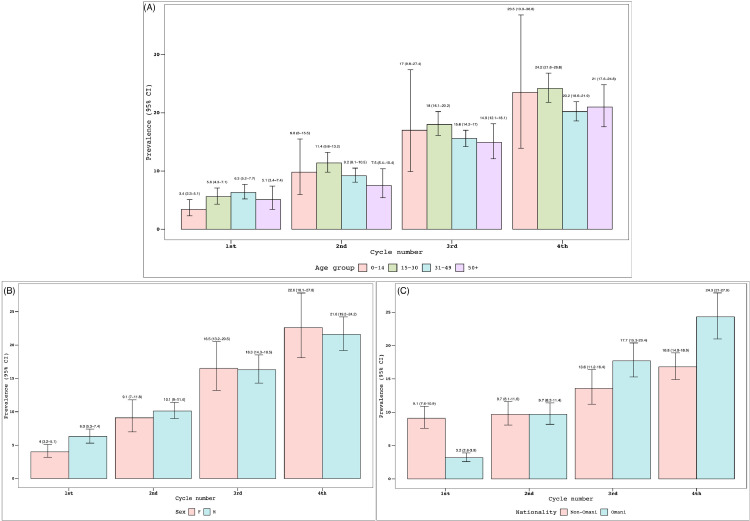
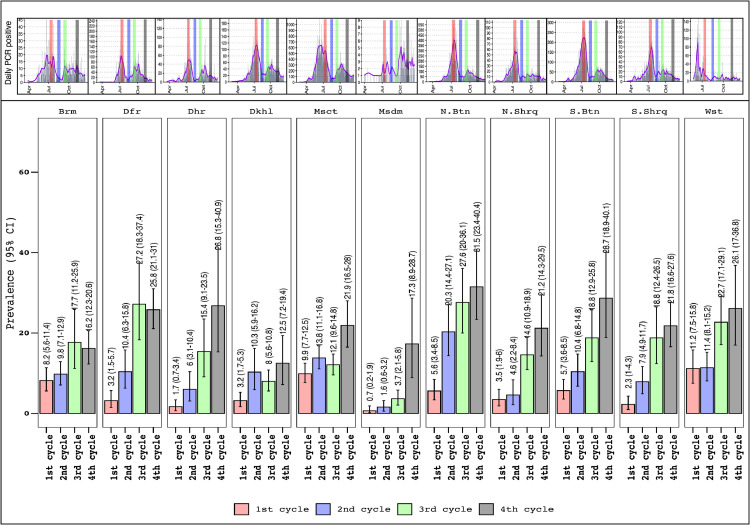
In total, 17,457 participants were surveyed. Thirty percent were female and 66.3% were Omani. There was a significant increase in seroprevalence throughout the study cycles, from 5.5% (4.8-6.2%) in Cycle 1 to 22% (19.6-24.6%) in Cycle 4. There was no difference in seroprevalence between genders, but significant differences were found between age groups. There was a transition of seroprevalence from being higher in non-Omanis than Omanis in Cycle 1 [9.1% (7.6-10.9%) vs 3.2% (2.6-3.9%)] to being higher in Omanis than non-Omanis in Cycle 4 [24.3% (21.0-27.9%) vs 16.8% (14.9-18.9%)]. There was remarkable variation in the seroprevalence of SARS-CoV-2 according to governorate. Close contacts of people with COVID-19 had a 96% higher risk of having the disease [adjusted odds ratio (AOR) 1.96, 95% confidence intervals (CI) 1.64-2.34]. Labourers had 58% higher risk of infection compared with office workers (AOR 1.58, 95% CI 1.04-2.35).
This study showed a wide variation in the spread of SARS-CoV-2 across governorates in Oman, with higher estimated seroprevalence in migrants in the first two cycles. Prevalence estimates remain low and are insufficient to provide herd immunity.
评估阿曼严重急性呼吸综合征冠状病毒 2 型(SARS-CoV-2)的血清流行率,并在 2019 年冠状病毒病(COVID-19)大流行的前 11 个月内,纵向观察抗体水平随时间的变化。
这是一项全国性的横断面研究,采用多阶段分层抽样方法,于 2020 年 7 月至 11 月进行了四轮血清学调查。采用问卷进行调查,内容包括人口统计学、急性呼吸道感染史和症状清单、COVID-19 接触史、既往诊断或入院史、旅行史和危险因素。
共调查了 17457 名参与者。其中 30%为女性,66.3%为阿曼人。整个研究周期中血清阳性率呈显著上升趋势,从第 1 周期的 5.5%(4.8-6.2%)上升到第 4 周期的 22%(19.6-24.6%)。不同性别之间的血清阳性率无差异,但不同年龄组之间存在显著差异。在第 1 周期,非阿曼人的血清阳性率高于阿曼人[9.1%(7.6-10.9%)比 3.2%(2.6-3.9%)],而在第 4 周期,阿曼人的血清阳性率高于非阿曼人[24.3%(21.0-27.9%)比 16.8%(14.9-18.9%)]。根据不同的省份,SARS-CoV-2 的血清阳性率有显著差异。COVID-19 患者的密切接触者患病风险高 96%[调整比值比(AOR)1.96,95%置信区间(CI)1.64-2.34]。与上班族相比,工人感染的风险高 58%(AOR 1.58,95%CI 1.04-2.35)。
本研究表明,阿曼不同省份 SARS-CoV-2 的传播存在广泛差异,在前两个周期中,移民的血清阳性率估计较高。估计的患病率仍然很低,不足以提供群体免疫力。