Tordoff Diana M, Greninger Alexander L, Roychoudhury Pavitra, Shrestha Lasata, Xie Hong, Jerome Keith R, Breit Nathan, Huang Meei-Li, Famulare Mike, Herbeck Joshua T
University of Washington, Department of Epidemiology, Seattle, WA, USA.
Institute for Disease Modeling, Seattle, WA, USA.
Lancet Reg Health Am. 2021 Sep;1:100018. doi: 10.1016/j.lana.2021.100018. Epub 2021 Jul 13.
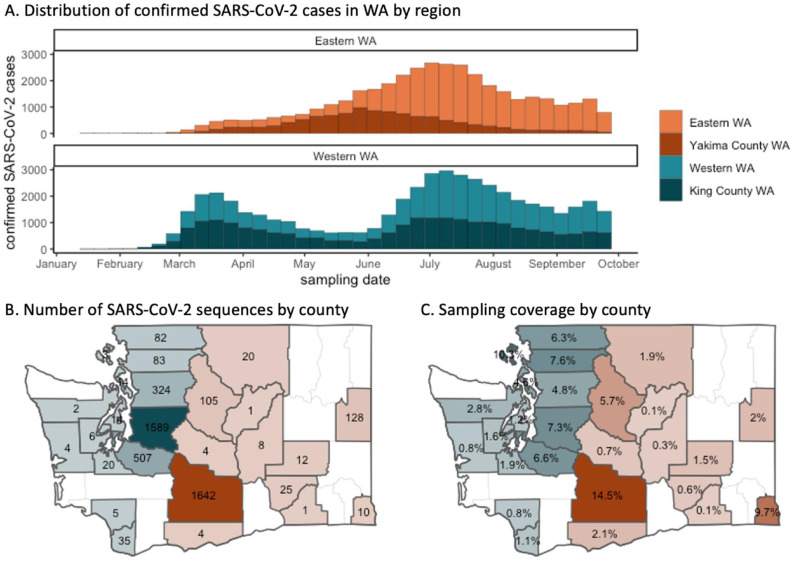
The first confirmed case of SARS-CoV-2 in North America was identified in Washington state on January 21, 2020. We aimed to quantify the number and temporal trends of out-of-state introductions of SARS-CoV-2 into Washington.
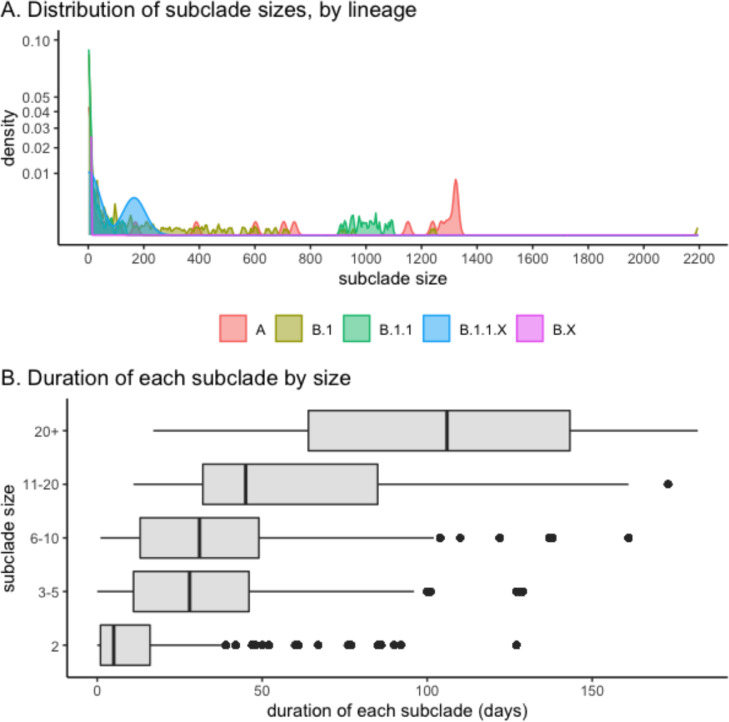
We conducted a molecular epidemiologic analysis of 11,422 publicly available whole genome SARS-CoV-2 sequences from GISAID sampled between December 2019 and September 2020. We used maximum parsimony ancestral state reconstruction methods on time-calibrated phylogenies to enumerate introductions/exports, their likely geographic source (US, non-US, and between eastern and western Washington), and estimated date of introduction. To incorporate phylogenetic uncertainty into our estimates, we conducted 5,000 replicate analyses by generating 25 random time-stratified samples of non-Washington reference sequences, 20 random polytomy resolutions, and 10 random resolutions of the reconstructed ancestral state.
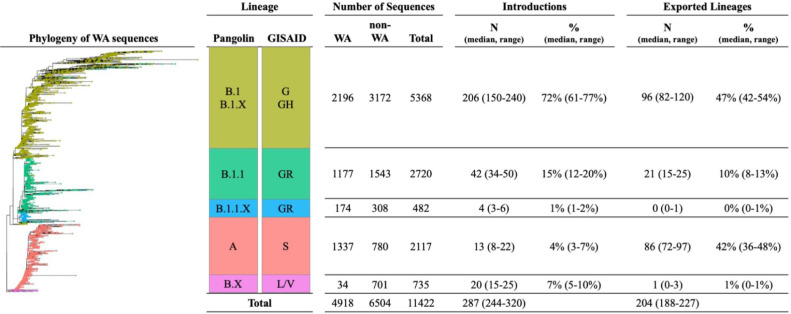
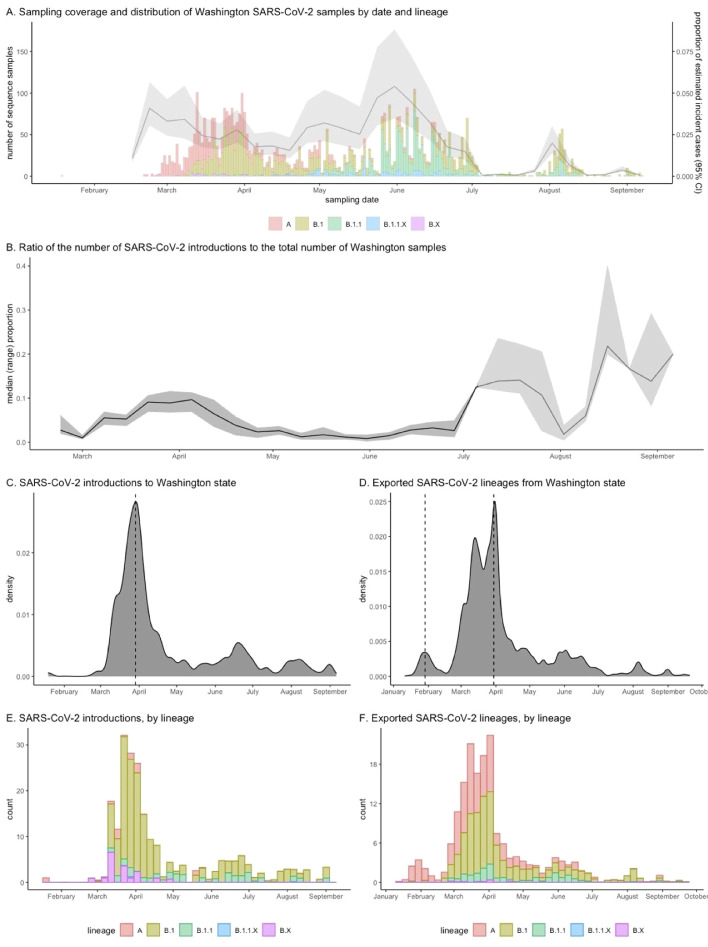
We estimated a minimum 287 introductions (range 244-320) into Washington and 204 exported lineages (range 188-227) of SARS-CoV-2 out of Washington. Introductions began in mid-January and peaked on March 29, 2020. Lineages with the Spike D614G variant accounted for the majority (88%) of introductions. Overall, 61% (range 55-65%) of introductions into Washington likely originated from a source elsewhere within the US, while the remaining 39% (range 35-45%) likely originated from outside of the US. Intra-state transmission accounted for 65% and 28% of introductions into eastern and western Washington, respectively.
The SARS-CoV-2 epidemic in Washington was continually seeded by a large number of introductions. Our findings highlight the importance of genomic surveillance to monitor for emerging variants due to high levels of inter- and intra-state transmission of SARS-CoV-2.
None.
2020年1月21日,华盛顿州确诊了北美首例新冠病毒病例。我们旨在量化新冠病毒传入华盛顿州的州外输入数量及时间趋势。
我们对2019年12月至2020年9月期间从全球流感共享数据库(GISAID)获取的11422条公开的新冠病毒全基因组序列进行了分子流行病学分析。我们在时间校准的系统发育树上使用最大简约法祖先状态重建方法来确定输入/输出情况、其可能的地理来源(美国、美国以外地区以及华盛顿州东部和西部之间),并估计输入日期。为了将系统发育的不确定性纳入我们的估计中,我们通过生成25个非华盛顿参考序列的随机时间分层样本、20个随机多歧分类分辨率以及10个重建祖先状态的随机分辨率,进行了5000次重复分析。
我们估计至少有287次新冠病毒传入华盛顿州(范围为244 - 320次),以及204个新冠病毒谱系从华盛顿州输出(范围为188 - 227个)。输入始于1月中旬,并于2020年3月29日达到峰值。带有刺突蛋白D614G变体的谱系占输入的大多数(88%)。总体而言,传入华盛顿州的61%(范围为55 - 65%)可能源自美国其他地区,而其余39%(范围为35 - 45%)可能源自美国以外地区。州内传播分别占传入华盛顿州东部和西部的65%和28%。
华盛顿州的新冠病毒疫情因大量输入而持续传播。我们的研究结果凸显了基因组监测对于监测因新冠病毒在州际和州内的高水平传播而出现的新变体的重要性。
无。