Department of Astronomy and Physics (DIFA), University of Bologna, 40127, Bologna, Italy.
Digital Epidemiology Lab, Ecole polytechnique fédérale de Lausanne (EPFL), 1202, Geneva, Switzerland.
Sci Rep. 2021 Oct 4;11(1):19655. doi: 10.1038/s41598-021-99301-0.
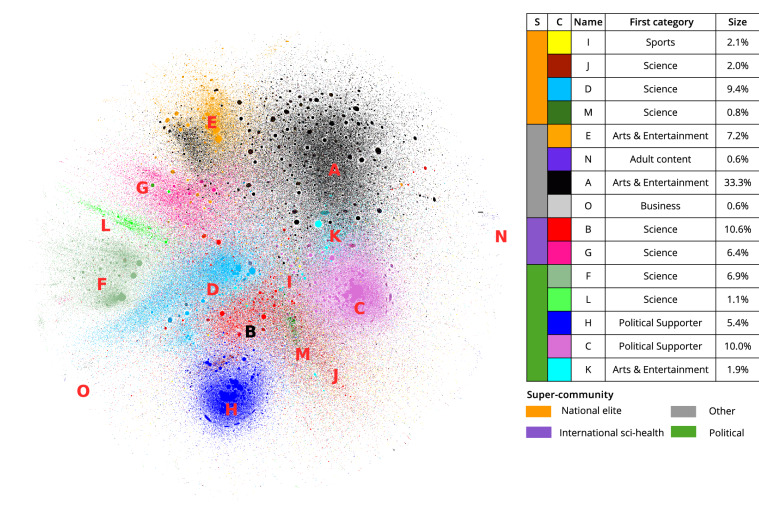
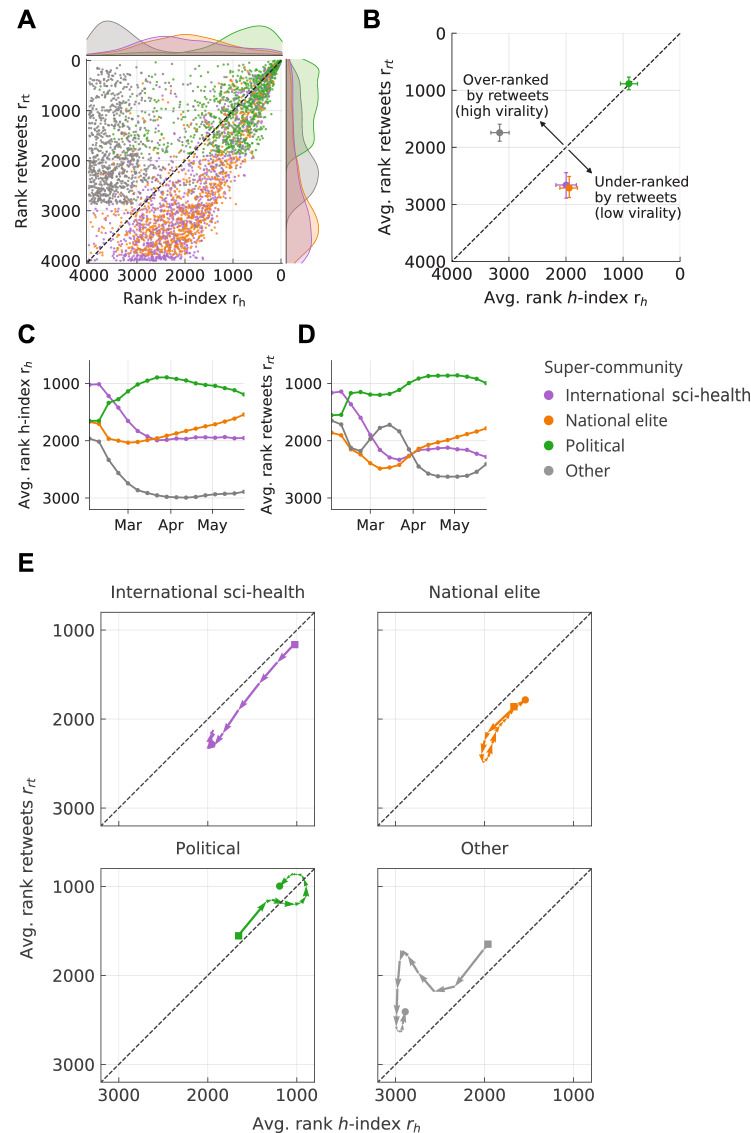
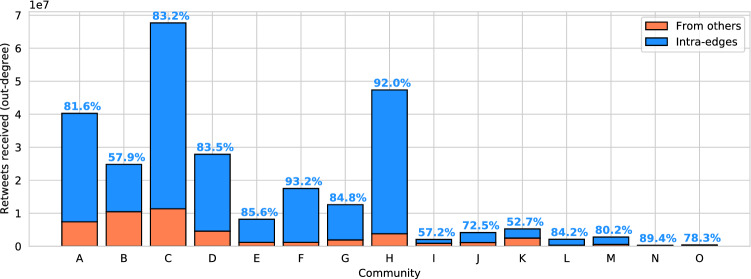
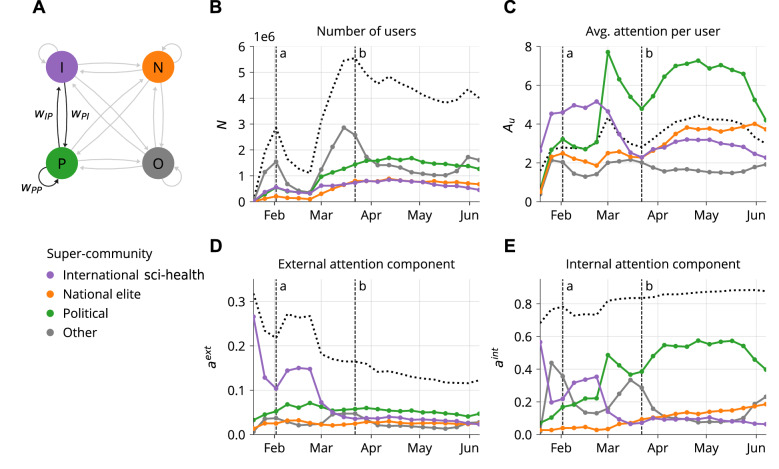
COVID-19 represents the most severe global crisis to date whose public conversation can be studied in real time. To do so, we use a data set of over 350 million tweets and retweets posted by over 26 million English speaking Twitter users from January 13 to June 7, 2020. We characterize the retweet network to identify spontaneous clustering of users and the evolution of their interaction over time in relation to the pandemic's emergence. We identify several stable clusters (super-communities), and are able to link them to international groups mainly involved in science and health topics, national elites, and political actors. The science- and health-related super-community received disproportionate attention early on during the pandemic, and was leading the discussion at the time. However, as the pandemic unfolded, the attention shifted towards both national elites and political actors, paralleled by the introduction of country-specific containment measures and the growing politicization of the debate. Scientific super-community remained present in the discussion, but experienced less reach and became more isolated within the network. Overall, the emerging network communities are characterized by an increased self-amplification and polarization. This makes it generally harder for information from international health organizations or scientific authorities to directly reach a broad audience through Twitter for prolonged time. These results may have implications for information dissemination along the unfolding of long-term events like epidemic diseases on a world-wide scale.
COVID-19 代表了迄今为止最严重的全球危机,其公共对话可以实时研究。为此,我们使用了一个数据集,其中包含 2020 年 1 月 13 日至 6 月 7 日期间,超过 2600 万英语 Twitter 用户发布的超过 3.5 亿条推文和转推。我们对转推网络进行了特征描述,以确定用户的自发聚类及其与大流行出现相关的随时间演变的相互作用。我们确定了几个稳定的集群(超级社区),并能够将它们与主要涉及科学和健康主题的国际团体、国家精英和政治行为者联系起来。与科学和健康相关的超级社区在大流行早期受到了不成比例的关注,并且在当时主导着讨论。然而,随着大流行的展开,人们的注意力转向了国家精英和政治行为者,同时引入了具体国家的遏制措施,辩论也越来越政治化。科学超级社区仍然存在于讨论中,但影响力较小,在网络中更加孤立。总的来说,新兴的网络社区的特点是自我放大和极化程度增加。这使得国际卫生组织或科学当局的信息更难通过 Twitter 长时间直接传达到广大受众。这些结果可能对传染病等长期事件在全球范围内的信息传播产生影响。