Hadley Lauren V, Ward Jamie A
Hearing Sciences-Scottish Section, School of Medicine, University of Nottingham, Glasgow, United Kingdom.
Computing, Goldsmiths, University of London, London, United Kingdom.
PLoS One. 2021 Oct 5;16(10):e0258247. doi: 10.1371/journal.pone.0258247. eCollection 2021.
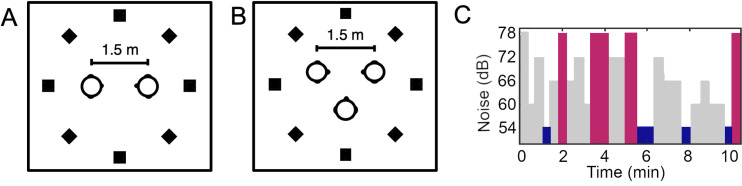
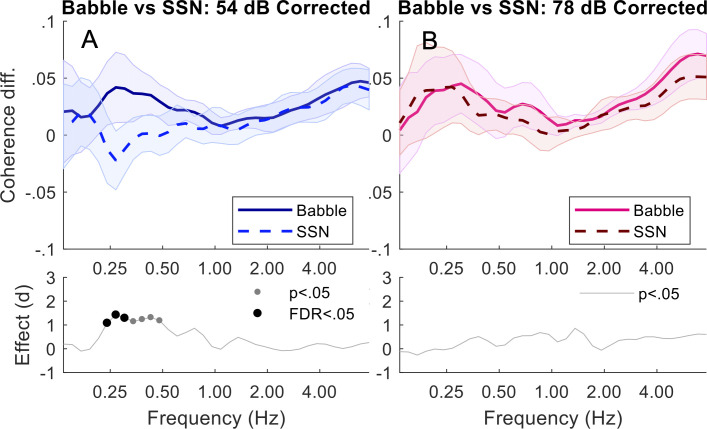
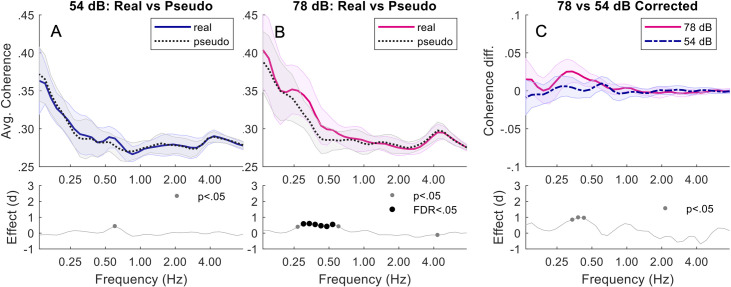
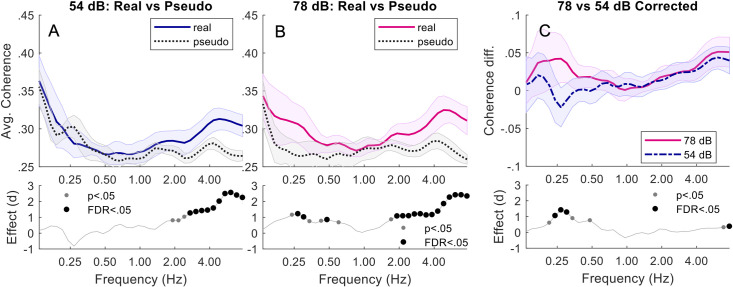
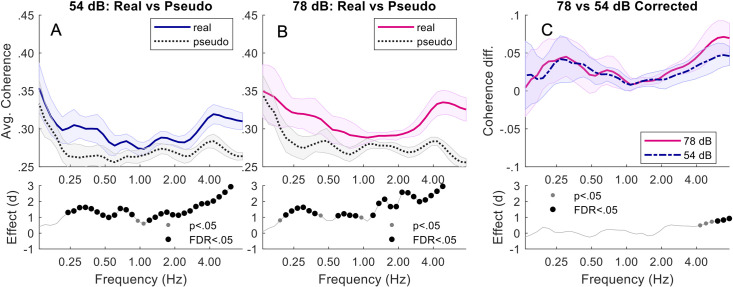
When people interact, they fall into synchrony. This synchrony has been demonstrated in a range of contexts, from walking or playing music together to holding a conversation, and has been linked to prosocial outcomes such as development of rapport and efficiency of cooperation. While the basis of synchrony remains unclear, several studies have found synchrony to increase when an interaction is made challenging, potentially providing a means of facilitating interaction. Here we focus on head movement during free conversation. As verbal information is obscured when conversing over background noise, we investigate whether synchrony is greater in high vs low levels of noise, as well as addressing the effect of background noise complexity. Participants held a series of conversations with unfamiliar interlocutors while seated in a lab, and the background noise level changed every 15-30s between 54, 60, 66, 72, and 78 dB. We report measures of head movement synchrony recorded via high-resolution motion tracking at the extreme noise levels (i.e., 54 vs 78 dB) in dyads (n = 15) and triads (n = 11). In both the dyads and the triads, we report increased movement coherence in high compared to low level speech-shaped noise. Furthermore, in triads we compare behaviour in speech-shaped noise vs multi-talker babble, and find greater movement coherence in the more complex babble condition. Key synchrony differences fall in the 0.2-0.5 Hz frequency bands, and are discussed in terms of their correspondence to talkers' average utterance durations. Additional synchrony differences occur at higher frequencies in the triads only (i.e., >5 Hz), which may relate to synchrony of backchannel cues (as multiple individuals were listening and responding to the same talker). Not only do these studies replicate prior work indicating interlocutors' increased reliance on behavioural synchrony as task difficulty increases, but they demonstrate these effects using multiple difficulty manipulations and across different sized interaction groups.
当人们互动时,他们会进入同步状态。这种同步在一系列情境中都得到了证明,从一起走路或演奏音乐到进行对话,并且与诸如融洽关系的发展和合作效率等亲社会结果相关联。虽然同步的基础尚不清楚,但几项研究发现,当互动变得具有挑战性时,同步性会增强,这可能提供了一种促进互动的方式。在这里,我们关注自由对话中的头部运动。由于在有背景噪音的情况下交谈时言语信息会被掩盖,我们研究了在高噪音水平与低噪音水平下同步性是否更强,以及探讨背景噪音复杂性的影响。参与者坐在实验室里与不熟悉的对话者进行一系列对话,背景噪音水平每隔15 - 30秒在54、60、66、72和78分贝之间变化。我们报告了通过高分辨率运动跟踪记录的二元组(n = 15)和三元组(n = 11)在极端噪音水平(即54分贝与78分贝)下的头部运动同步性测量结果。在二元组和三元组中,我们都报告了与低水平言语塑造噪声相比,高水平言语塑造噪声下运动连贯性增加。此外,在三元组中,我们比较了言语塑造噪声与多说话者嘈杂声条件下的行为,发现在更复杂的嘈杂声条件下运动连贯性更强。关键的同步差异出现在0.2 - 0.5赫兹频段,并根据它们与说话者平均话语持续时间的对应关系进行了讨论。额外的同步差异仅在三元组的较高频率(即>5赫兹)出现,这可能与反馈线索的同步有关(因为多个人在倾听并回应同一个说话者)。这些研究不仅重复了之前的工作,表明随着任务难度增加,对话者对行为同步的依赖增加,而且它们使用多种难度操纵并在不同规模的互动群体中证明了这些效果。