Hearing Sciences - Scottish Section, Division of Clinical Neuroscience, University of Nottingham, Glasgow, UK.
Sci Rep. 2019 Jul 18;9(1):10451. doi: 10.1038/s41598-019-46416-0.
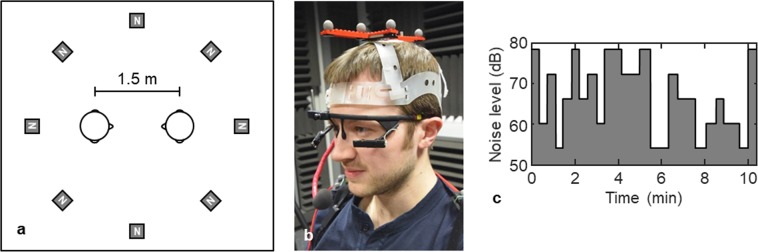
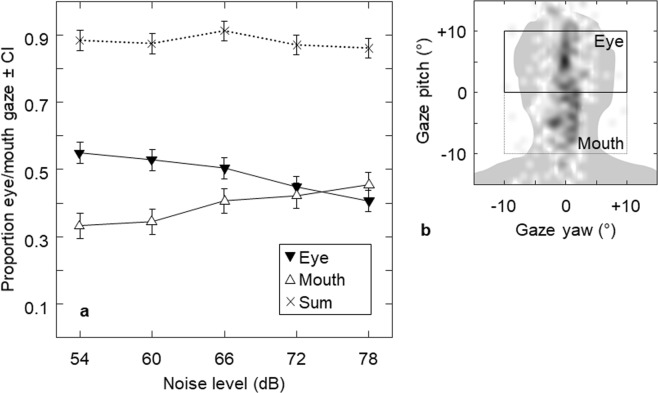
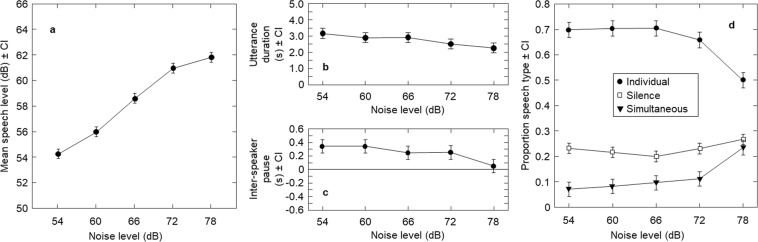
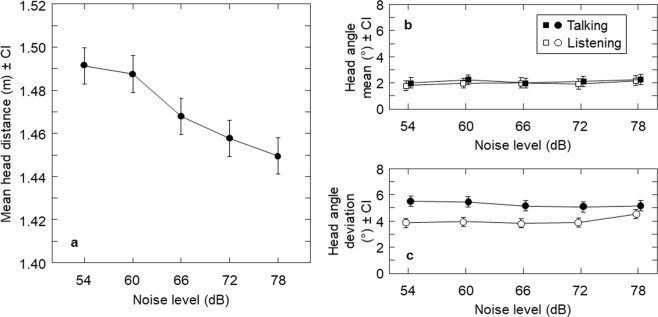
How do people have conversations in noise and make themselves understood? While many previous studies have investigated speaking and listening in isolation, this study focuses on the behaviour of pairs of individuals in an ecologically valid context. Specifically, we report the fine-grained dynamics of natural conversation between interlocutors of varying hearing ability (n = 30), addressing how different levels of background noise affect speech, movement, and gaze behaviours. We found that as noise increased, people spoke louder and moved closer together, although these behaviours provided relatively small acoustic benefit (0.32 dB speech level increase per 1 dB noise increase). We also found that increased noise led to shorter utterances and increased gaze to the speaker's mouth. Surprisingly, interlocutors did not make use of potentially beneficial head orientations. While participants were able to sustain conversation in noise of up to 72 dB, changes in conversation structure suggested increased difficulty at 78 dB, with a significant decrease in turn-taking success. Understanding these natural conversation behaviours could inform broader models of interpersonal communication, and be applied to the development of new communication technologies. Furthermore, comparing these findings with those from isolation paradigms demonstrates the importance of investigating social processes in ecologically valid multi-person situations.
人们在噪声环境中如何进行对话并使彼此理解?虽然之前有许多研究分别调查了说话和倾听的情况,但本研究关注的是在生态有效背景下的两个人的行为。具体来说,我们报告了不同听力能力的交谈者之间的自然对话的细粒度动态(n=30),探讨了不同水平的背景噪声如何影响言语、运动和注视行为。我们发现,随着噪声的增加,人们会说得更大声,彼此之间也靠得更近,尽管这些行为只带来了相对较小的声学增益(噪声每增加 1dB,语音水平增加 0.32dB)。我们还发现,增加的噪声会导致言语变短,并且注视说话者的嘴的次数增加。令人惊讶的是,交谈者并没有利用潜在有益的头部方向。虽然参与者能够在高达 72dB 的噪声中维持对话,但在 78dB 的噪声中,对话结构的变化表明难度增加,轮流成功的次数显著减少。了解这些自然对话行为可以为更广泛的人际沟通模型提供信息,并应用于新的沟通技术的开发。此外,将这些发现与隔离范式的发现进行比较,证明了在生态有效多人情境中研究社交过程的重要性。