Dale Rick, Bryant Gregory A, Manson Joseph H, Gervais Matthew M
Department of Communication, University of California, Los Angeles, CA, USA.
Center for Behavior, Evolution, and Culture, University of California, Los Angeles, CA, USA.
R Soc Open Sci. 2020 Sep 16;7(9):200095. doi: 10.1098/rsos.200095. eCollection 2020 Sep.
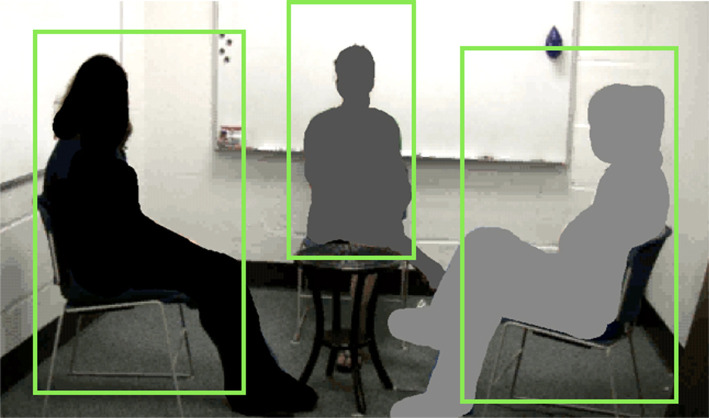
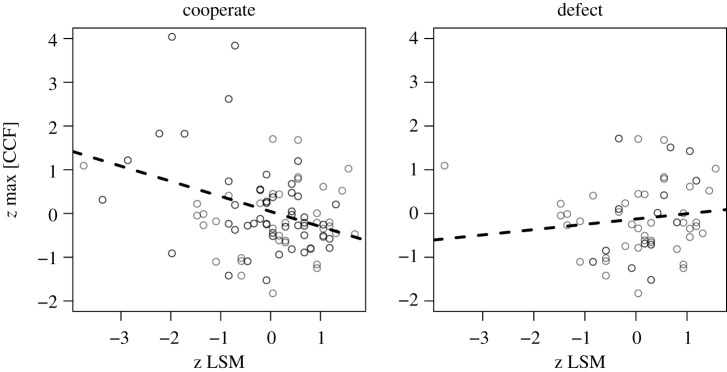
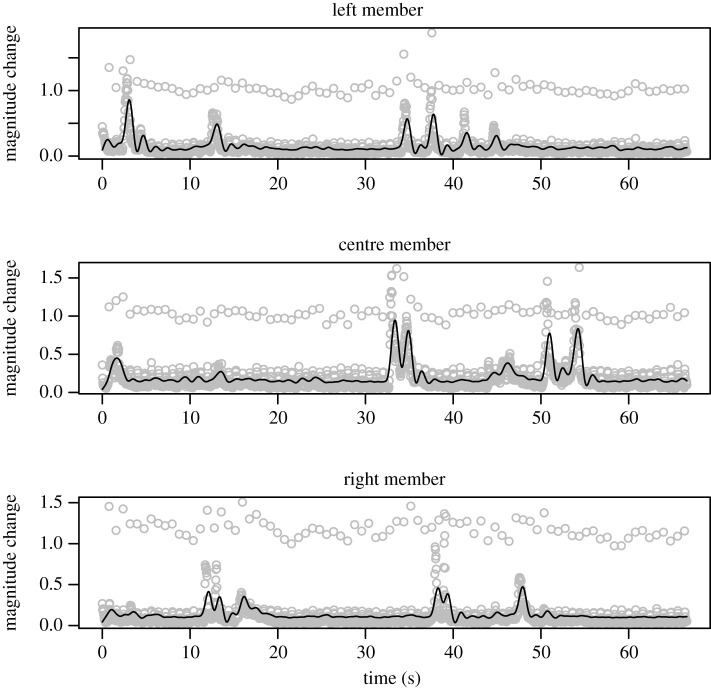
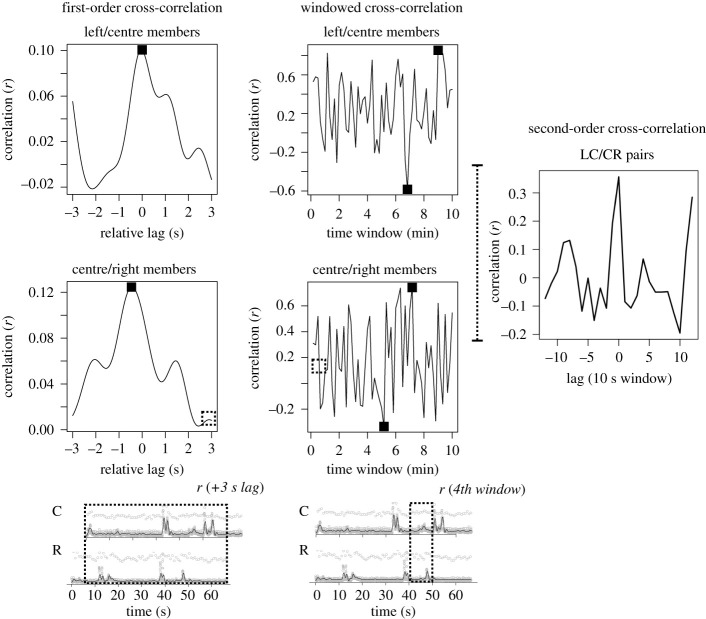
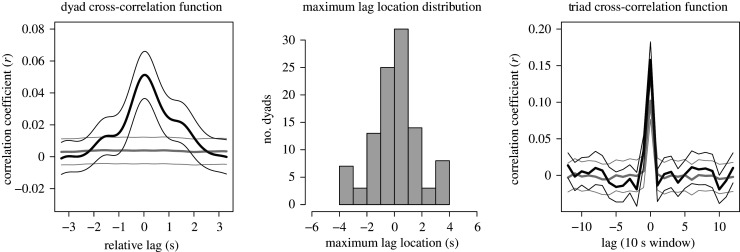
Humans subtly synchronize body movement during face-to-face conversation. In this context, bodily synchrony has been linked to affiliation and social bonding, task success and comprehension, and potential conflict. Almost all studies of conversational synchrony involve dyads, and relatively less is known about the structure of synchrony in groups larger than two. We conducted an optic flow analysis of body movement in triads engaged in face-to-face conversation, and explored a common measure of synchrony: time-aligned bodily covariation. We correlated this measure of synchrony with a diverse set of covariates related to the outcome of interactions. Triads showed higher maximum cross-correlation relative to a surrogate baseline, and 'meta-synchrony', in that composite dyads in a triad tended to show correlated structure. A windowed analysis also revealed that synchrony varies widely across an interaction. As in prior studies, average synchrony was low but statistically reliable in just a few minutes of interaction. In an exploratory analysis, we investigated the potential function of body synchrony by predicting it from various covariates, such as linguistic style matching, liking, laughter and cooperative play in a behavioural economic game. Exploratory results do not reveal a clear function for synchrony, though colaughter within triads was associated with greater body synchrony, and is consistent with an earlier analysis showing a positive connection between colaughter and cooperation. We end by discussing the importance of expanding and codifying analyses of synchrony and assessing its function.
在面对面交流过程中,人们会微妙地同步身体动作。在这种情况下,身体同步与归属感、社会联结、任务成功与理解以及潜在冲突都有关联。几乎所有关于对话同步的研究都涉及二元组,而对于超过两人的群体中同步结构的了解相对较少。我们对进行面对面交流的三人组中的身体动作进行了光流分析,并探索了一种同步的通用度量方法:时间对齐的身体协变。我们将这种同步度量与一系列与互动结果相关的协变量进行了关联。相对于替代基线,三人组显示出更高的最大互相关,以及“元同步”,即三人组中的复合二元组倾向于显示出相关结构。窗口分析还表明,同步在整个互动过程中变化很大。与先前的研究一样,平均同步性较低,但在短短几分钟的互动中具有统计学可靠性。在一项探索性分析中,我们通过从各种协变量(如语言风格匹配、喜欢程度、笑声以及行为经济游戏中的合作行为)预测身体同步,来研究其潜在功能。探索性结果并未揭示同步的明确功能,不过三人组中的共同笑声与更大的身体同步性相关,这与早期一项显示共同笑声与合作之间存在正相关的分析结果一致。我们最后讨论了扩展和编纂同步分析并评估其功能的重要性。