Graduation Program in Animal Science, Santa Cruz State University, Ilhéus (BA), Brazil.
Graduate Student in Veterinary Medicine, Santa Cruz State University, Ilhéus (BA), Brazil.
PLoS One. 2021 Oct 5;16(10):e0253630. doi: 10.1371/journal.pone.0253630. eCollection 2021.
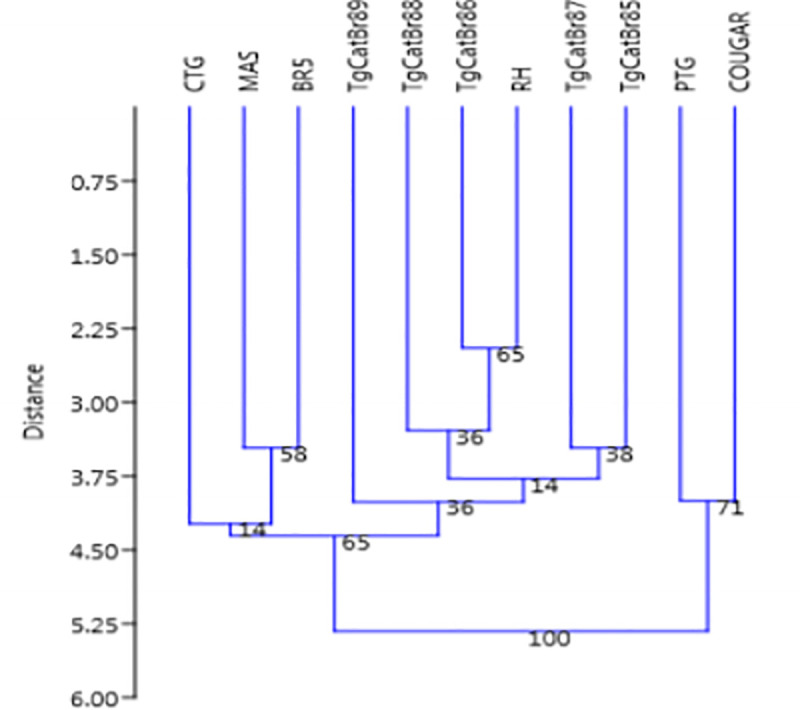
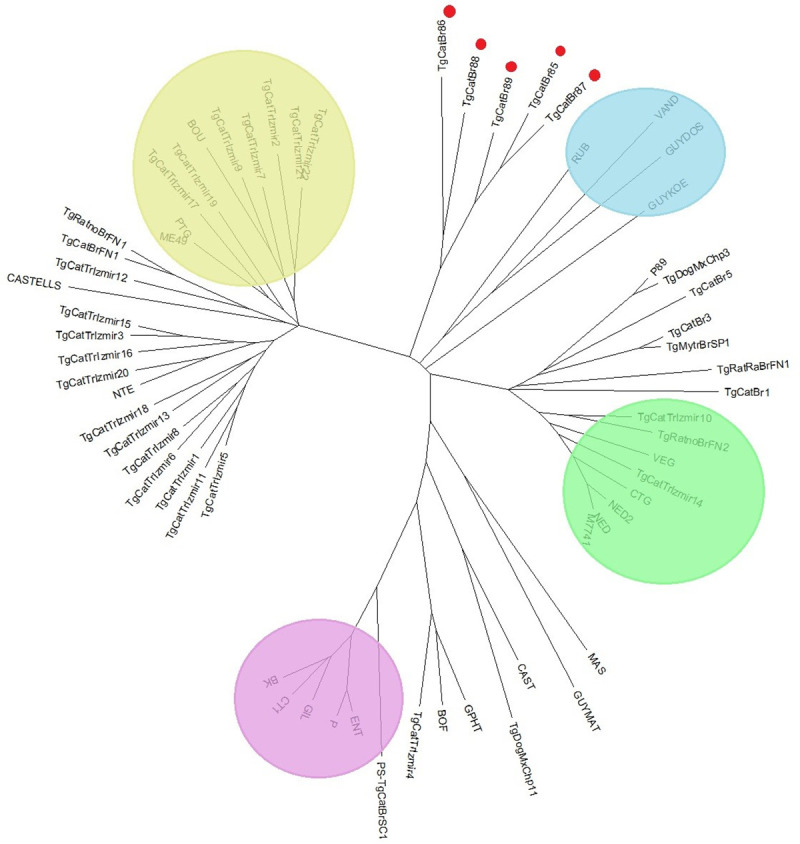
In this study, 20 blood, heart, and brain samples were collected from euthanized cats at the Zoonosis Control Centers and Veterinary Clinics in the state of Bahia, Brazil. The sera were examined for anti-T. gondii antibodies using the indirect hemagglutination test. The brains and hearts of seven seropositive cats were ground, and peptide digestion was performed for bioassay in mice. Toxoplasma gondii was isolated in 5/7 (71.42%) of seropositive cats. In these isolates, the parasite was genotyped using the Polymerase chain reaction, associated with the DNA fragment polymorphism obtained by restriction enzyme PCR-RFLP technique with 11 markers (SAG1, 5'-SAG2, 3'-SAG2, alt. SAG2, SAG3, BTUB, GRA6, c22-8, c29-2, L358, PK1, Apico, and CS3) and 15 microsatellite markers (TUB-2, W35, TgM-A, B18, B17, M33, IV.1, XI.1, M48, M102, N60, N82, AA, N61, N83). The analysis of the isolates by PCR-RFLP revealed five distinct genotypes. Three of these genotypes have never been reported before; one corresponded to the TgDgCo13 genotype, and one incomplete genotype. In genotyping analysis using microsatellite markers, it was observed that the isolates showed atypical alleles in the typing and fingerprint markers. This revealed five atypical genotypes. The typing marker B17 showed the highest degree of atypia. This study is the first to report the genotyping of T. gondii obtained from naturally infected cats in Bahia, Northeast Brazil. The genotypes found in this study were different from those found in other studies conducted in Bahia, which included different species of animals. None of the clonal lineages I, II, or III were found. This study demonstrates the diversity of T. gondii in the study region, with the presence of unusual genotypes, reaffirming the genetic variability of the parasite in Brazil.
在这项研究中,从巴西巴伊亚州的动物传染病控制中心和兽医诊所处死的猫身上采集了 20 份血液、心脏和脑组织样本。使用间接血凝试验检测血清中的抗弓形虫抗体。对 7 只血清阳性猫的脑和心进行研磨,并进行肽消化以进行小鼠生物测定。在 7 只血清阳性猫中的 5 只(71.42%)中分离出弓形虫。在这些分离物中,使用聚合酶链反应对寄生虫进行基因分型,并结合限制性内切酶 PCR-RFLP 技术获得的 11 个标记物(SAG1、5'-SAG2、3'-SAG2、alt.SAG2、SAG3、BTUB、GRA6、c22-8、c29-2、L358、PK1、Apico 和 CS3)和 15 个微卫星标记物(TUB-2、W35、TgM-A、B18、B17、M33、IV.1、XI.1、M48、M102、N60、N82、AA、N61、N83)进行分析。PCR-RFLP 分析显示,这些分离株有 5 种不同的基因型。其中三种基因型以前从未报道过;一种对应于 TgDgCo13 基因型,一种为不完全基因型。使用微卫星标记物进行基因分型分析时,观察到分离株在分型和指纹标记物中表现出非典型等位基因。这揭示了 5 种非典型基因型。标记物 B17 显示出最高程度的非典型性。这项研究是首次报道从巴西巴伊亚州自然感染猫中获得的弓形虫基因分型。在本研究中发现的基因型与在巴伊亚州进行的其他研究中发现的基因型不同,这些研究包括不同的动物物种。没有发现 I、II 或 III 型克隆谱系。本研究表明,在研究区域内,弓形虫存在多样性,存在不寻常的基因型,再次证实了巴西寄生虫的遗传变异性。