Harvard T.H. Chan School of Public Health, Boston, MA.
Harvard T.H. Chan School of Public Health, Boston, MA.
Am J Obstet Gynecol. 2022 Apr;226(4):545.e1-545.e29. doi: 10.1016/j.ajog.2021.09.041. Epub 2021 Oct 2.
Prospective longitudinal cohorts assessing women's health and gynecologic conditions have historically been limited.
The Apple Women's Health Study was designed to gain a deeper understanding of the relationship among menstrual cycles, health, and behavior. This paper describes the design and methods of the ongoing Apple Women's Health Study and provides the demographic characteristics of the first 10,000 participants.
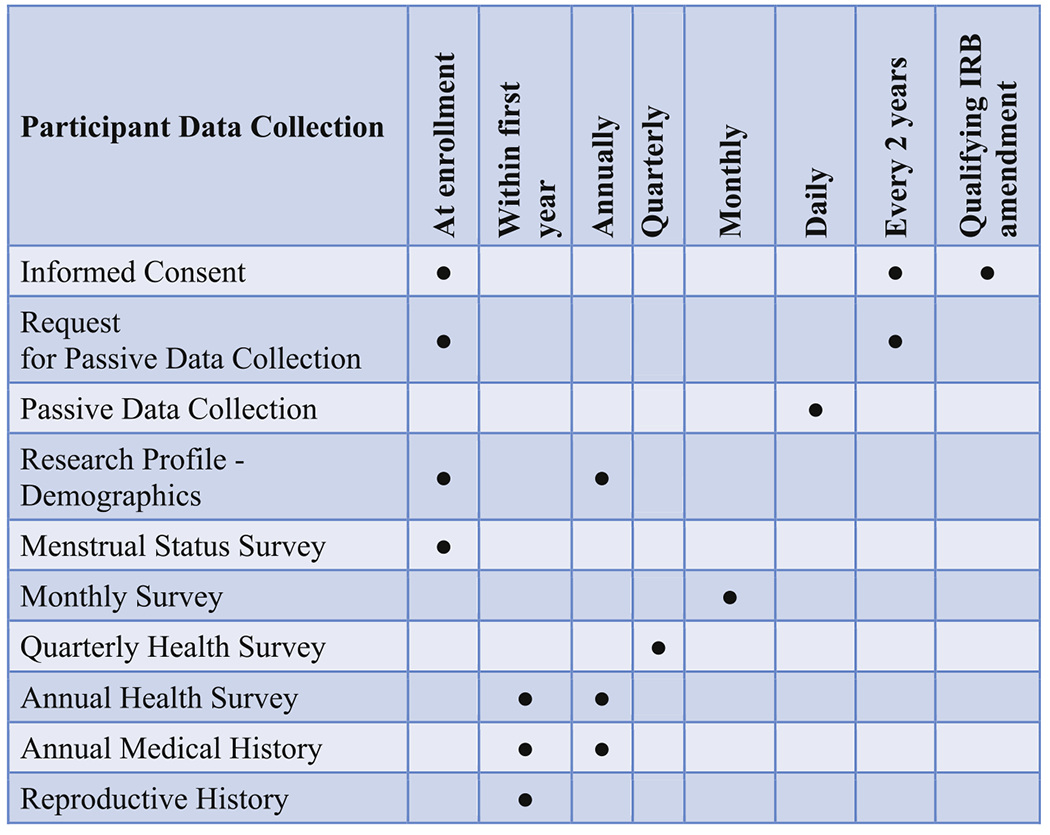
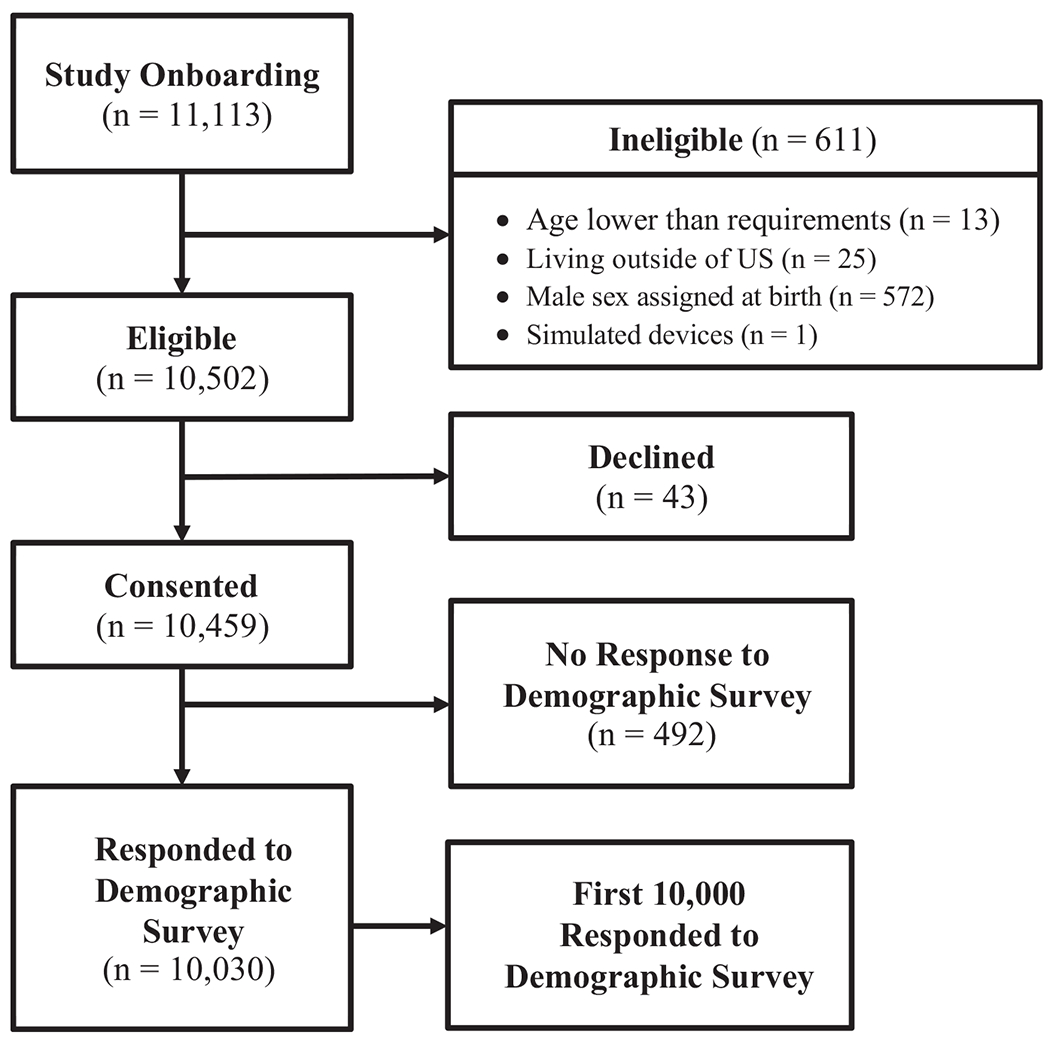
This was a mobile-application-based longitudinal cohort study involving survey and sensor-based data. We collected the data from 10,000 participants who responded to the demographics survey on enrollment between November 14, 2019 and May 20, 2020. The participants were asked to complete a monthly follow-up through November 2020. The eligibility included installed Apple Research app on their iPhone with iOS version 13.2 or later, were living in the United States, being of age greater than 18 years (19 in Alabama and Nebraska, 21 years old in Puerto Rico), were comfortable in communicating in written and spoken English, were the sole user of an iCloud account or iPhone, and were willing to provide consent to participate in the study.
The mean age at enrollment was 33.6 years old (±standard deviation, 10.3). The race and ethnicity was representative of the US population (69% White and Non-Hispanic [6910/10,000]), whereas 51% (5089/10,000) had a college education or above. The participant geographic distribution included all the US states and Puerto Rico. Seventy-two percent (7223/10,000) reported the use of an Apple Watch, and 24.4% (2438/10,000) consented to sensor-based data collection. For this cohort, 38% (3490/9238) did not respond to the Monthly Survey: Menstrual Update after enrollment. At the 6-month follow-up, there was a 35% (3099/8972) response rate to the Monthly Survey: Menstrual Update. 82.7% (8266/10,000) of the initial cohort and 95.1% (2948/3099) of the participants who responded to month 6 of the Monthly Survey: Menstrual Update tracked at least 1 menstrual cycle via HealthKit. The participants tracked their menstrual bleeding days for an average of 4.44 (25%-75%; range, 3-6) calendar months during the study period. Non-White participants were slightly more likely to drop out than White participants; those remaining at 6 months were otherwise similar in demographic characteristics to the original enrollment group.
The first 10,000 participants of the Apple Women's Health Study were recruited via the Research app and were diverse in race and ethnicity, educational attainment, and economic status, despite all using an Apple iPhone. Future studies within this cohort incorporating this high-dimensional data may facilitate discovery in women's health in exposure outcome relationships and population-level trends among iPhone users. Retention efforts centered around education, communication, and engagement will be utilized to improve the survey response rates, such as the study update feature.
评估女性健康和妇科状况的前瞻性纵向队列研究历来受到限制。
Apple 女性健康研究旨在更深入地了解月经周期、健康和行为之间的关系。本文介绍了正在进行的 Apple 女性健康研究的设计和方法,并提供了前 10,000 名参与者的人口统计学特征。
这是一项基于移动应用程序的纵向队列研究,涉及调查和基于传感器的数据。我们从 2019 年 11 月 14 日至 2020 年 5 月 20 日期间参与人口统计调查的 10,000 名参与者中收集数据。参与者被要求在 2020 年 11 月之前完成每月一次的随访。参与条件包括在 iPhone 上安装了带有 iOS 版本 13.2 或更高版本的 Apple Research 应用程序,居住在美国,年龄大于 18 岁(阿拉巴马州和内布拉斯加州为 19 岁,波多黎各为 21 岁),能够熟练使用英语进行书面和口头交流,是 iCloud 账户或 iPhone 的唯一用户,并且愿意同意参与研究。
入组时的平均年龄为 33.6 岁(±标准差,10.3)。种族和民族构成具有美国人口代表性(69%为白人且非西班牙裔[6910/10000]),而 51%(5089/10000)具有大学学历或以上。参与者的地理分布包括美国所有州和波多黎各。72%(7223/10000)报告使用了 Apple Watch,24.4%(2438/10000)同意进行基于传感器的数据收集。对于这个队列,38%(3490/9238)在入组后没有回复每月调查:月经更新。在 6 个月的随访中,有 35%(3099/8972)的人回复了每月调查:月经更新。82.7%(8266/10000)的初始队列和 95.1%(2948/3099)的参与者在第 6 个月的每月调查:月经更新中至少跟踪了 1 个月经周期通过 HealthKit。参与者在研究期间平均跟踪月经出血天数为 4.44(25%-75%;范围,3-6)个日历月。非白人参与者比白人参与者更有可能中途退出;在 6 个月时仍留在队列中的参与者在人口统计学特征上与最初的入组组相似。
Apple 女性健康研究的前 10,000 名参与者是通过 Research 应用程序招募的,尽管他们都使用苹果 iPhone,但在种族和民族、教育程度和经济地位方面存在多样性。未来在这个队列中进行的研究纳入这些高维数据可能会促进在 iPhone 用户的暴露结果关系和人群水平趋势中发现女性健康方面的发现。以教育、沟通和参与为中心的保留工作将用于提高调查回复率,例如研究更新功能。