Health, Apple Inc, Cupertino, CA.
Harvard T.H. Chan School of Public Health, Harvard University, Boston, MA.
Am J Obstet Gynecol. 2023 Feb;228(2):213.e1-213.e22. doi: 10.1016/j.ajog.2022.10.029. Epub 2022 Oct 29.
Use of menstrual tracking data to understand abnormal bleeding patterns has been limited because of lack of incorporation of key demographic and health characteristics and confirmation of menstrual tracking accuracy.
This study aimed to identify abnormal uterine bleeding patterns and their prevalence and confirm existing and expected associations between abnormal uterine bleeding patterns, demographics, and medical conditions.
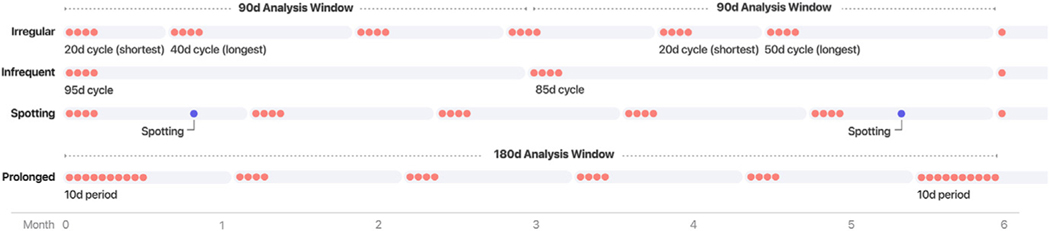
Apple Women's Health Study participants from November 2019 through July 2021 who contributed menstrual tracking data and did not report pregnancy, lactation, use of hormones, or menopause were included in the analysis. Four abnormal uterine bleeding patterns were evaluated: irregular menses, infrequent menses, prolonged menses, and irregular intermenstrual bleeding (spotting). Monthly tracking confirmation using survey responses was used to exclude inaccurate or incomplete digital records. We investigated the prevalence of abnormal uterine bleeding stratified by demographic characteristics and used logistic regression to evaluate the relationship of abnormal uterine bleeding to a number of self-reported medical conditions.
There were 18,875 participants who met inclusion criteria, with a mean age of 33 (standard deviation, 8.2) years, mean body mass index of 29.3 (standard deviation, 8.0), and with 68.9% (95% confidence interval, 68.2-69.5) identifying as White, non-Hispanic. Abnormal uterine bleeding was found in 16.4% of participants (n=3103; 95% confidence interval, 15.9-17.0) after accurate tracking was confirmed; 2.9% had irregular menses (95% confidence interval, 2.7-3.1), 8.4% had infrequent menses (95% confidence interval, 8.0-8.8), 2.3% had prolonged menses (95% confidence interval, 2.1-2.5), and 6.1% had spotting (95% confidence interval, 5.7-6.4). Black participants had 33% higher prevalence (prevalence ratio, 1.33; 95% confidence interval, 1.09-1.61) of infrequent menses compared with White, non-Hispanic participants after controlling for age and body mass index. The prevalence of infrequent menses was increased in class 1, 2, and 3 obesity (class 1: body mass index, 30-34.9; prevalence ratio, 1.31; 95% confidence interval, 1.13-1.52; class 2: body mass index, 35-39.9; prevalence ratio, 1.25; 95% confidence interval, 1.05-1.49; class 3: body mass index, >40; prevalence ratio, 1.51; 95% confidence interval, 1.21-1.88) after controlling for age and race/ethnicity. Those with class 3 obesity had 18% higher prevalence of abnormal uterine bleeding compared with healthy-weight participants (prevalence ratio, 1.18; 95% confidence interval, 1.02-1.38). Participants with polycystic ovary syndrome had 19% higher prevalence of abnormal uterine bleeding compared with participants without this condition (prevalence ratio, 1.19; 95% confidence interval, 1.08-1.31). Participants with hyperthyroidism (prevalence ratio, 1.34; 95% confidence interval, 1.13-1.59) and hypothyroidism (prevalence ratio, 1.17; 95% confidence interval, 1.05-1.31) had a higher prevalence of abnormal uterine bleeding, as did those reporting endometriosis (prevalence ratio, 1.28; 95% confidence interval, 1.12-1.45), cervical dysplasia (prevalence ratio, 1.20; 95% confidence interval, 1.03-1.39), and fibroids (prevalence ratio, 1.14; 95% confidence interval, 1.00-1.30).
In this cohort, abnormal uterine bleeding was present in 16.4% of those with confirmed menstrual tracking. Black or obese participants had increased prevalence of abnormal uterine bleeding. Participants reporting conditions such as polycystic ovary syndrome, thyroid disease, endometriosis, and cervical dysplasia had a higher prevalence of abnormal uterine bleeding.
由于缺乏关键人口统计学和健康特征的纳入以及对月经跟踪准确性的确认,利用月经跟踪数据来了解异常出血模式受到限制。
本研究旨在确定异常子宫出血模式及其流行率,并确认异常子宫出血模式、人口统计学特征和医疗状况之间现有的和预期的关联。
从 2019 年 11 月至 2021 年 7 月参与 Apple 女性健康研究且未报告怀孕、哺乳、使用激素或绝经的参与者被纳入分析。评估了四种异常子宫出血模式:不规则月经、月经稀少、经期延长和不规则的经间出血(点滴出血)。使用调查回复进行每月跟踪确认,以排除不准确或不完整的数字记录。我们根据人口统计学特征调查了异常子宫出血的流行率,并使用逻辑回归评估了异常子宫出血与许多自我报告的医疗状况之间的关系。
共有 18875 名符合纳入标准的参与者,平均年龄为 33(标准差,8.2)岁,平均体重指数为 29.3(标准差,8.0),68.9%(95%置信区间,68.2-69.5%)的参与者为白人非西班牙裔。在经过准确的跟踪确认后,有 16.4%的参与者(n=3103;95%置信区间,15.9-17.0%)出现异常子宫出血;2.9%的参与者有不规则月经(95%置信区间,2.7-3.1%),8.4%的参与者有月经稀少(95%置信区间,8.0-8.8%),2.3%的参与者有经期延长(95%置信区间,2.1-2.5%),6.1%的参与者有点滴出血(95%置信区间,5.7-6.4%)。与白人非西班牙裔参与者相比,黑人参与者月经稀少的流行率高 33%(流行率比,1.33;95%置信区间,1.09-1.61),在控制年龄和体重指数后。肥胖类别 1、2 和 3(类别 1:体重指数 30-34.9;流行率比,1.31;95%置信区间,1.13-1.52;类别 2:体重指数 35-39.9;流行率比,1.25;95%置信区间,1.05-1.49;类别 3:体重指数>40;流行率比,1.51;95%置信区间,1.21-1.88)参与者中,月经稀少的流行率增加。与健康体重的参与者相比,肥胖类别 3 参与者的异常子宫出血流行率高 18%(流行率比,1.18;95%置信区间,1.02-1.38)。患有多囊卵巢综合征的参与者的异常子宫出血流行率比没有这种情况的参与者高 19%(流行率比,1.19;95%置信区间,1.08-1.31)。患有甲状腺功能亢进症(流行率比,1.34;95%置信区间,1.13-1.59)和甲状腺功能减退症(流行率比,1.17;95%置信区间,1.05-1.31)的参与者以及报告子宫内膜异位症(流行率比,1.28;95%置信区间,1.12-1.45)、宫颈发育不良(流行率比,1.20;95%置信区间,1.03-1.39)和肌瘤(流行率比,1.14;95%置信区间,1.00-1.30)的参与者异常子宫出血的流行率也更高。
在本队列中,有 16.4%的经确认月经跟踪的参与者出现异常子宫出血。黑人或肥胖参与者的异常子宫出血流行率增加。报告多囊卵巢综合征、甲状腺疾病、子宫内膜异位症和宫颈发育不良等疾病的参与者异常子宫出血的流行率更高。