Department of Environmental Health Sciences, Columbia University Mailman School of Public Health, New York, 10032, USA; Unit for Biomedical Research in Cancer, Instituto Nacional de Cancerología - Instituto de Investigaciones Biomédicas, Universidad Nacional Autónoma de México, Mexico City, 14080, Mexico; Department of Biomedical Informatics, Faculty of Medicine, Universidad Nacional Autónoma de México, Mexico City, 04510, Mexico.
Program of Support and Promotion of Research (AFINES), School of Medicine, Universidad Nacional Autónoma de México, Mexico City, 04510, Mexico; Department of Physiology, Universidad Nacional Autónoma de México, Mexico City, 14080, Mexico.
Environ Res. 2020 Jun;185:109465. doi: 10.1016/j.envres.2020.109465. Epub 2020 Apr 6.
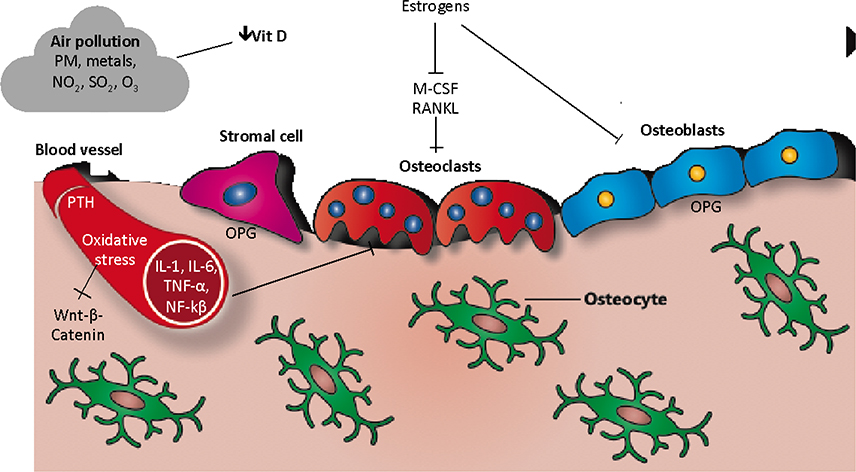
Air pollution is the second most important risk factor associated with noncommunicable diseases after smoking. The effects of pollution on health are commonly attributable to particulate matter (PM), a complex mixture of particles suspended in the air. PM can penetrate the lower respiratory tract and has harmful direct and indirect effects on different organs and tissues. Direct effects are caused by the ability of PM components to cross the respiratory membrane and enter the bloodstream; indirect effects are systemic consequences of the local airway response. Recent work suggests that PM is an independent risk factor for low bone mineral density and osteoporosis-related fractures. Osteoporosis is a common age-related disease closely linked to bone fractures, with severe clinical consequences affecting quality of life, morbidity, and mortality. In this review, we discuss potential mechanisms behind the association between outdoor air pollution, especially PM, and bone damage. The discussion features four main mechanisms: 1) several different atmospheric pollutants can induce low-grade systemic inflammation, which affects bone metabolism through a specific effect of cytokines such as TNFα, IL-1β, IL-6, and IL-17 on osteoblast and osteoclast differentiation and function; 2) some pollutants, particularly certain gas and metal compounds, can cause oxidative damage in the airway and bone cells; 3) different groups of pollutants can act as endocrine disruptors when binding to the receptors in bone cells, changing their functioning; and 4) air pollution can directly and indirectly cause vitamin D deficiency. Characterizing these mechanisms will better define the physiopathology of bone damage, and recognizing air pollution as a modifiable risk factor for osteoporosis will inform environmental policies. Such knowledge will also guide the prevention of fractures due to fragility and help reduce health-related costs.
空气污染是仅次于吸烟的与非传染性疾病相关的第二大重要风险因素。污染对健康的影响通常归因于颗粒物(PM),这是一种悬浮在空气中的复杂粒子混合物。PM 可以穿透下呼吸道,并对不同的器官和组织产生有害的直接和间接影响。直接影响是由 PM 成分穿透呼吸膜并进入血液的能力引起的;间接影响是局部气道反应的全身后果。最近的研究表明,PM 是低骨密度和骨质疏松症相关骨折的独立危险因素。骨质疏松症是一种常见的与年龄相关的疾病,与骨折密切相关,严重的临床后果会影响生活质量、发病率和死亡率。在这篇综述中,我们讨论了户外空气污染(尤其是 PM)与骨骼损伤之间关联的潜在机制。讨论的主要机制有四个:1)几种不同的大气污染物可以诱导低度全身炎症,通过 TNFα、IL-1β、IL-6 和 IL-17 等细胞因子对成骨细胞和破骨细胞分化和功能的特定作用,影响骨代谢;2)一些污染物,特别是某些气体和金属化合物,可以在气道和骨细胞中引起氧化损伤;3)不同组的污染物可以作为内分泌干扰物,当它们与骨细胞中的受体结合时,改变其功能;4)空气污染可以直接和间接导致维生素 D 缺乏。描述这些机制将更好地定义骨骼损伤的病理生理学,并认识到空气污染是骨质疏松症的一个可改变的危险因素,这将为环境政策提供信息。这些知识还将指导因脆弱性导致的骨折预防,并有助于降低与健康相关的成本。