Xiang Hengyang, Wang Run, Chen Jiawei, Li Fushan, Zeng Haibo
MIIT Key Laboratory of Advanced Display Materials and Devices, Institute of Optoelectronics & Nanomaterials, College of Materials Science and Engineering, Nanjing University of Science and Technology, Nanjing, 210094, China.
College of Physics and Information Engineering, Fuzhou University, Fuzhou, 350108, China.
Light Sci Appl. 2021 Oct 5;10(1):206. doi: 10.1038/s41377-021-00640-4.
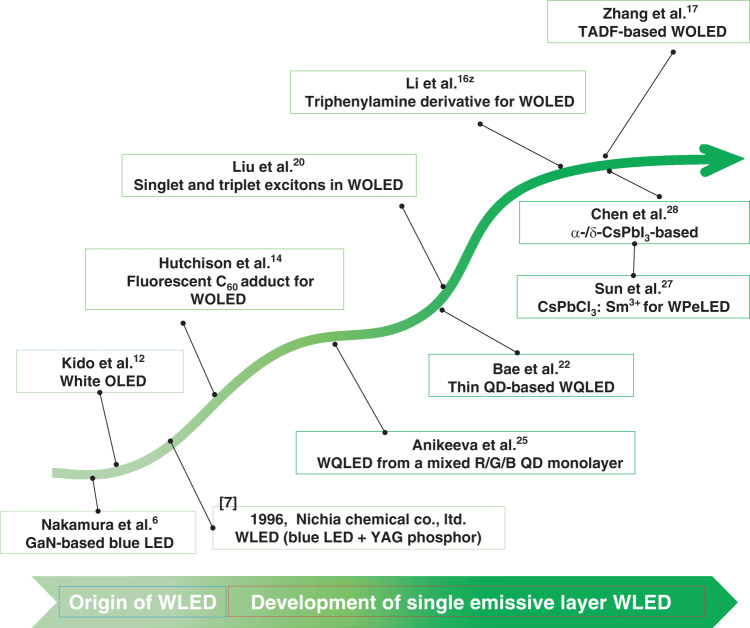
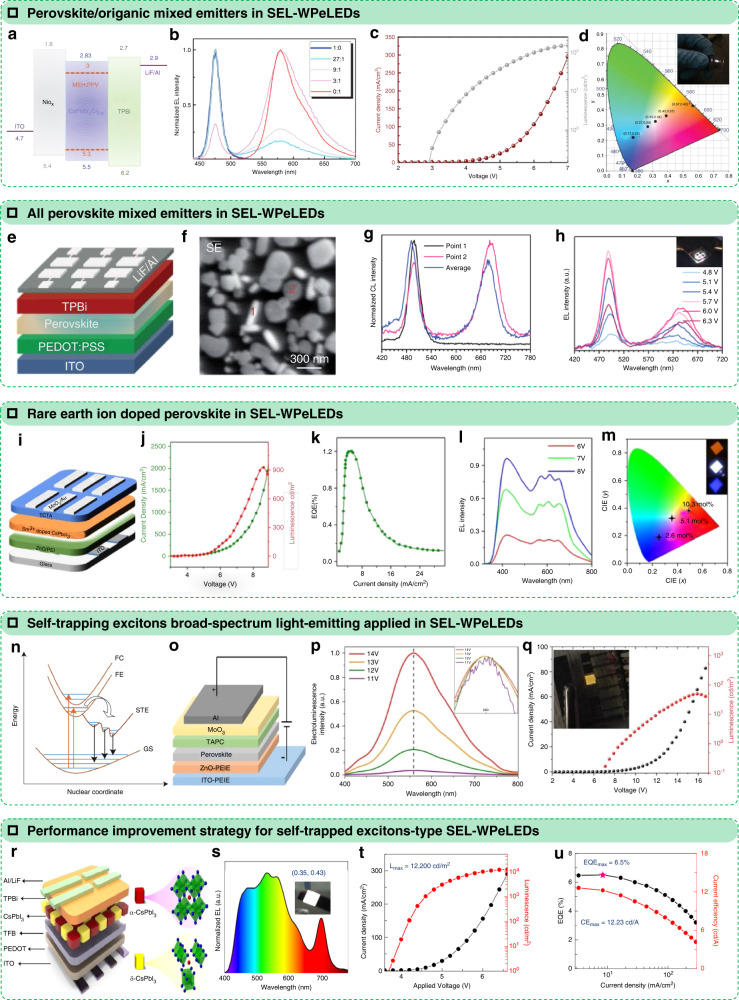
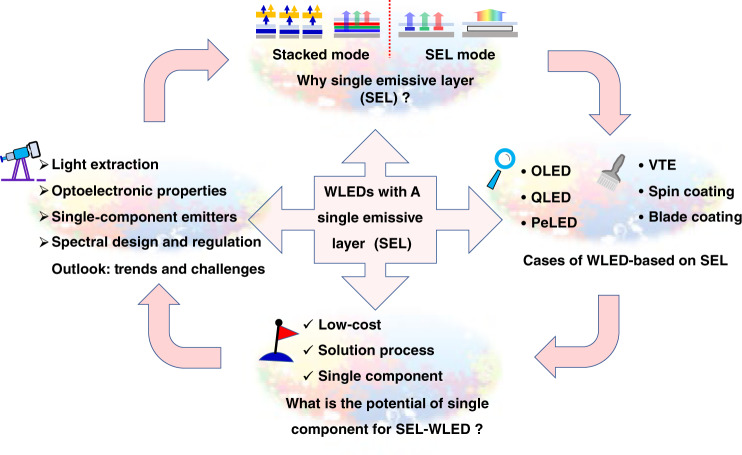
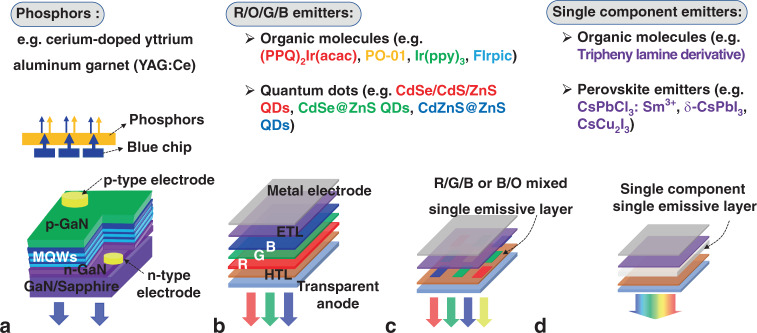
Carbon neutrality, energy savings, and lighting costs and quality have always led to urgent demand for lighting technology innovation. White light-emitting diodes (WLEDs) based on a single emissive layer (SEL) fabricated by the solution method have been continuously researched in recent years; they are advantageous because they have a low cost and are ultrathin and flexible. Here, we reviewed the history and development of SEL-WLEDs over recent years to provide inspiration and promote their progress in lighting applications. We first introduced the emitters and analysed the advantages of these emitters in creating SEL-WLEDs and then reviewed some cases that involve the above emitters, which were formed via vacuum thermal evaporation or solution processes. Some notable developments that deserve attention are highlighted in this review due to their potential use in SEL-WLEDs, such as perovskite materials. Finally, we looked at future development trends of SEL-WLEDs and proposed potential research directions.
碳中和、节能以及照明成本与质量一直催生对照明技术创新的迫切需求。近年来,基于溶液法制备的单发光层(SEL)的白光发光二极管(WLED)不断得到研究;它们具有成本低、超薄且灵活的优势。在此,我们回顾了近年来SEL-WLED的历史与发展,以提供启发并推动其在照明应用中的进展。我们首先介绍了发光体,并分析了这些发光体在制造SEL-WLED方面的优势,然后回顾了一些涉及上述通过真空热蒸发或溶液工艺形成的发光体的案例。由于其在SEL-WLED中的潜在用途,一些值得关注的显著进展在本综述中得到突出,例如钙钛矿材料。最后,我们探讨了SEL-WLED的未来发展趋势,并提出了潜在的研究方向。