• 文献检索
  • 文档翻译
  • 深度研究
  • 学术资讯
  • Suppr Zotero 插件Zotero 插件
  • 邀请有礼
  • 套餐&价格
  • 历史记录
应用&插件
Suppr Zotero 插件Zotero 插件浏览器插件Mac 客户端Windows 客户端微信小程序
定价
高级版会员购买积分包购买API积分包
服务
文献检索文档翻译深度研究API 文档MCP 服务
关于我们
关于 Suppr公司介绍联系我们用户协议隐私条款
关注我们

Suppr 超能文献

核心技术专利:CN118964589B侵权必究
粤ICP备2023148730 号-1Suppr @ 2026

文献检索

告别复杂PubMed语法,用中文像聊天一样搜索,搜遍4000万医学文献。AI智能推荐,让科研检索更轻松。

立即免费搜索

文件翻译

保留排版,准确专业,支持PDF/Word/PPT等文件格式,支持 12+语言互译。

免费翻译文档

深度研究

AI帮你快速写综述,25分钟生成高质量综述,智能提取关键信息,辅助科研写作。

立即免费体验

巴西卫生专业人员对婴儿主导的断乳法(BLW)用于补充喂养的看法:一项探索性研究。

Brazilian health professionals' perception about the Baby-Led Weaning (BLW) method for complementary feeding: an exploratory study.

机构信息

Universidade Federal de Juiz de Fora, Juiz de Fora, MG, Brazil.

出版信息

Rev Paul Pediatr. 2021 Oct 4;40:e2020321. doi: 10.1590/1984-0462/2022/40/2020321. eCollection 2021.

DOI:10.1590/1984-0462/2022/40/2020321
PMID:34614129
原文链接:https://pmc.ncbi.nlm.nih.gov/articles/PMC8543847/
Abstract

OBJECTIVE

To describe Brazilian health professionals' perception about the Baby-Led Weaning (BLW) method use for complementary feeding.

METHODS

Cross-sectional, descriptive study including 458 health professionals graduated in Nursing, Speech Therapy, Medicine, Nutrition or Dentistry and working in Pediatrics, being directly or indirectly involved with pediatric nutrition. We used a convenience non-probability sampling. The questionnaire applied to participants addressed demographic characteristics, academic degree, workplace, knowledge about clinical practice and perceptions about the possible advantages of the BLW method.

RESULTS

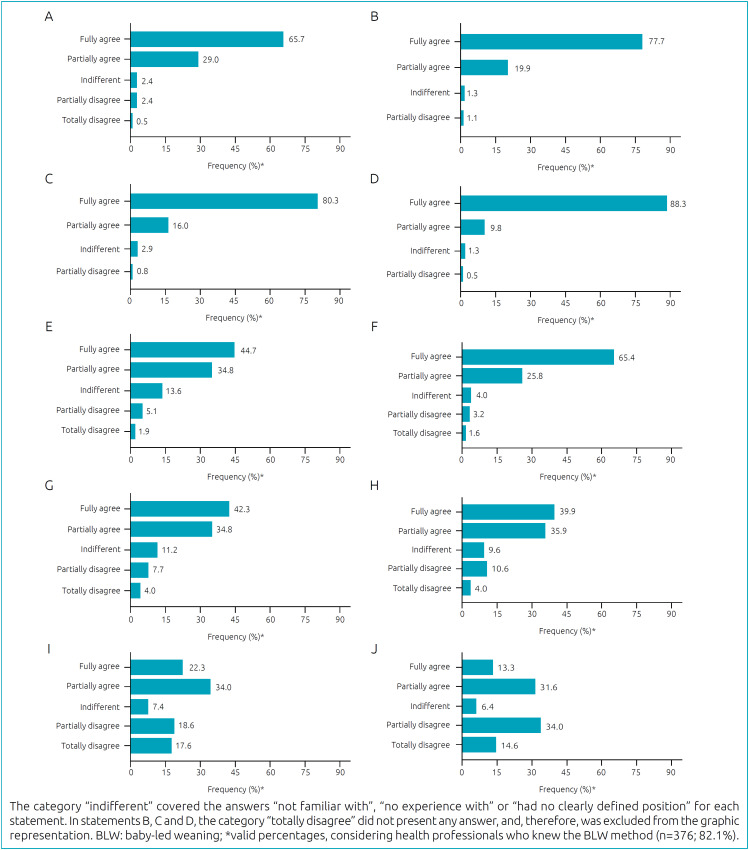
Participants had a mean age of 34.5±8.5 years, 64.6% of them working in Southeast Brazil and 65.3% being nutritionists. Most participants reported being acquainted with the BLW method (82.0%). Regarding clinical practice, 38.3% mentioned having recommended the BLW some times, 37.5% often and 20.5% always. Most participants fully agreed that the BLW method could have advantages for babies, for example, having them more likely to share family meals, facilitating adaptation to food flavors and consistencies, enhancing chewing and favoring the development of motor skills. On the other hand, important disagreements were also expressed regarding the BLW convenience and the possibility to create less concerns or anxiety in parents.

CONCLUSIONS

The BLW method reported as advantageous, but disagreements were also raised, probably because scientific evidences on the suject are scarse. Further investigation is needed so we can better understand the risks and benefits and health care professionals can feel effectively assisted to offer support and advice to parents and caretakers.

摘要

目的

描述巴西卫生专业人员对婴儿主导的离乳(BLW)方法在补充喂养中的使用的看法。

方法

这是一项横断面、描述性研究,纳入了 458 名毕业于护理、言语治疗、医学、营养或牙科专业,并在儿科工作的卫生专业人员,他们直接或间接地参与儿童营养。我们使用了便利非概率抽样。应用于参与者的问卷涉及人口统计学特征、学历、工作场所、对临床实践的了解以及对 BLW 方法可能优势的看法。

结果

参与者的平均年龄为 34.5±8.5 岁,其中 64.6%在巴西东南部工作,65.3%为营养师。大多数参与者表示熟悉 BLW 方法(82.0%)。关于临床实践,38.3%的人表示曾多次推荐 BLW,37.5%的人经常推荐,20.5%的人总是推荐。大多数参与者完全同意 BLW 方法对婴儿可能有优势,例如,他们更有可能与家人一起用餐,便于适应食物的味道和质地,增强咀嚼能力,并促进运动技能的发展。另一方面,对于 BLW 的便利性和减少父母担忧或焦虑的可能性,也表达了重要的不同意见。

结论

BLW 方法被认为是有利的,但也存在分歧,这可能是因为关于该主题的科学证据不足。需要进一步研究,以便我们更好地了解风险和益处,使卫生保健专业人员能够有效地提供支持和建议给父母和照顾者。
https://cdn.ncbi.nlm.nih.gov/pmc/blobs/8c5c/8543847/a7a510e4120c/1984-0462-rpp-40-e2020321-gf01.jpg

相似文献

1
Brazilian health professionals' perception about the Baby-Led Weaning (BLW) method for complementary feeding: an exploratory study.巴西卫生专业人员对婴儿主导的断乳法(BLW)用于补充喂养的看法:一项探索性研究。
Rev Paul Pediatr. 2021 Oct 4;40:e2020321. doi: 10.1590/1984-0462/2022/40/2020321. eCollection 2021.
2
Knowledge and attitudes towards baby-led-weaning by health professionals and parents: A cross-sectional study.健康专业人员和家长对婴儿主导的断奶的知识和态度:一项横断面研究。
Enferm Clin (Engl Ed). 2022 Jun;32 Suppl 1:S64-S72. doi: 10.1016/j.enfcle.2021.04.005.
3
Experiences and opinions towards baby-led weaning by healthcare professionals. A qualitative study.医护人员对婴儿主导的离乳法的经验和看法。一项定性研究。
Pediatr Res. 2023 Nov;94(5):1784-1788. doi: 10.1038/s41390-023-02694-z. Epub 2023 Jun 20.
4
THE BABY-LED WEANING METHOD (BLW) IN THE CONTEXT OF COMPLEMENTARY FEEDING: A REVIEW.辅食添加背景下的婴儿自主进食法(BLW):综述
Rev Paul Pediatr. 2018 Jul-Sep;36(3):353-363. doi: 10.1590/1984-0462/;2018;36;3;00001. Epub 2018 Jul 10.
5
[What is currently known about the baby-led weaning method-BLW?].[目前关于婴儿主导式断乳法(BLW)有哪些已知信息?]
Andes Pediatr. 2022 Jun;93(3):300-311. doi: 10.32641/andespediatr.v93i3.4181.
6
Baby-led weaning: Health professionals 'knowledge and attitudes and parents' experiences from Spain. A mixed methods approach.婴儿主导的离乳:来自西班牙的健康专业人员的知识、态度和父母的经验。混合方法研究。
Health Soc Care Community. 2022 Jul;30(4):e1352-e1363. doi: 10.1111/hsc.13543. Epub 2021 Sep 17.
7
How different are baby-led weaning and conventional complementary feeding? A cross-sectional study of infants aged 6-8 months.婴儿主导式辅食添加与传统辅食添加有何不同?一项针对6至8个月婴儿的横断面研究。
BMJ Open. 2016 May 6;6(5):e010665. doi: 10.1136/bmjopen-2015-010665.
8
Comparison of food and nutrient intake in infants aged 6-12 months, following baby-led or traditional weaning: A cross-sectional study.6-12 月龄婴儿采用自主进食或传统方法添加辅食后食物及营养素摄入的比较:一项横断面研究。
J Hum Nutr Diet. 2022 Apr;35(2):310-324. doi: 10.1111/jhn.12947. Epub 2021 Sep 2.
9
Food fussiness and early feeding characteristics of infants following Baby-Led Weaning and traditional spoon-feeding in New Zealand: An internet survey.新西兰婴儿主导式进食和传统勺喂法的婴儿的食物挑剔和早期喂养特征:一项网络调查。
Appetite. 2018 Nov 1;130:110-116. doi: 10.1016/j.appet.2018.07.033. Epub 2018 Aug 2.
10
Use of the Baby-Led Weaning (BLW) Method in Complementary Feeding of the Infant-A Cross-Sectional Study of Mothers Using and Not Using the BLW Method.婴儿主导的离乳法(BLW)在婴儿补充喂养中的应用——使用和不使用 BLW 方法的母亲的横断面研究。
Nutrients. 2022 Jun 8;14(12):2372. doi: 10.3390/nu14122372.

引用本文的文献

1
Health Professionals' Knowledge, Perceptions, and Attitudes Toward Baby-Led Weaning: Scoping Review.卫生专业人员对婴儿主导式断奶的知识、认知和态度:范围综述
SAGE Open Nurs. 2024 Sep 27;10:23779608241285417. doi: 10.1177/23779608241285417. eCollection 2024 Jan-Dec.
2
Analysis of 108 flexible bronchoscopies for the removal of foreign bodies from the airways.分析 108 例经支气管镜取气道内异物术。
Einstein (Sao Paulo). 2023 Dec 22;21:eAO0391. doi: 10.31744/einstein_journal/2023AO0391. eCollection 2023.
3
What is the best method for introducing complementary feeding?

本文引用的文献

1
Recruiting Mothers of Children With Developmental Disabilities: Adaptations of the Snowball Sampling Technique Using Social Media.招募发育障碍儿童的母亲:利用社交媒体对滚雪球抽样技术的调整
J Pediatr Health Care. 2019 Jan;33(1):107-110. doi: 10.1016/j.pedhc.2018.09.011.
2
THE BABY-LED WEANING METHOD (BLW) IN THE CONTEXT OF COMPLEMENTARY FEEDING: A REVIEW.辅食添加背景下的婴儿自主进食法(BLW):综述
Rev Paul Pediatr. 2018 Jul-Sep;36(3):353-363. doi: 10.1590/1984-0462/;2018;36;3;00001. Epub 2018 Jul 10.
3
Impact of a modified version of baby-led weaning on iron intake and status: a randomised controlled trial.
引入辅食的最佳方法是什么?
Rev Paul Pediatr. 2023 Oct 3;42:e2023119. doi: 10.1590/1984-0462/2024/42/2023119.
4
Experiences and opinions towards baby-led weaning by healthcare professionals. A qualitative study.医护人员对婴儿主导的离乳法的经验和看法。一项定性研究。
Pediatr Res. 2023 Nov;94(5):1784-1788. doi: 10.1038/s41390-023-02694-z. Epub 2023 Jun 20.
5
Micronutrient Profile and Carbohydrate Microstructure of Commercially Prepared and Home Prepared Infant Fruit and Vegetable Purees.市售和家庭自制婴儿果蔬泥的微量营养素特征和碳水化合物微观结构。
Nutrients. 2022 Dec 22;15(1):45. doi: 10.3390/nu15010045.
6
Traditional complementary feeding or BLW (Baby Led Weaning) method? - A cross-sectional study of Polish infants during complementary feeding.传统辅食喂养法还是自主进食法(婴儿主导断乳法)?——一项关于波兰婴儿辅食喂养的横断面研究
Front Pediatr. 2022 Oct 21;10:992244. doi: 10.3389/fped.2022.992244. eCollection 2022.
7
Use of the Baby-Led Weaning (BLW) Method in Complementary Feeding of the Infant-A Cross-Sectional Study of Mothers Using and Not Using the BLW Method.婴儿主导的离乳法(BLW)在婴儿补充喂养中的应用——使用和不使用 BLW 方法的母亲的横断面研究。
Nutrients. 2022 Jun 8;14(12):2372. doi: 10.3390/nu14122372.
8
Practical Implementation of the BLW Method During the Expansion of the Infant Diet-A Study Among Polish Children.婴儿饮食扩展期间BLW方法的实际应用——一项针对波兰儿童的研究
Front Nutr. 2022 May 24;9:890843. doi: 10.3389/fnut.2022.890843. eCollection 2022.
改良版自主进食法对铁摄入量及铁状态的影响:一项随机对照试验
BMJ Open. 2018 Jun 27;8(6):e019036. doi: 10.1136/bmjopen-2017-019036.
4
Impact of a Modified Version of Baby-Led Weaning on Infant Food and Nutrient Intakes: The BLISS Randomized Controlled Trial.改良版婴儿主导式断乳对婴儿食物和营养素摄入量的影响:BLISS 随机对照试验。
Nutrients. 2018 Jun 7;10(6):740. doi: 10.3390/nu10060740.
5
Modified Version of Baby-Led Weaning Does Not Result in Lower Zinc Intake or Status in Infants: A Randomized Controlled Trial.婴儿主导的辅食添加方法的改良版本并不会导致婴儿锌摄入量或状态降低:一项随机对照试验。
J Acad Nutr Diet. 2018 Jun;118(6):1006-1016.e1. doi: 10.1016/j.jand.2018.02.005.
6
Baby-led weaning: what a systematic review of the literature adds on.婴儿主导的离乳:文献系统评价增加了什么。
Ital J Pediatr. 2018 May 3;44(1):49. doi: 10.1186/s13052-018-0487-8.
7
No difference in self-reported frequency of choking between infants introduced to solid foods using a baby-led weaning or traditional spoon-feeding approach.采用婴儿主导的断乳法或传统勺喂法引入固体食物的婴儿,自我报告的哽噎频率无差异。
J Hum Nutr Diet. 2018 Aug;31(4):496-504. doi: 10.1111/jhn.12528. Epub 2017 Dec 5.
8
Effect of a Baby-Led Approach to Complementary Feeding on Infant Growth and Overweight: A Randomized Clinical Trial.婴儿主导的辅食添加方法对婴儿生长及超重的影响:一项随机临床试验
JAMA Pediatr. 2017 Sep 1;171(9):838-846. doi: 10.1001/jamapediatrics.2017.1284.
9
Baby-Led Weaning: The Evidence to Date.婴儿主导式辅食添加:迄今的证据
Curr Nutr Rep. 2017;6(2):148-156. doi: 10.1007/s13668-017-0201-2. Epub 2017 Apr 29.
10
A Baby-Led Approach to Eating Solids and Risk of Choking.婴儿主导的固体食物进食方法与窒息风险。
Pediatrics. 2016 Oct;138(4). doi: 10.1542/peds.2016-0772. Epub 2016 Sep 19.