Department of Gynecologic Oncology, The International Peace Maternity and Child Health Hospital, School of Medicine, Shanghai Jiao Tong University, Shanghai, People's Republic of China.
State Key Laboratory of Chemical Engineering, School of Chemical Engineering, East China University of Science and Technology, Shanghai, People's Republic of China.
Int J Nanomedicine. 2021 Sep 29;16:6661-6679. doi: 10.2147/IJN.S329341. eCollection 2021.
Iron-based nanomaterials have recently been developed as excellent and potent Fenton reagents to reactive oxygen species (ROS) during chemodynamic therapy (CDT). The performance of the materials, however, can be impaired by the intrinsic antioxidant defense mechanism in organisms, such as autophagy.
The nanoscale metal-organic frameworks (nMOFs), nMIL-100 (Fe), were exploited and characterized. Also, the Fenton-like catalytic characteristics, anti-endometrial cancer (EC) effects and potential mechanisms of nMIL-100 (Fe) nanoparticles were investigated in vitro.
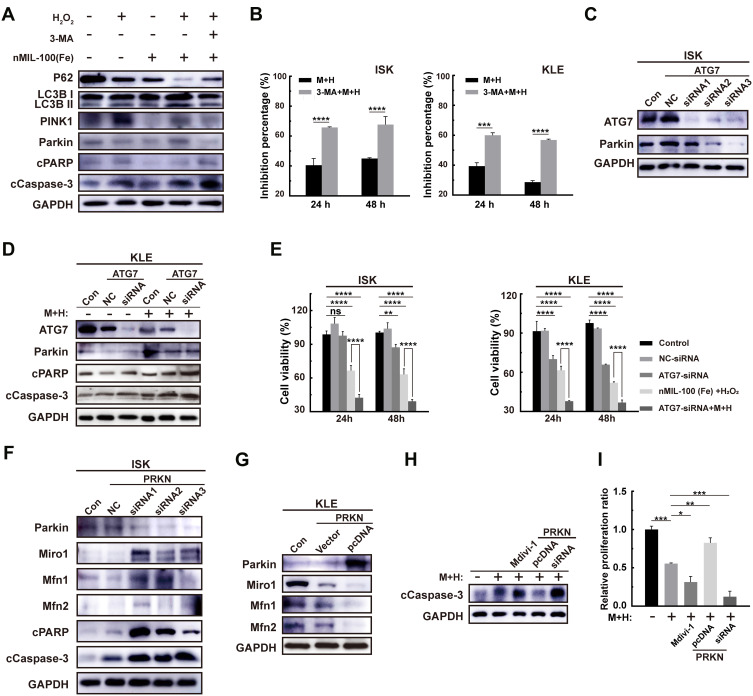
The synthesized nMIL-100 (Fe) nanocatalyst catalyzed hydroxyl radicals (·OH) production in the presence of hydrogen peroxide (HO) and simultaneously depleted intracellular glutathione (GSH). Combining with HO, nMIL-100 (Fe) nanoparticles exhibited enhanced cytotoxicity for EC cells, especially for progesterone treatment-insensitive KLE cells, probably due to relatively lower expression of the catalase gene. The accumulated ·OH initiated PTEN induced putative kinase 1 (PINK1)/E3 ubiquitin-protein ligase Parkin-mediated cytoprotective mitophagy in turn to partially rescue ·OH-induced cell apoptosis. Furthermore, both pretreatments of EC cells with siRNA-mediated Parkin knockdown and Mdivi-1 (a mitophagy inhibitor) addition were sufficient to ensure nMIL-100 (Fe) synergizing with HO-induced oxidative damages.
These results suggest that the degree of mitophagy should be taken into consideration to optimize therapeutic efficiency when developing ROS based-CDT for EC cancer therapies. Therefore, a nMIL-100 (Fe)-guided, elevated ROS and overwhelmed mitophagy-mediated therapeutic strategy may have greater promise for EC therapy compared with current treatment modalities.
铁基纳米材料最近被开发为用于化学动力学治疗(CDT)中活性氧(ROS)的优秀且有效的芬顿试剂。然而,材料的性能可能会受到生物体内在抗氧化防御机制的损害,例如自噬。
利用和表征了纳米级金属有机骨架(nMOFs),nMIL-100(Fe)。还研究了 nMIL-100(Fe)纳米粒子的类芬顿催化特性、抗子宫内膜癌(EC)作用及其潜在机制。
合成的 nMIL-100(Fe)纳米催化剂在过氧化氢(HO)存在下催化羟基自由基(·OH)的产生,同时耗尽细胞内谷胱甘肽(GSH)。与 HO 结合,nMIL-100(Fe)纳米粒子对 EC 细胞表现出增强的细胞毒性,特别是对孕激素治疗不敏感的 KLE 细胞,这可能是由于过氧化氢酶基因的相对低表达。积累的·OH 引发 PTEN 诱导的假定激酶 1(PINK1)/E3 泛素蛋白连接酶 Parkin 介导的细胞保护性自噬,从而部分挽救·OH 诱导的细胞凋亡。此外,EC 细胞用 siRNA 介导的 Parkin 敲低预处理和添加 Mdivi-1(一种自噬抑制剂)足以确保 nMIL-100(Fe)与 HO 诱导的氧化损伤协同作用。
这些结果表明,在开发基于 ROS 的 CDT 用于 EC 癌症治疗时,应考虑自噬的程度,以优化治疗效率。因此,与当前的治疗方式相比,nMIL-100(Fe)指导、ROS 升高和自噬过度介导的治疗策略可能对 EC 治疗更有希望。