Zboril Emily, Yoo Hannah, Chen Lizhen, Liu Zhijie
Department of Molecular Medicine, Mays Cancer Center, University of Texas Health Science Center at San Antonio, San Antonio, TX, United States.
Department of Cell Systems and Anatomy, Barshop Institute for Longevity and Aging Studies, University of Texas Health Science Center at San Antonio, San Antonio, TX, United States.
Front Oncol. 2021 Sep 20;11:753051. doi: 10.3389/fonc.2021.753051. eCollection 2021.
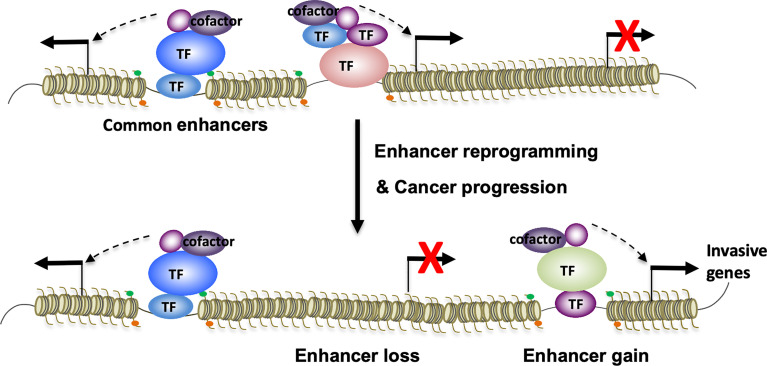
While improved tumor treatment has significantly reduced the overall mortality rates, invasive progression including recurrence, therapy resistance and metastasis contributes to the majority of deaths caused by cancer. Enhancers are essential distal DNA regulatory elements that control temporal- or spatial-specific gene expression patterns during development and other biological processes. Genome-wide sequencing has revealed frequent alterations of enhancers in cancers and reprogramming of distal enhancers has emerged as one of the important features for tumors. In this review, we will discuss tumor progression-associated enhancer dynamics, its transcription factor (TF) drivers and how enhancer reprogramming modulates gene expression during cancer invasive progression. Additionally, we will explore recent advancements in contemporary technology including single-cell sequencing, spatial transcriptomics and CUT&RUN, which have permitted integrated studies of enhancer reprogramming . Given the essential roles of enhancer dynamics and its drivers in controlling cancer progression and treatment outcome, understanding these changes will be paramount in mitigating invasive events and discovering novel therapeutic targets.
虽然改进的肿瘤治疗方法显著降低了总体死亡率,但包括复发、治疗抗性和转移在内的侵袭性进展是导致癌症死亡的主要原因。增强子是重要的远端DNA调控元件,在发育和其他生物学过程中控制时间或空间特异性基因表达模式。全基因组测序揭示了癌症中增强子的频繁改变,远端增强子重编程已成为肿瘤的重要特征之一。在本综述中,我们将讨论与肿瘤进展相关的增强子动态变化、其转录因子驱动因素,以及增强子重编程在癌症侵袭性进展过程中如何调节基因表达。此外,我们将探索当代技术的最新进展,包括单细胞测序、空间转录组学和CUT&RUN,这些技术允许对增强子重编程进行综合研究。鉴于增强子动态变化及其驱动因素在控制癌症进展和治疗结果中的重要作用,了解这些变化对于减轻侵袭性事件和发现新的治疗靶点至关重要。