Department of Audiology, Rehabilitation Research Center, School of Rehabilitation Sciences, Iran University of Medical Sciences, Tehran, Iran.
Department of Audiology, Rehabilitation Research Center, School of Rehabilitation Sciences, Iran University of Medical Sciences, Tehran, Iran; Audiology Department, Rehabilitation School, Arak University of Medical Sciences, Arak, Markazi Province, Iran.
J Int Adv Otol. 2021 Sep;17(5):417-421. doi: 10.5152/iao.2021.9072.
Benign Paroxysmal Positional Vertigo (BPPV) as the most common vestibular disorder can affect the quality of life. This study aimed to compare the effectiveness of the half somersault maneuver (HSM) as a treatment to that of the Epley maneuver (EM) as a clinical-based treatment in subjects with PC-BPPV.
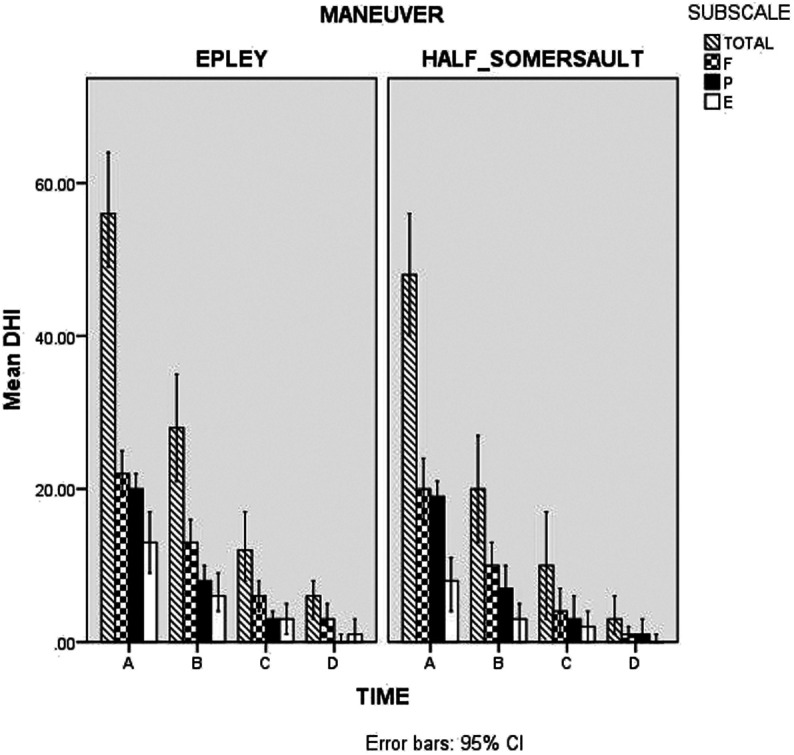
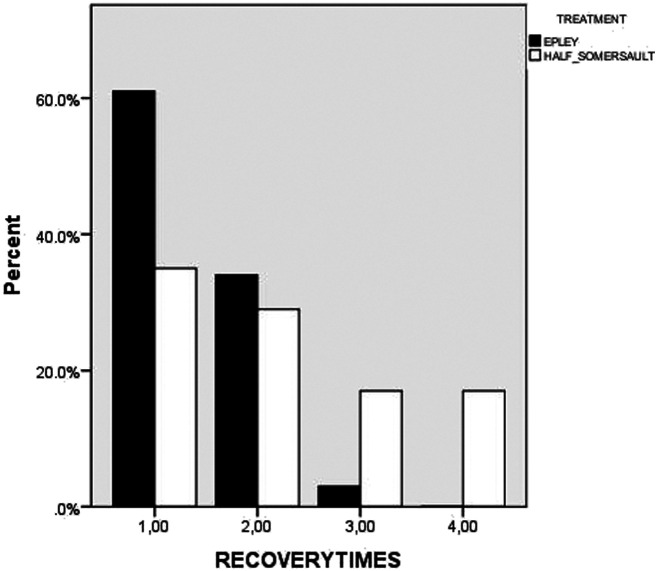
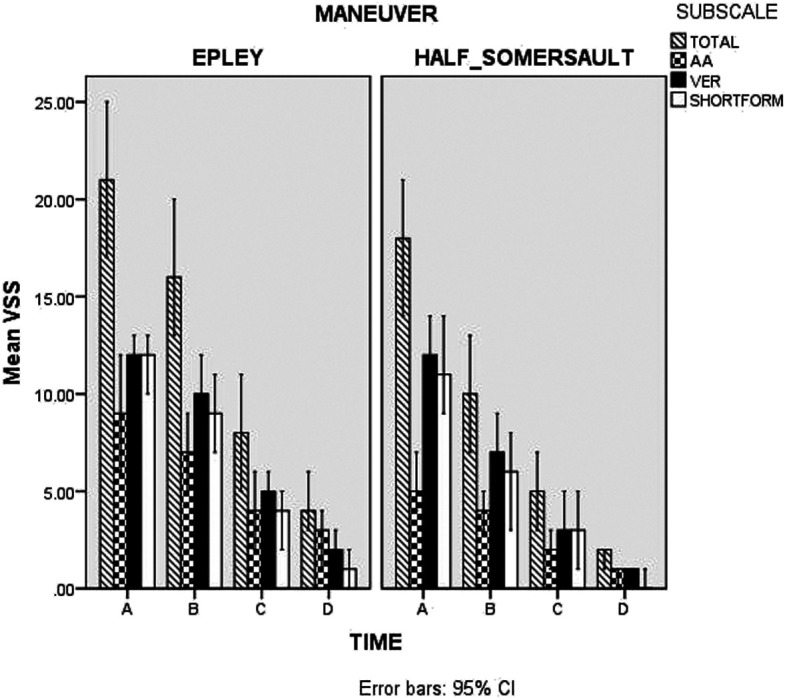
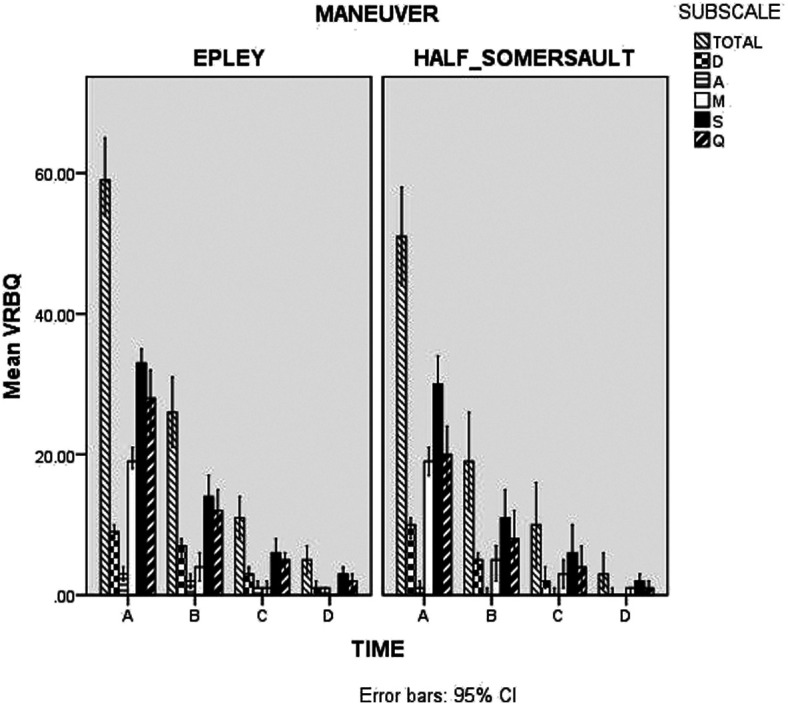
In this randomized study, 43 participants with unilateral posterior canal BPPV were recruited. The experimental group received the HSM, whereas the control group received the EM. All participants were asked to fill in the Vestibular Rehabilitation Benefit Questionnaire (VRBQ), Dizziness Handicap Inventory (DHI), and Vertigo Symptom Scale (VSS) questionnaires at pretreatment and at 48 hours, 1 week, and 1 month posttreatment. The severity of residual dizziness was determined by the visual analog scale (VAS) weekly for up to 4 weeks after treatment. The success rate and the recurrence rate were assessed after the 3-month follow-up.
The differences between the results of pretreatment and post-treatment questionnaires for both groups were significant. However, the differences were not significant between the 2 groups for the DHI scores, the total, dizziness, motion-provoked dizziness, and symptom subscale scores of the VRBQ, and the anxiety subscale scores of the VSS. There were significant differences between the 2 groups for VAS, the total VSS and vertigo subscale scores, and the VRBQ anxiety subscale scores.
Even though both maneuvers are significantly effective in the treatment of PC-BPPV, subjects in the HSM group reported more improvement in terms of psychometric symptoms and residual dizziness compared to the EM group.
良性阵发性位置性眩晕(BPPV)作为最常见的前庭障碍,会影响生活质量。本研究旨在比较翻滚半规管复位法(HSM)和 Epley 复位法(EM)作为基于临床的治疗方法对后半规管 BPPV (PC-BPPV)患者的治疗效果。
在这项随机研究中,招募了 43 名单侧后半规管 BPPV 患者。实验组接受 HSM,对照组接受 EM。所有患者在治疗前和治疗后 48 小时、1 周和 1 个月分别填写前庭康复效益问卷(VRBQ)、头晕残疾量表(DHI)和眩晕症状量表(VSS)问卷。每周通过视觉模拟量表(VAS)评估残余头晕的严重程度,持续 4 周。治疗后 3 个月进行随访,评估成功率和复发率。
两组治疗前后问卷结果的差异均有统计学意义。然而,两组 DHI 评分、VRBQ 总分、头晕、运动诱发头晕和症状子量表评分以及 VSS 焦虑子量表评分差异无统计学意义。两组 VAS、总 VSS 和眩晕子量表评分以及 VRBQ 焦虑子量表评分差异有统计学意义。
尽管两种手法治疗 PC-BPPV 均有显著效果,但与 EM 组相比,HSM 组患者在心理症状和残余头晕方面的改善更为明显。