Department of Plant Biology, University of Illinois at Urbana-Champaign, Urbana, Illinois 61801, USA.
Department of Crop Sciences, University of Illinois at Urbana-Champaign, Urbana, Illinois 61801, USA.
Plant Physiol. 2021 Dec 4;187(4):2544-2562. doi: 10.1093/plphys/kiab395.
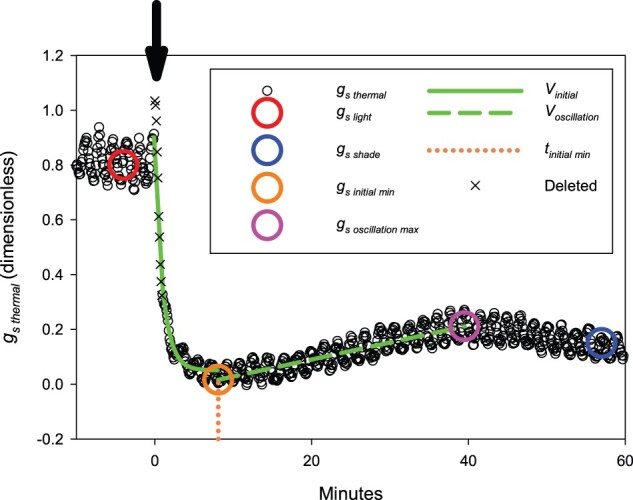
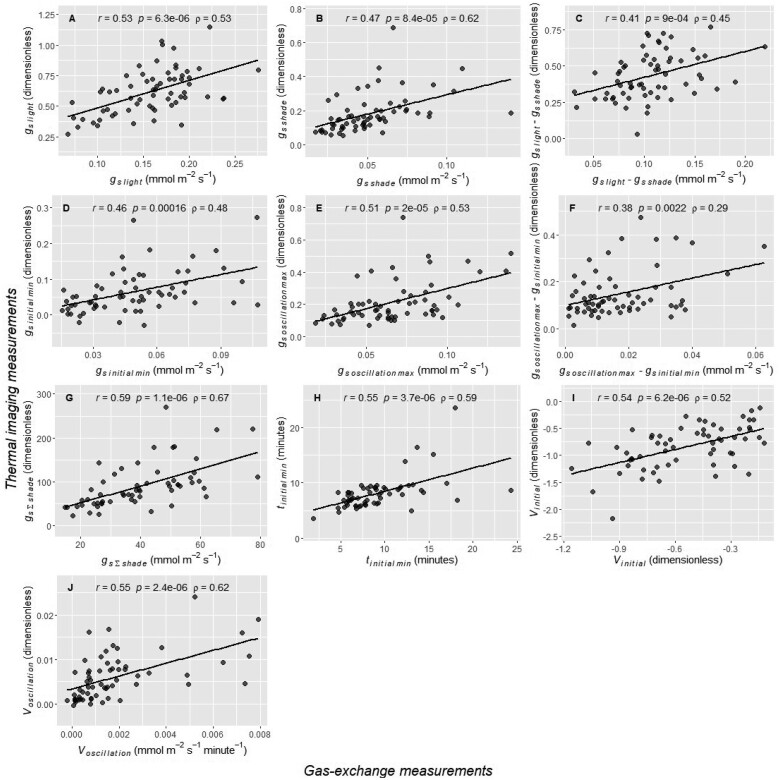
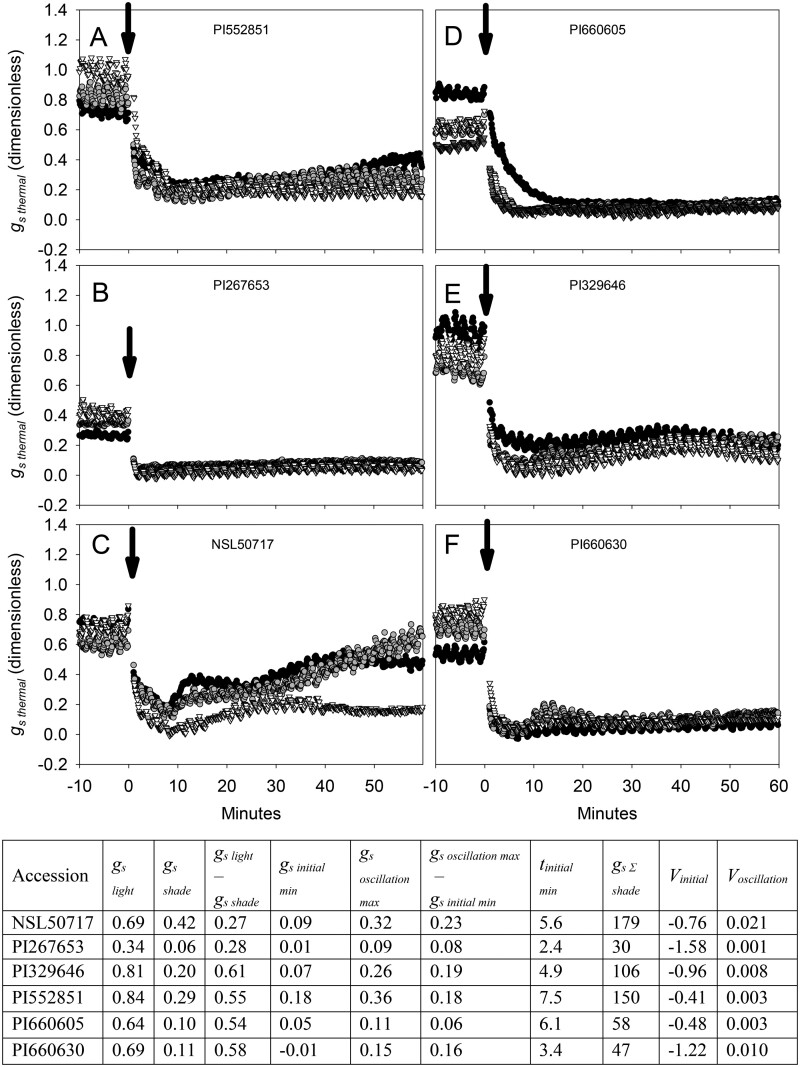
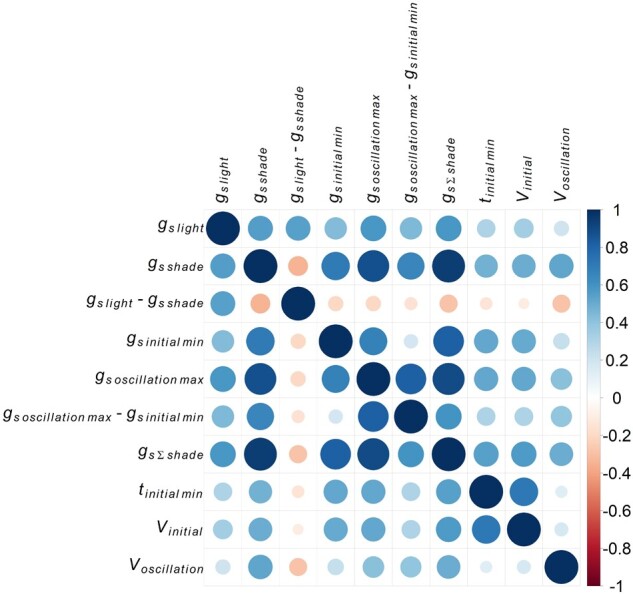
Stomata allow CO2 uptake by leaves for photosynthetic assimilation at the cost of water vapor loss to the atmosphere. The opening and closing of stomata in response to fluctuations in light intensity regulate CO2 and water fluxes and are essential for maintaining water-use efficiency (WUE). However, a little is known about the genetic basis for natural variation in stomatal movement, especially in C4 crops. This is partly because the stomatal response to a change in light intensity is difficult to measure at the scale required for association studies. Here, we used high-throughput thermal imaging to bypass the phenotyping bottleneck and assess 10 traits describing stomatal conductance (gs) before, during and after a stepwise decrease in light intensity for a diversity panel of 659 sorghum (Sorghum bicolor) accessions. Results from thermal imaging significantly correlated with photosynthetic gas exchange measurements. gs traits varied substantially across the population and were moderately heritable (h2 up to 0.72). An integrated genome-wide and transcriptome-wide association study identified candidate genes putatively driving variation in stomatal conductance traits. Of the 239 unique candidate genes identified with the greatest confidence, 77 were putative orthologs of Arabidopsis (Arabidopsis thaliana) genes related to functions implicated in WUE, including stomatal opening/closing (24 genes), stomatal/epidermal cell development (35 genes), leaf/vasculature development (12 genes), or chlorophyll metabolism/photosynthesis (8 genes). These findings demonstrate an approach to finding genotype-to-phenotype relationships for a challenging trait as well as candidate genes for further investigation of the genetic basis of WUE in a model C4 grass for bioenergy, food, and forage production.
气孔允许二氧化碳被叶片吸收用于光合作用,但其代价是水蒸气会逸散到大气中。气孔会根据光照强度的波动而开启和关闭,从而调节二氧化碳和水蒸气的通量,这对于维持水分利用效率(WUE)至关重要。然而,人们对气孔运动的自然变异的遗传基础知之甚少,特别是在 C4 作物中。这在一定程度上是因为很难在关联研究所需的规模上测量气孔对光照强度变化的响应。在这里,我们使用高通量热成像技术绕过表型分析的瓶颈,评估了一个由 659 份高粱(Sorghum bicolor)种质组成的多样性群体在光照强度逐步降低过程中描述气孔导度(gs)的 10 个特征,包括 gs 在降低前、降低中和降低后的变化。热成像结果与光合气体交换测量结果显著相关。gs 性状在整个群体中差异很大,具有中度的遗传力(h2 最高可达 0.72)。综合全基因组和全转录组关联研究鉴定出候选基因,这些基因可能驱动气孔导度性状的变异。在具有最大置信度的 239 个独特候选基因中,有 77 个是拟南芥(Arabidopsis thaliana)与 WUE 相关功能的基因的假定同源基因,包括气孔开启/关闭(24 个基因)、气孔/表皮细胞发育(35 个基因)、叶片/维管束发育(12 个基因)或叶绿素代谢/光合作用(8 个基因)。这些发现表明,我们找到了一种针对具有挑战性的性状的基因型-表型关系的方法,以及候选基因,可进一步研究用于生物能源、食品和饲料生产的模式 C4 草的 WUE 遗传基础。