Molecular Interaction Ecology, German Centre for Integrative Biodiversity Research (iDiv) Halle-Jena-Leipzig, Puschstraße 4, 04103 Leipzig, Germany.
Institute of Biodiversity, Friedrich Schiller University Jena, Dornburgerstraße 159, 07743 Jena, Germany.
Plant Physiol. 2021 Nov 3;187(3):1762-1778. doi: 10.1093/plphys/kiab368.
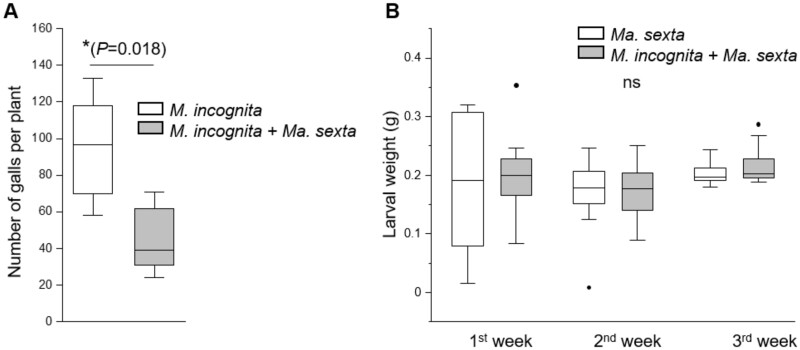
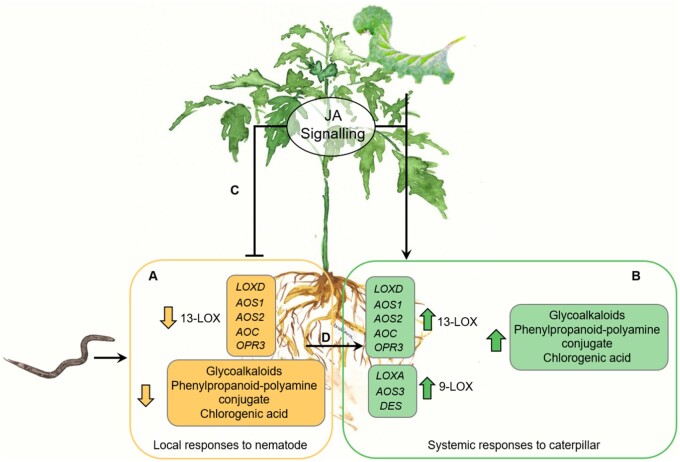
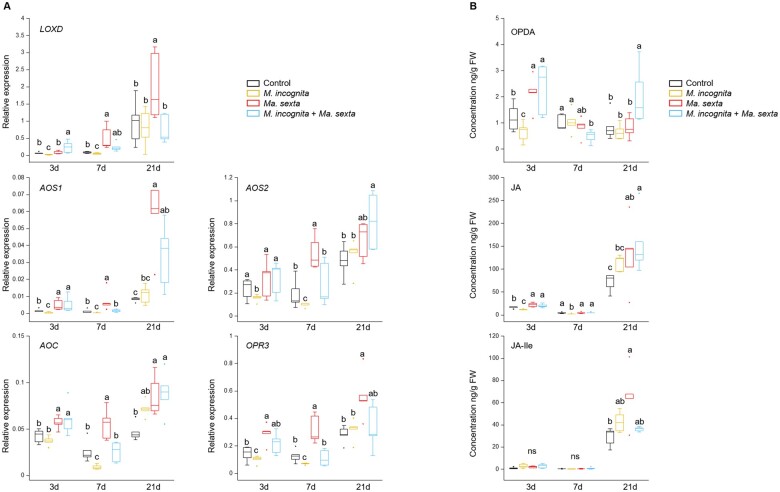
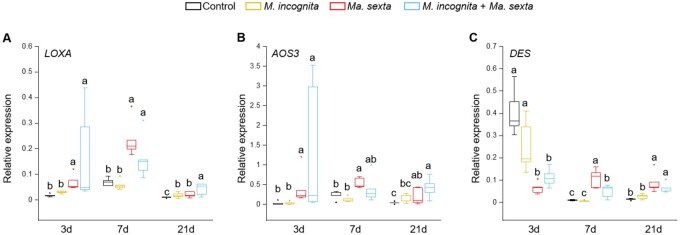
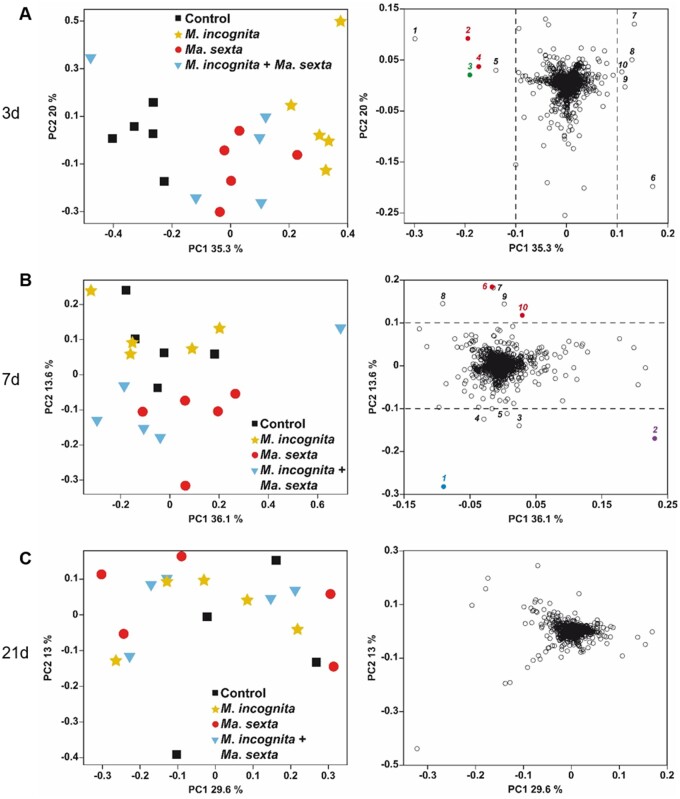
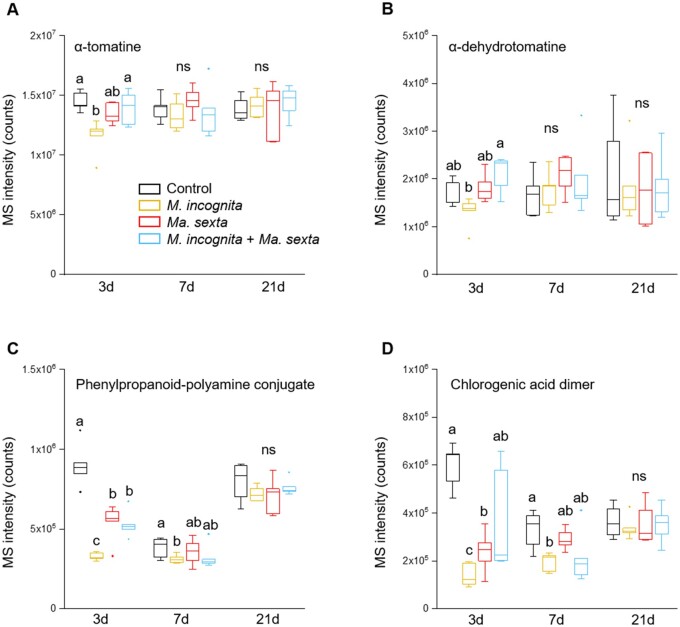
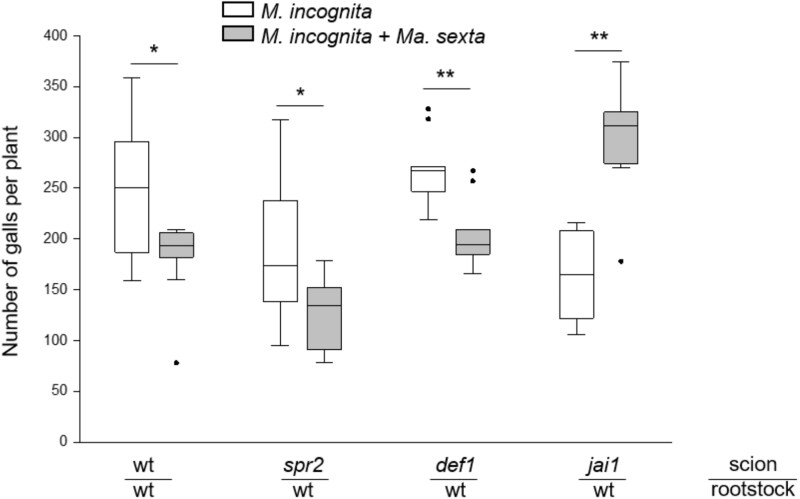
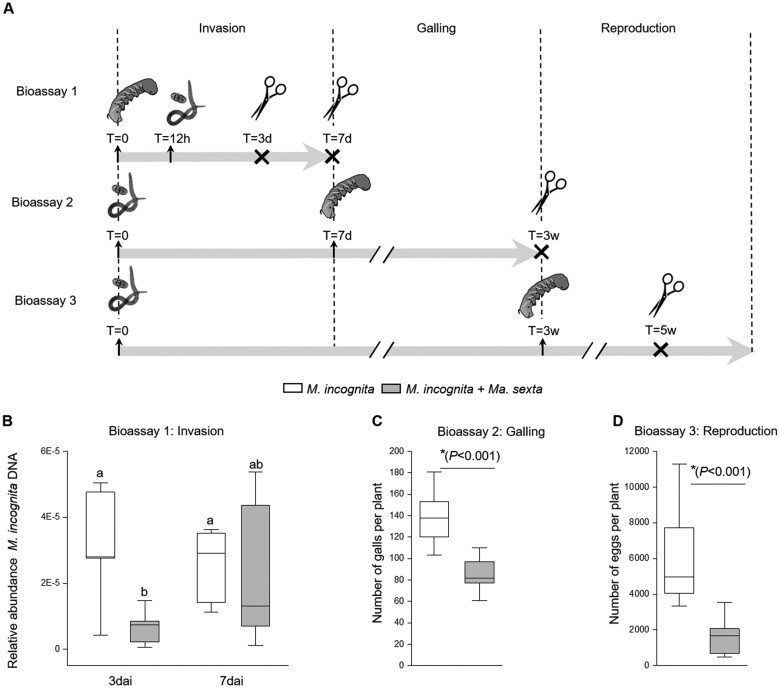
Shoot herbivores may influence the communities of herbivores associated with the roots via inducible defenses. However, the molecular mechanisms and hormonal signaling underpinning the systemic impact of leaf herbivory on root-induced responses against nematodes remain poorly understood. By using tomato (Solanum lycopersicum) as a model plant, we explored the impact of leaf herbivory by Manduca sexta on the performance of the root knot nematode Meloidogyne incognita. By performing glasshouse bioassays, we found that leaf herbivory reduced M. incognita performance in the roots. By analyzing the root expression profile of a set of oxylipin-related marker genes and jasmonate root content, we show that leaf herbivory systemically activates the 13-Lipoxigenase (LOX) and 9-LOX branches of the oxylipin pathway in roots and counteracts the M. incognita-triggered repression of the 13-LOX branch. By using untargeted metabolomics, we also found that leaf herbivory counteracts the M. incognita-mediated repression of putative root chemical defenses. To explore the signaling involved in this shoot-to-root interaction, we performed glasshouse bioassays with grafted plants compromised in jasmonate synthesis or perception, specifically in their shoots. We demonstrated the importance of an intact shoot jasmonate perception, whereas having an intact jasmonate biosynthesis pathway was not essential for this shoot-to-root interaction. Our results highlight the impact of leaf herbivory on the ability of M. incognita to manipulate root defenses and point to an important role for the jasmonate signaling pathway in shoot-to-root signaling.
食草动物的捕食可能会通过诱导防御来影响与根相关的食草动物群落。然而,叶片取食对根诱导的抗线虫反应的系统影响背后的分子机制和激素信号仍然知之甚少。本研究以番茄(Solanum lycopersicum)为模式植物,探讨了烟粉虱(Manduca sexta)对根结线虫(Meloidogyne incognita)的影响。通过温室生物测定,发现叶片取食减少了根结线虫在根部的生长。通过分析一组氧化脂素相关标记基因和茉莉酸根含量的表达谱,表明叶片取食系统地激活了根部的 13-脂氧合酶(LOX)和 9-LOX 分支,并抵消了 M. incognita 对 13-LOX 分支的抑制作用。通过非靶向代谢组学分析,还发现叶片取食抵消了 M. incognita 对根化学防御的抑制作用。为了探索这种地上部与地下部相互作用涉及的信号转导,本研究对茉莉酸合成或感知受损的嫁接植物进行了温室生物测定,特别是在其地上部。结果表明,完整的地上部茉莉酸感知对这种地上部与地下部的相互作用至关重要,而具有完整的茉莉酸生物合成途径对于这种相互作用并不是必需的。研究结果强调了叶片取食对 M. incognita 操纵根防御能力的影响,并指出茉莉酸信号通路在地上部与地下部信号转导中起着重要作用。