Department of Epidemiology and Health Statistics, Fujian Provincial Key Laboratory of Environment Factors and Cancer, School of Public Health, Fujian Medical University, Fuzhou, 350122, Fujian, China.
Centre for Epidemiology and Evidence-Based Practice, Department of Social and Preventive Medicine, Faculty of Medicine, University of Malaya, 50603, Kuala Lumpur, Malaysia.
Infect Dis Poverty. 2021 Oct 7;10(1):122. doi: 10.1186/s40249-021-00900-w.
The availability of various types of COVID-19 vaccines and diverse characteristics of the vaccines present a dilemma in vaccination choices, which may result in individuals refusing a particular COVID-19 vaccine offered, hence presenting a threat to immunisation coverage and reaching herd immunity. The study aimed to assess global COVID-19 vaccination intention, vaccine characteristics influencing vaccination acceptance and desirable vaccine characteristics influencing the choice of vaccines.
An anonymous cross-sectional survey was conducted between 4 January and 5 March 2021 in 17 countries worldwide. Proportions and the corresponding 95% confidence intervals (CI) of COVID-19 vaccine acceptance and vaccine characteristics influencing vaccination acceptance were generated and compared across countries and regions. Multivariable logistic regression analysis was used to determine the factors associated with COVID-19 vaccine hesitancy.
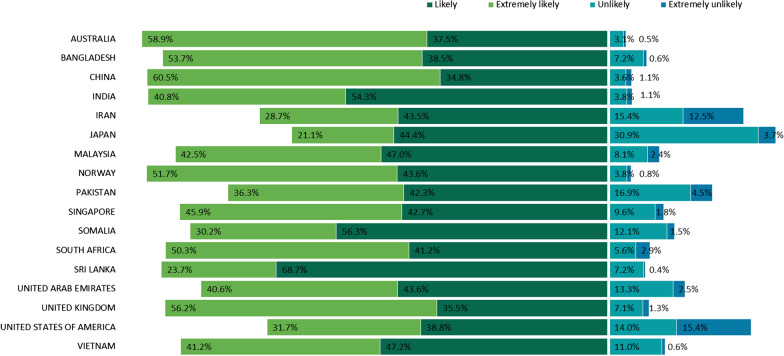
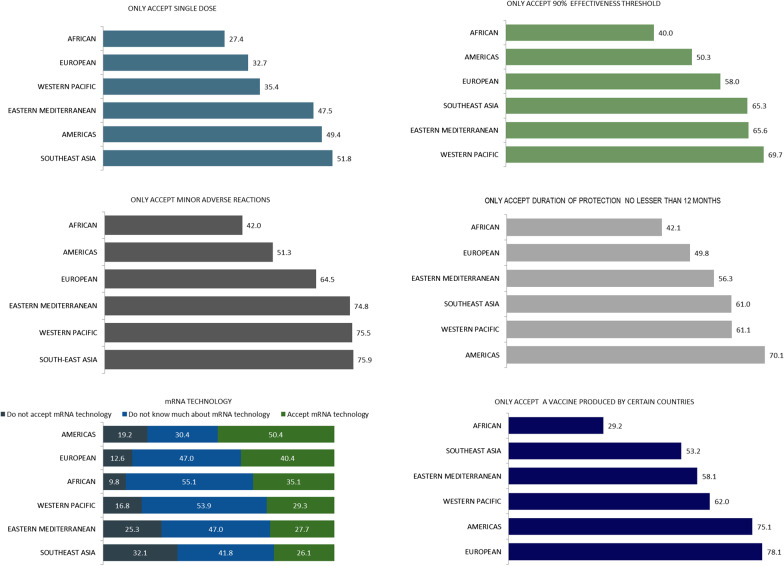
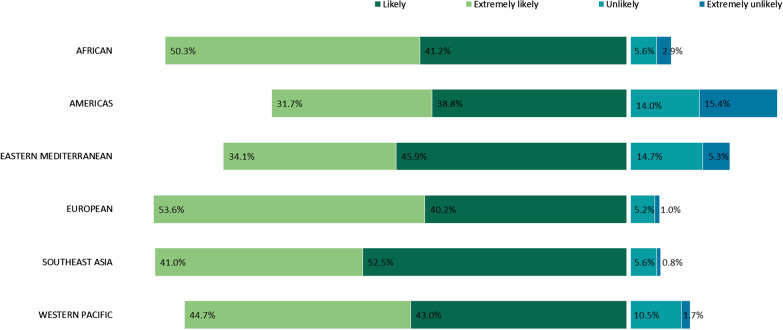
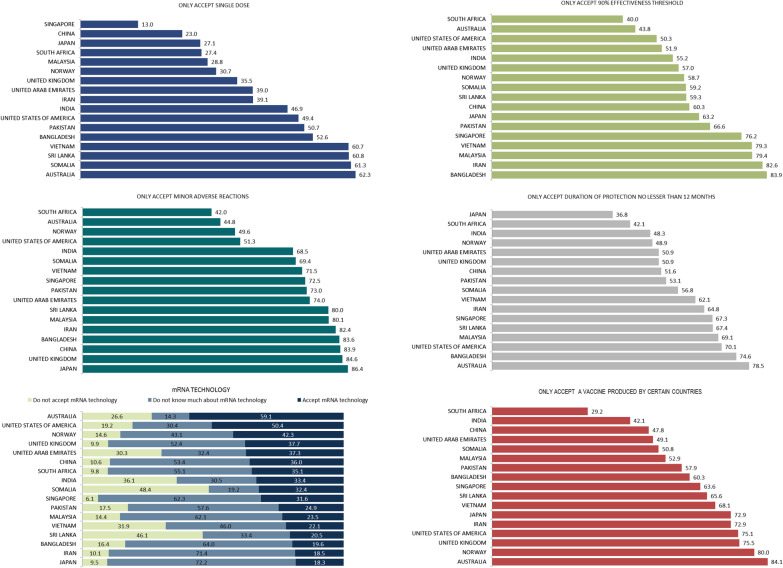
Of the 19,714 responses received, 90.4% (95% CI 81.8-95.3) reported likely or extremely likely to receive COVID-19 vaccine. A high proportion of likely or extremely likely to receive the COVID-19 vaccine was reported in Australia (96.4%), China (95.3%) and Norway (95.3%), while a high proportion reported being unlikely or extremely unlikely to receive the vaccine in Japan (34.6%), the U.S. (29.4%) and Iran (27.9%). Males, those with a lower educational level and those of older age expressed a higher level of COVID-19 vaccine hesitancy. Less than two-thirds (59.7%; 95% CI 58.4-61.0) reported only being willing to accept a vaccine with an effectiveness of more than 90%, and 74.5% (95% CI 73.4-75.5) said they would accept a COVID-19 vaccine with minor adverse reactions. A total of 21.0% (95% CI 20.0-22.0) reported not accepting an mRNA vaccine and 51.8% (95% CI 50.3-53.1) reported that they would only accept a COVID-19 vaccine from a specific country-of-origin. Countries from the Southeast Asia region reported the highest proportion of not accepting mRNA technology. The highest proportion from Europe and the Americas would only accept a vaccine produced by certain countries. The foremost important vaccine characteristic influencing vaccine choice is adverse reactions (40.6%; 95% CI 39.3-41.9) of a vaccine and effectiveness threshold (35.1%; 95% CI 33.9-36.4).
The inter-regional and individual country disparities in COVID-19 vaccine hesitancy highlight the importance of designing an efficient plan for the delivery of interventions dynamically tailored to the local population.
各种类型的 COVID-19 疫苗的出现和疫苗的不同特性给接种选择带来了困境,这可能导致个人拒绝提供的特定 COVID-19 疫苗,从而对免疫接种覆盖率和实现群体免疫构成威胁。本研究旨在评估全球 COVID-19 疫苗接种意愿、影响疫苗接种接受度的疫苗特性以及影响疫苗选择的理想疫苗特性。
2021 年 1 月 4 日至 3 月 5 日,在全球 17 个国家进行了一项匿名横断面调查。生成了 COVID-19 疫苗接种接受度和影响疫苗接种接受度的疫苗特性的比例及其相应的 95%置信区间(CI),并在国家和地区之间进行了比较。多变量逻辑回归分析用于确定与 COVID-19 疫苗犹豫相关的因素。
在收到的 19714 份回复中,90.4%(95%CI 81.8-95.3)表示可能或极有可能接受 COVID-19 疫苗。澳大利亚(96.4%)、中国(95.3%)和挪威(95.3%)报告了很高的可能或极有可能接受 COVID-19 疫苗的比例,而日本(34.6%)、美国(29.4%)和伊朗(27.9%)报告了很高的不太可能或极不可能接受疫苗的比例。男性、教育程度较低和年龄较大的人对 COVID-19 疫苗的犹豫程度更高。不到三分之二(59.7%;95%CI 58.4-61.0)的人表示只愿意接受有效性超过 90%的疫苗,74.5%(95%CI 73.4-75.5)的人表示他们将接受具有轻微不良反应的 COVID-19 疫苗。共有 21.0%(95%CI 20.0-22.0)的人表示不接受 mRNA 疫苗,51.8%(95%CI 50.3-53.1)的人表示只接受来自特定原产国的 COVID-19 疫苗。东南亚地区的国家报告了最高比例的不接受 mRNA 技术。来自欧洲和美洲的最高比例只接受特定国家生产的疫苗。影响疫苗选择的最重要疫苗特性是疫苗的不良反应(40.6%;95%CI 39.3-41.9)和有效性阈值(35.1%;95%CI 33.9-36.4)。
COVID-19 疫苗犹豫的区域间和国家间差异突出表明,设计一项有效的计划,以动态地向当地人口提供量身定制的干预措施非常重要。