Division of Nephrology, University Medical Center Groningen and University of Groningen, Groningen, The Netherlands.
Department of Surgery, University Medical Center Groningen and University of Groningen, Groningen, The Netherlands.
Transpl Int. 2021 Dec;34(12):2746-2754. doi: 10.1111/tri.14130. Epub 2021 Oct 28.
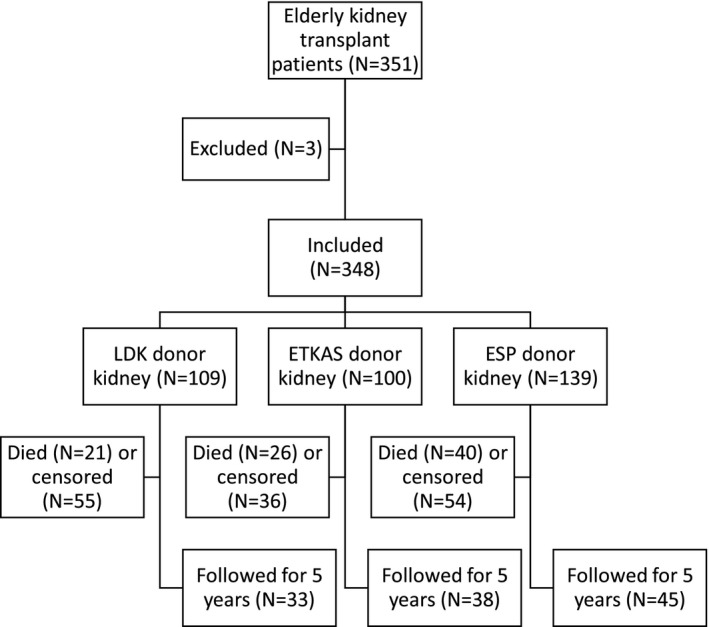
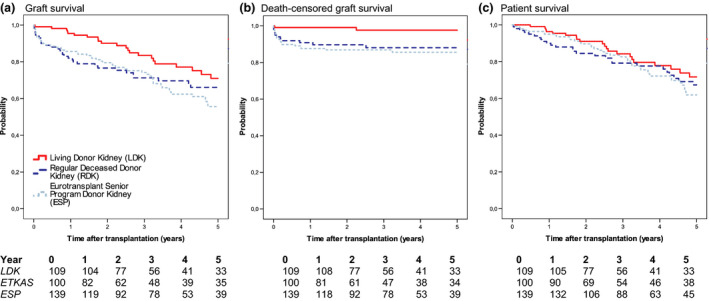
Increasing numbers of elderly (≥65 years) patients are listed for kidney transplantation. This study compares the survival outcome between living (LDK), regularly allocated (ETKAS), and Eurotransplant Senior Program (ESP) donor kidneys in elderly recipients. This is a single-center retrospective cohort study of elderly kidney transplant recipients transplanted between 2005 and 2017. Primary outcome measures were nondeath-censored graft, death-censored graft, and patient survival. In total, 348 patients were transplanted, 109 recipients (31.3%) received an LDK, 100 (28.7%) an ETKAS, and 139 (40%) an ESP kidney. 62.5% were male, and median age was 68 years. LDK recipients had significantly better 5-year nondeath-censored graft survival compared with ETKAS and ESP (resp. 71.0% vs. 66.1% vs. 55.6%, P = 0.047). Death-censored graft survival after 1 year was significantly better in LDK recipients (99.1%) (ETKAS 90.8%; ESP 87.7%, P < 0.001). After 5 years, the difference remained significant (P < 0.001) with little additional graft loss (97.7% vs. 88.1% vs. 85.6). There was no significant difference in patient survival after 5 years (71.7% vs. 67.4% vs 61.9%, P = 0.480). In elderly recipients, the patient survival benefits of an LDK are limited, but there is decreased death-censored graft loss for LDK recipients. Nevertheless, graft survival in ETKAS and ESP remains satisfactory.
越来越多的老年人(≥65 岁)被列入肾脏移植名单。本研究比较了活体(LDK)、定期分配(ETKAS)和 Eurotransplant Senior Program(ESP)供体肾脏在老年受者中的生存结果。这是一项单中心回顾性队列研究,纳入了 2005 年至 2017 年期间接受肾脏移植的老年患者。主要观察终点为无死亡事件的移植物、死亡事件相关的移植物和患者生存。共纳入 348 例患者,其中 109 例(31.3%)接受 LDK,100 例(28.7%)接受 ETKAS,139 例(40%)接受 ESP 供体肾。62.5%为男性,中位年龄为 68 岁。与 ETKAS 和 ESP 相比,LDK 受者的 5 年无死亡事件相关的移植物存活率显著更高(分别为 71.0%、66.1%和 55.6%,P=0.047)。1 年后,LDK 受者的死亡事件相关的移植物存活率显著更高(99.1%)(ETKAS 为 90.8%;ESP 为 87.7%,P<0.001)。5 年后,差异仍然显著(P<0.001),且移植物丢失率增加很少(97.7%比 88.1%比 85.6%)。5 年后患者存活率无显著差异(71.7%比 67.4%比 61.9%,P=0.480)。在老年受者中,LDK 的患者生存获益有限,但 LDK 受者的死亡事件相关的移植物丢失风险降低。尽管如此,ETKAS 和 ESP 的移植物存活率仍然令人满意。