Department of Biomedicine and Prevention, Section of Histology and Embryology, University of Rome Tor Vergata, Rome, Italy.
Fondazione Santa Lucia, IRCCS, Rome, Italy.
Stem Cell Res Ther. 2021 Oct 10;12(1):537. doi: 10.1186/s13287-021-02590-5.
Although recent studies have investigated the ability of Mesenchymal Stromal Cells (MSCs) to alleviate short-term ovarian damage in animal models of chemotherapy-induced Premature Ovarian Insufficiency (POI), no data are available on reproductive lifespan recovery, especially in a severe POI condition. For this reason, we investigated the potential of MSCs isolated from human adipose tissue (hASCs), since they are easy to harvest and abundant, in ameliorating the length and performance of reproductive life in both mild and severe chemotherapy-induced murine POI models.
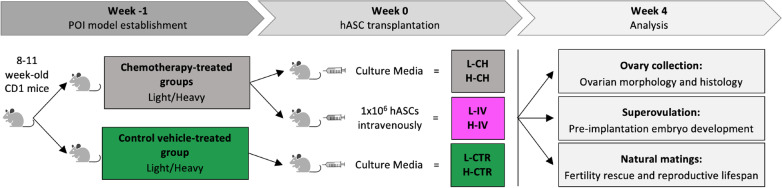
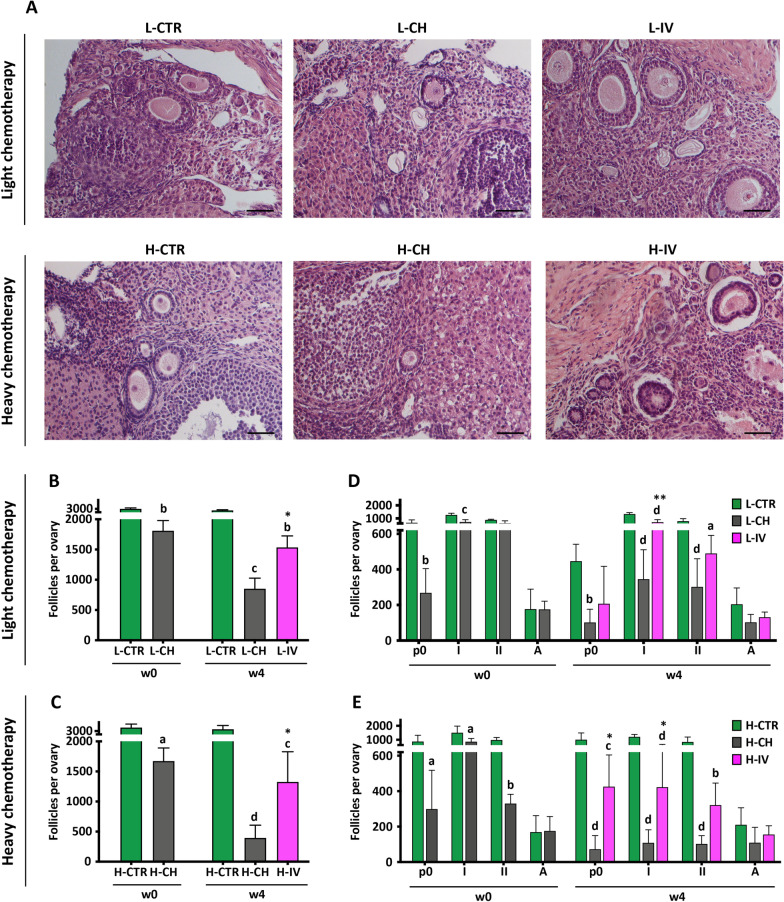
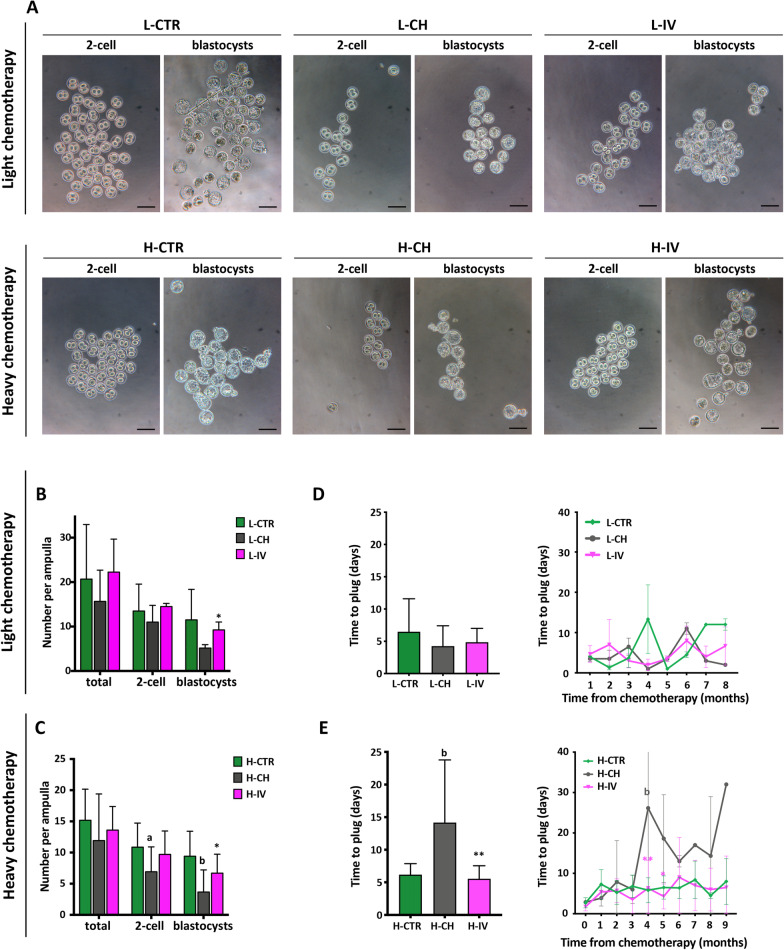
Mild and severe POI models were established by intraperitoneally administering a light (12 mg/kg busulfan + 120 mg/kg cyclophosphamide) or heavy (30 mg/kg busulfan + 120 mg/kg cyclophosphamide) dose of chemotherapy, respectively, in CD1 mice. In both cases, a week later, 1 × 10 hASCs were transplanted systemically through the tail vein. After four additional weeks, some females were sacrificed to collect ovaries for morphological evaluation. H&E staining was performed to assess stroma alteration and to count follicle numbers; immunofluorescence staining for αSMA was used to analyse vascularization. Of the remaining females, some were mated after superovulation to collect 2-cell embryos in order to evaluate their pre-implantation developmental capacity in vitro, while others were naturally mated to monitor litters and reproductive lifespan length. F1 litters' weight, ovaries and reproductive lifespan were also analysed.
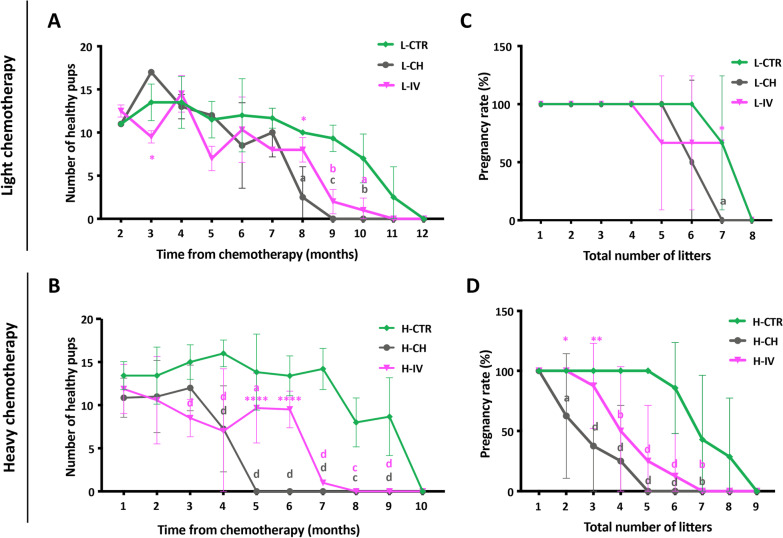
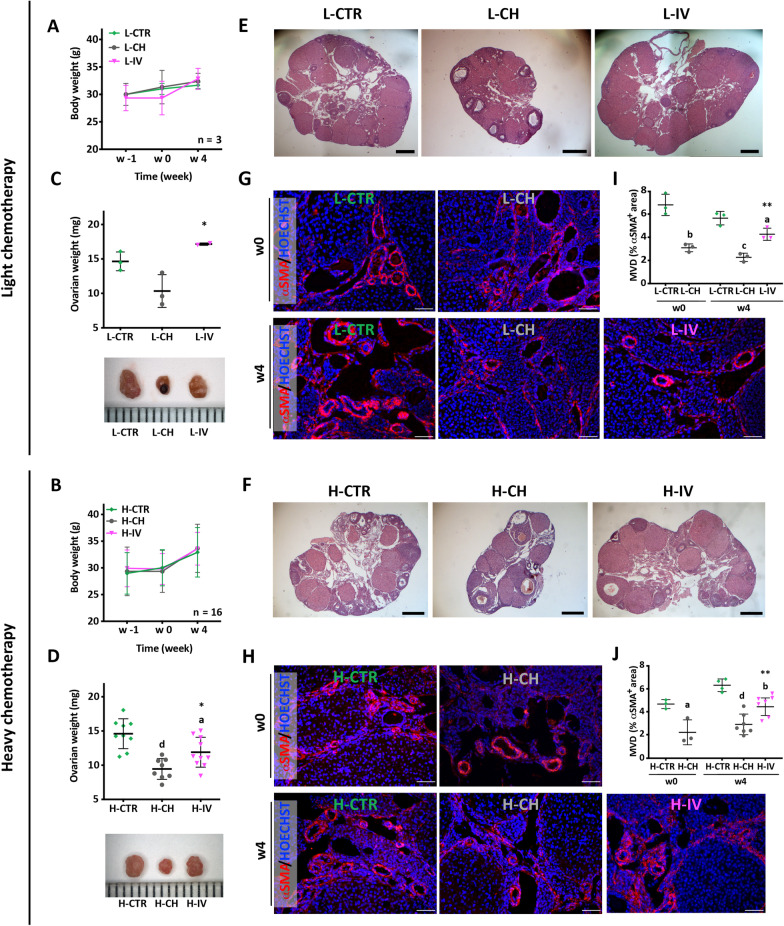
hASC transplantation alleviated ovarian weight loss and size decrease and reduced alterations on ovarian stroma and vasculature, concurrently preventing the progressive follicle stockpile depletion caused by chemotherapy. These effects were associated with the preservation of the oocyte competence to develop into blastocyst in vitro and, more interestingly, with a significant decrease of chemotherapy-induced POI features, like shortness of reproductive lifespan, reduced number of litters and longer time to plug (the latter only presented in the severe POI model).
Human ASC transplantation was able to significantly reduce all the alterations induced by the chemotherapeutic treatment, while improving oocyte quality and prolonging reproductive functions, thus counteracting infertility. These results, strengthened by the use of an outbred model, support the potential applications of hASCs in women with POI, nowadays mainly induced by anticancer therapies.
尽管最近的研究已经调查了间充质基质细胞(MSCs)在化疗诱导的卵巢早衰(POI)动物模型中缓解短期卵巢损伤的能力,但关于生殖寿命恢复的数据尚不可用,尤其是在严重 POI 情况下。出于这个原因,我们研究了从人脂肪组织(hASCs)中分离的 MSCs 的潜力,因为它们易于采集且丰富,可改善轻度和重度化疗诱导的 POI 小鼠模型中生殖寿命的长度和性能。
通过腹腔内给予低(12mg/kg 白消安+120mg/kg 环磷酰胺)或高(30mg/kg 白消安+120mg/kg 环磷酰胺)剂量的化疗,分别在 CD1 小鼠中建立轻度和重度 POI 模型。在两种情况下,一周后,通过尾静脉系统输注 1×10 hASCs。再增加四周后,部分雌性被处死以收集卵巢进行形态评估。进行 H&E 染色以评估基质改变并计数卵泡数量;免疫荧光染色用于分析血管化。对于其余的雌性,一些在超排卵后交配以收集 2 细胞胚胎,以评估它们的体外着床前发育能力,而另一些则自然交配以监测产仔和生殖寿命长度。还分析了 F1 产仔的体重、卵巢和生殖寿命。
hASC 移植减轻了卵巢重量损失和体积缩小,并减少了卵巢基质和血管的改变,同时防止了化疗引起的卵泡储备逐渐耗尽。这些效果与卵母细胞发育为体外囊胚的能力的保存有关,更有趣的是,与化疗诱导的 POI 特征的显著减少有关,如生殖寿命缩短、产仔数减少和插塞时间延长(后者仅在重度 POI 模型中出现)。
人 ASC 移植能够显著减少化疗治疗引起的所有改变,同时提高卵母细胞质量并延长生殖功能,从而对抗不孕。这些结果得到了使用杂种模型的支持,支持了 hASCs 在 POI 女性中的潜在应用,目前 POI 主要由抗癌治疗引起。