Prieto Mikel, Ielpo Benedetto, Jiménez Fuertes Montiel, González Sánchez María Del Carmen, Martín Antona Esteban, Balibrea José M, Aranda Narváez José Manuel
Servicio de Cirugía General, Unidad de Cirugía Hepatobiliar y Trasplante Hepático, Hospital Universitario Cruces, Bilbao, Universidad del País Vasco UPV-EHU.
Departamento de Cirugía General, Unidad de Cirugía Hepatobiliar, Complejo Asistencial Universitario de León.
Cir Esp. 2021 Jun-Jul;99(6):450-456. doi: 10.1016/j.ciresp.2020.06.018. Epub 2020 Jul 7.
The COVID-19 pandemic has had a significant impact on Spanish hospitals, which have had to allocate all available resources to treat these patients, reducing the ability to attend other common pathologies. The aim of this study is to analyze how the treatment of acute appendicitis has been affected.
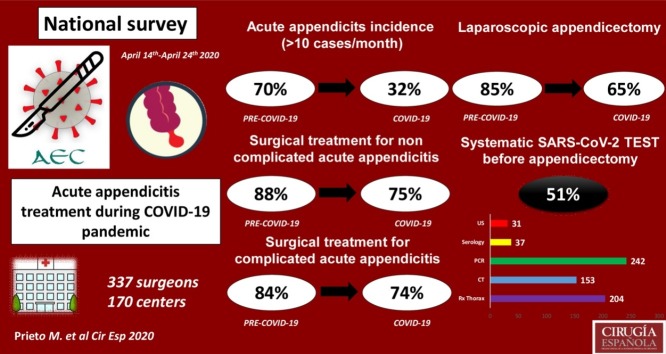
A national descriptive study was carried out by a online voluntary distribution of a specific questionnaire with Google Drive™ distributed by email by the Spanish Association of Surgeons (AEC) to all affiliated surgeons actually working in Spain (5203) opened from April 14th to April 24th.
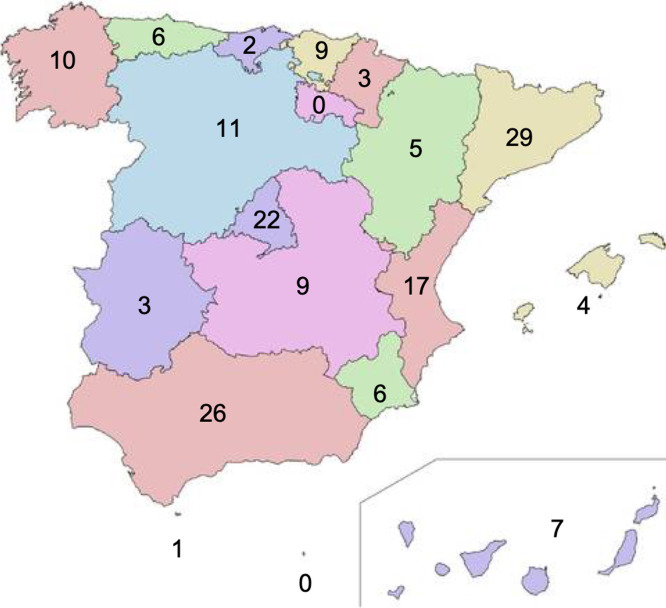
We received 337 responses from 170 centers. During the first month of the pandemic the incidence of acute appendicitis has decreased. Although conservative management has increased, surgical option has been the most used in both simple and complicated appendicitis. Despite the fact that the laparoscopic approach continues to be the most widely used in our services, the open approach has increased during this pandemic period.
Highlight the contribution of this study in terms of knowledge of the status of the treatment of acute appendicitis during this first month of the pandemic, being able to serve for a better possible organization in future waves of the pandemic and a reorganization of current protocols and management of acute appendicitis in a pandemic situation.
新冠疫情对西班牙医院产生了重大影响,医院不得不调配所有可用资源来治疗这些患者,从而降低了处理其他常见病症的能力。本研究旨在分析急性阑尾炎的治疗受到了怎样的影响。
西班牙外科医生协会(AEC)通过电子邮件,利用谷歌云端硬盘(Google Drive™)以在线自愿分发特定问卷的方式,对西班牙所有实际工作的附属外科医生(5203人)开展了一项全国性描述性研究,问卷于4月14日至4月24日开放。
我们收到了来自170个中心的337份回复。在疫情的第一个月,急性阑尾炎的发病率有所下降。尽管保守治疗有所增加,但手术仍是单纯性和复杂性阑尾炎最常用的治疗方式。尽管腹腔镜手术在我们的服务中仍然是使用最广泛的方法,但在这一疫情期间,开放手术的使用有所增加。
强调本研究在了解疫情第一个月急性阑尾炎治疗状况方面的贡献,可为未来疫情浪潮中更好地组织治疗以及在疫情情况下重新组织当前急性阑尾炎的治疗方案和管理提供参考。