
构建支持儿童超重和肥胖预防整体系统方法的逻辑框架:阿姆斯特丹健康体重方法。
Developing the logic framework underpinning a whole-systems approach to childhood overweight and obesity prevention: Amsterdam Healthy Weight Approach.
作者信息
Sawyer Alexia, den Hertog Karen, Verhoeff Arnoud P, Busch Vincent, Stronks Karien
机构信息
Department of Public and Occupational Health Academic Medical Centre Amsterdam University Medical Centres Amsterdam The Netherlands.
Amsterdam Healthy Weight Approach Public Health Service (GGD) Amsterdam The Netherlands.
出版信息
Obes Sci Pract. 2021 May 3;7(5):591-605. doi: 10.1002/osp4.505. eCollection 2021 Oct.
BACKGROUND
Whole-systems approaches (WSAs) are well placed to tackle the complex local environmental influences on overweight and obesity, yet there are few examples of WSAs in practice. is a long-term, municipality-led program to improve children's physical activity, diet, and sleep through action in the home, neighborhood, school, and city. Adopting a WSA, local political, physical, social, educational, and healthcare drivers of childhood obesity are viewed as a complex adaptive system. Since 2013, has reached >15,000 children. During this time, the estimated prevalence of 2-18-year-olds with overweight or obesity in Amsterdam has declined from 21% in 2012 to 18.7% in 2017. Declining trends are rarely observed in cities. There is a need to formally articulate program theory in order to: (i) inform future program evaluation which can interpret this decline within the context of and (ii) contribute a real-life example of a WSA to the literature.
METHODS
This study aimed to formally document the program theory of to permit future evaluation. A logic framework was developed through extensive document review and discussion, during program implementation.
RESULTS
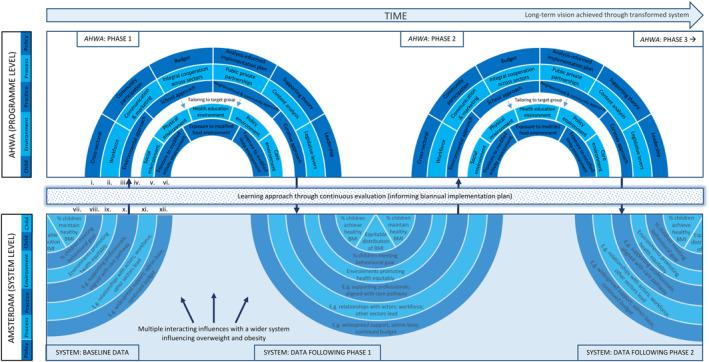
The working principles of the WSA underpinning were made explicit in an overarching theory of change, articulated in a logic framework. The framework was operationalized using an illustrative example of sugar intake.
CONCLUSIONS
The logic framework will inform development, monitoring, and evaluation and responds to a wider need to outline the working principles of WSAs in public health.
背景
全系统方法(WSAs)非常适合应对当地复杂的环境因素对超重和肥胖问题的影响,但在实践中全系统方法的实例却很少。[项目名称]是一项由市政府主导的长期项目,旨在通过在家庭、社区、学校和城市采取行动来改善儿童的身体活动、饮食和睡眠。采用全系统方法,儿童肥胖的当地政治、物理、社会、教育和医疗驱动因素被视为一个复杂的自适应系统。自2013年以来,[项目名称]已惠及超过15000名儿童。在此期间,阿姆斯特丹2至18岁超重或肥胖儿童的估计患病率从2012年的21%降至2017年的18.7%。在城市中很少观察到下降趋势。有必要正式阐明[项目名称]的项目理论,以便:(i)为未来的项目评估提供信息,从而在[项目名称]的背景下解释这种下降情况;(ii)为文献提供一个全系统方法的实际例子。
方法
本研究旨在正式记录[项目名称]的项目理论,以便进行未来评估。在项目实施过程中,通过广泛的文献回顾和讨论,制定了一个逻辑框架。
结果
支撑[项目名称]的全系统方法的工作原则在一个总体变革理论中得到明确阐述,并在一个逻辑框架中进行了表述。该框架通过一个糖摄入量的示例进行了操作化。
结论
该逻辑框架将为[项目名称]的发展、监测和评估提供信息,并回应了在公共卫生领域概述全系统方法工作原则的更广泛需求。


 Zotero 插件