Herrmann Leonie, Ebert Tim, Rosen Helena, Novak Bozidar, Philipsen Alexandra, Touma Chadi, Schreckenbach Monika, Gassen Nils C, Rein Theo, Schmidt Ulrike
German Center for Diabetes Research (DZD), Ingolstädter Landstr. 1, 85764, Neuherberg, Germany.
Max Planck Institute of Psychiatry, Kraepelinstrasse 2-10, 80804, München, Germany.
Neurobiol Stress. 2021 Sep 22;15:100401. doi: 10.1016/j.ynstr.2021.100401. eCollection 2021 Nov.
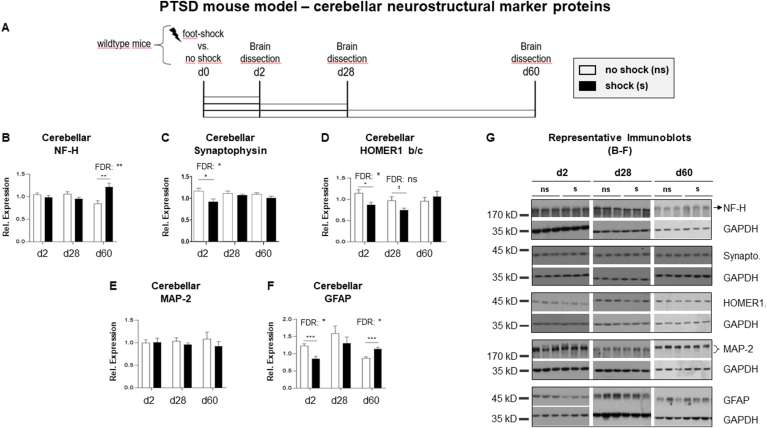
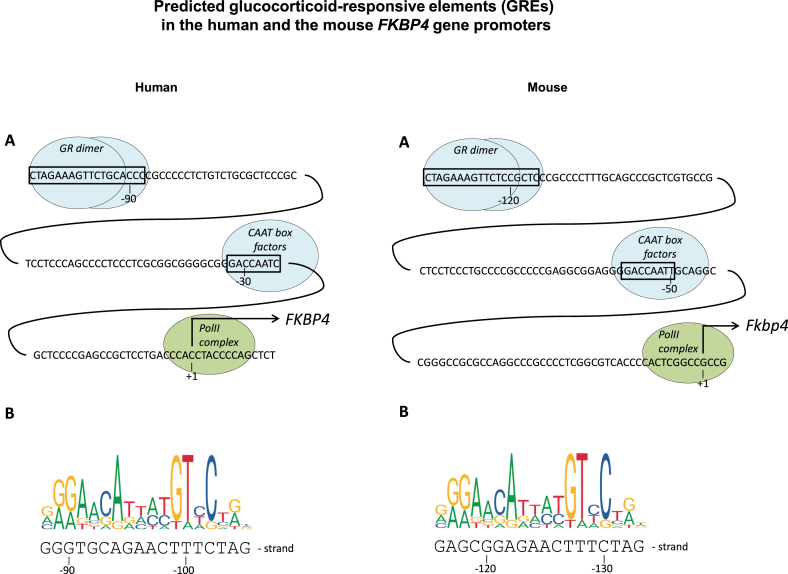
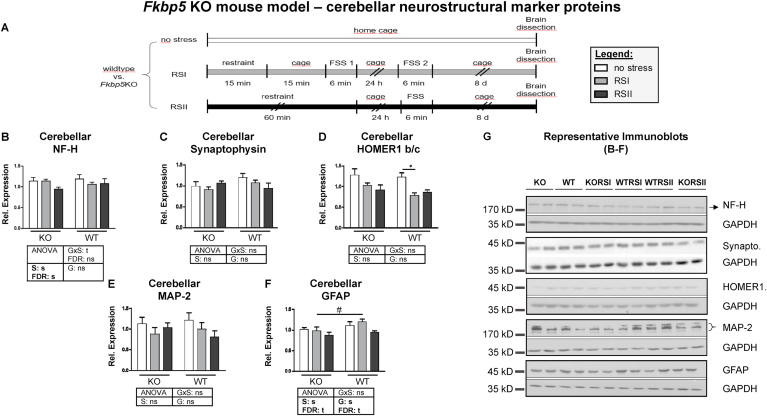
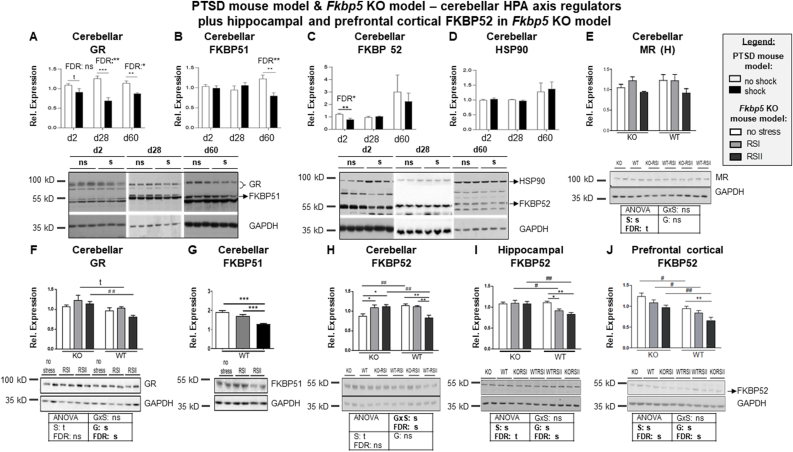
As the cerebellar molecular stress response is understudied, we assessed protein expression levels of hypothalamic-pituitary-adrenal (HPA) axis regulators and neurostructural markers in the cerebellum of a male PTSD mouse model and of unstressed vs. stressed male FK506 binding protein 51 () knockout (KO) vs. wildtype mice. We explored the translatability of our findings in the KO model to the situation in humans by correlating mRNA levels of candidates with those of in two whole transcriptome datasets of post-mortem human cerebellum and in blood of unstressed and stressed humans. deletion rescued the stress-induced loss in hippocampal, prefrontal cortical, and, possibly, also cerebellar FKBP52 expression and modulated post-stress cerebellar expression levels of the glucocorticoid receptor (GR) and possibly (trend) also of glial fibrillary acidic protein (GFAP). Accordingly, expression levels of genes encoding for these three genes correlated with those of in human post-mortem cerebellum, while other neurostructural markers were not related to either in mouse or human cerebellum. Also, gene expression levels of the two immunophilins correlated inversely in the blood of unstressed and stressed humans. We found transient changes in FKBP52 and persistent changes in GR and GFAP in the cerebellum of PTSD-like mice. Altogether, upon elucidating the cerebellar stress response we found first evidence for a novel facet of HPA axis regulation, i.e., the ability of FKBP51 to modulate the expression of its antagonist FKBP52 in the mouse and, speculatively, also in the human brain and blood and, moreover, detected long-term single stress-induced changes in expression of cerebellar HPA axis regulators and neurostructural markers of which some might contribute to the role of the cerebellum in fear extinction.
由于小脑分子应激反应尚未得到充分研究,我们评估了雄性创伤后应激障碍(PTSD)小鼠模型以及未应激与应激的雄性FK506结合蛋白51(FKBP51)基因敲除(KO)小鼠与野生型小鼠小脑中下丘脑-垂体-肾上腺(HPA)轴调节因子和神经结构标志物的蛋白表达水平。我们通过将候选基因的mRNA水平与死后人类小脑以及未应激和应激人类血液的两个全转录组数据集中的FKBP51 mRNA水平相关联,探讨了我们在FKBP51 KO模型中的发现对人类情况的可转化性。FKBP51基因缺失挽救了应激诱导的海马体、前额叶皮质以及可能还有小脑中FKBP52表达的损失,并调节了应激后小脑糖皮质激素受体(GR)的表达水平,可能还有胶质纤维酸性蛋白(GFAP)(呈趋势性)的表达水平。相应地,编码这三个基因的基因表达水平与人类死后小脑中FKBP51的表达水平相关,而其他神经结构标志物在小鼠或人类小脑中与FKBP51均无关联。此外,在未应激和应激人类的血液中,这两种亲免蛋白的基因表达水平呈负相关。我们在类PTSD小鼠的小脑中发现了FKBP52的短暂变化以及GR和GFAP的持续变化。总之,在阐明小脑应激反应时,我们首次发现了HPA轴调节的一个新方面的证据,即FKBP51能够在小鼠中调节其拮抗剂FKBP52的表达,推测在人类大脑和血液中也如此,而且还检测到了长期单一应激诱导的小脑HPA轴调节因子和神经结构标志物表达的变化,其中一些可能有助于小脑在恐惧消退中的作用。