J Emerg Nurs. 2021 Nov;47(6):879-891. doi: 10.1016/j.jen.2021.08.007. Epub 2021 Sep 3.
This study aimed to assess (1) the prevalence of burnout risk among nurses working in intensive care units and emergency department before and during the coronavirus disease 2019 pandemic and (2) the individual and work-related associated factors.
Data were collected as part of a cross-sectional study on intensive care unit and emergency nurses in Belgium using 2 self-administered online questionnaires distributed just before the pandemic (January 2020, N = 422) and during the first peak of the pandemic (April 2020, N = 1616). Burnout was assessed with the Maslach Burnout Inventory scale.
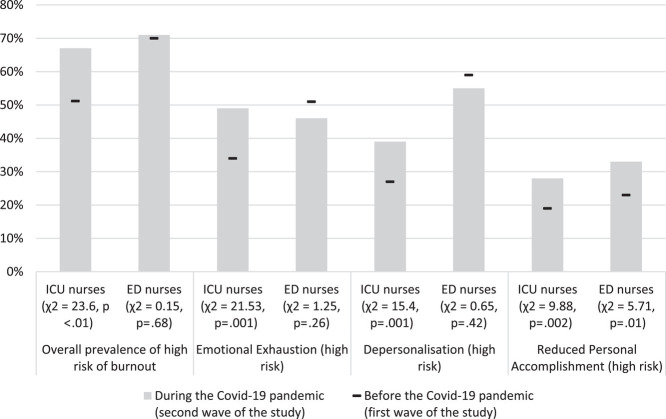
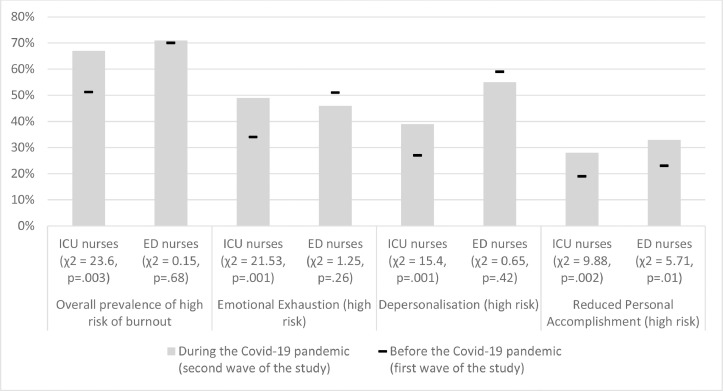
The overall prevalence of burnout risk was higher among emergency nurses than intensive care unit nurses but was not significantly different after the coronavirus disease 2019 pandemic (from 69.8% to 70.7%, χ = 0.15, P = .68), whereas it increased significantly among intensive care unit nurses (from 51.2% to 66.7%, χ = 23.64, P < .003). During the pandemic, changes in workload and the lack of personal protective equipment were significantly associated with a higher likelihood of burnout risk, whereas social support from colleagues and from superiors and management were associated with a lower likelihood of burnout risk. Several determinants of burnout risk were different between intensive care unit and emergency nurses.
Our findings indicate that nurses in intensive care unit and emergency department were at risk of burnout but their experience during the coronavirus disease 2019 pandemic was quite different. Therefore, it is important to implement specific measures for these 2 groups of nurses to prevent and manage their risk of burnout.
本研究旨在评估(1)在新冠肺炎大流行之前和期间,在重症监护病房和急诊科工作的护士的倦怠风险的患病率,以及(2)个体和与工作相关的相关因素。
数据是作为比利时重症监护室和急诊护士的横断面研究的一部分收集的,使用了 2 份在大流行之前(2020 年 1 月,N=422)和大流行期间的第一个高峰期间(2020 年 4 月,N=1616)分发的自我管理在线问卷。使用 Maslach 倦怠量表评估倦怠。
与重症监护室护士相比,急诊护士的倦怠风险总体患病率更高,但在新冠肺炎大流行后没有显著差异(从 69.8%到 70.7%,χ²=0.15,P=0.68),而重症监护室护士的倦怠风险显著增加(从 51.2%到 66.7%,χ²=23.64,P<.003)。在大流行期间,工作量的变化和缺乏个人防护设备与倦怠风险增加显著相关,而同事和上级的社会支持与倦怠风险降低相关。倦怠风险的几个决定因素在重症监护室和急诊护士之间存在差异。
我们的研究结果表明,重症监护病房和急诊部的护士存在倦怠风险,但他们在新冠肺炎大流行期间的经历却大不相同。因此,为这两组护士实施特定的预防和管理倦怠风险的措施非常重要。