Department of Biological and Medical Psychology, University of Bergen, Bergen, Norway.
Mohn Medical and Imaging Visualization Centre, Haukeland University Hospital, Bergen, Norway.
Brain Connect. 2022 Aug;12(6):515-523. doi: 10.1089/brain.2021.0129. Epub 2021 Nov 29.
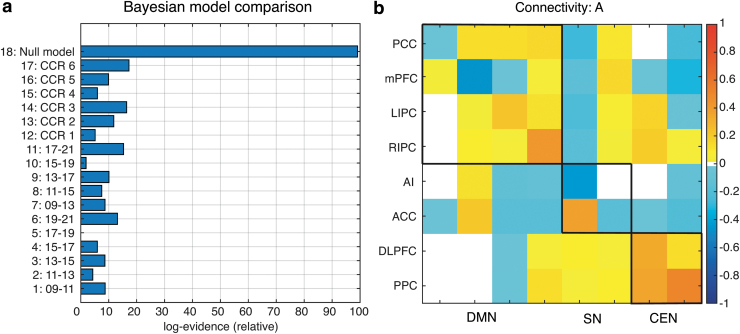
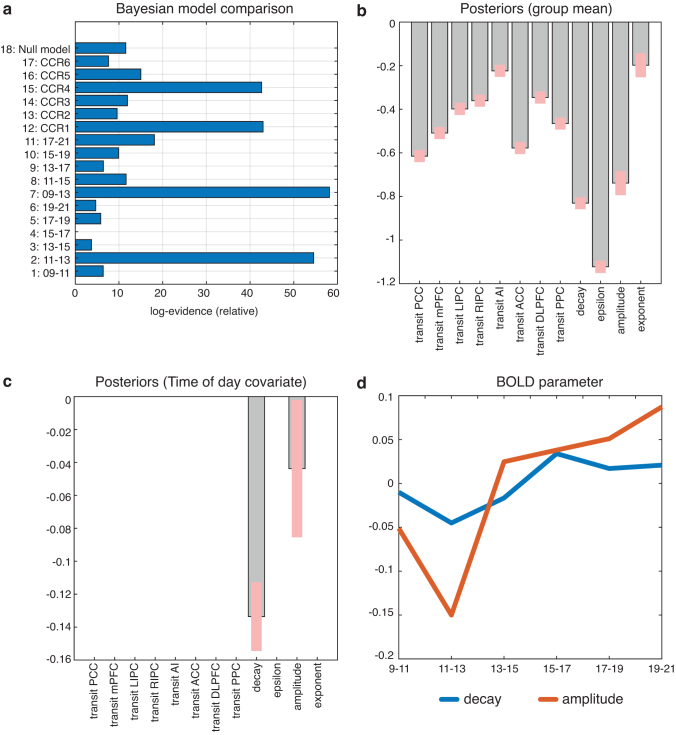
In the light of the ongoing replication crisis in the field of neuroimaging, it is necessary to assess the possible exogenous and endogenous factors that may affect functional magnetic resonance imaging (fMRI). The current project investigated time-of-day effects in the spontaneous fluctuations (<0.1 Hz) of the blood oxygenation level dependent (BOLD) signal. Using data from the human connectome project release S1200, cross-spectral density dynamic causal modeling (DCM) was used to analyze time-dependent effects on the hemodynamic response and effective connectivity parameters. The DCM analysis covered three networks, namely the default mode network, the central executive network, and the saliency network. Hierarchical group-parametric empirical Bayes (PEB) was used to test varying design-matrices against the time-of-day model. Hierarchical group-PEB found no support for changes in effective connectivity, whereas the hemodynamic parameters exhibited a significant time-of-day dependent effect, indicating a diurnal vascular effect that might affect the measured BOLD signal in the absence of any diurnal variations of the underlying neuronal activations and effective connectivity. We conclude that these findings urge the need to account for the time of data acquisition in future MRI studies and suggest that time-of-day dependent metabolic variations contribute to reduced reliability in resting-state fMRI studies.
鉴于神经影像学领域持续存在的复制危机,有必要评估可能影响功能磁共振成像(fMRI)的外源性和内源性因素。本项目研究了自发波动(<0.1 Hz)的血氧水平依赖(BOLD)信号的时间效应。使用人类连接组计划 S1200 发布的数据,通过交叉谱密度动态因果建模(DCM)分析了对血液动力学响应和有效连接参数的时间依赖性影响。DCM 分析涵盖了三个网络,即默认模式网络、中央执行网络和突显网络。分层组参数经验贝叶斯(PEB)用于针对时间模型测试不同的设计矩阵。分层组-PEB 没有发现有效连接变化的支持,而血液动力学参数表现出显著的时间依赖效应,表明在没有潜在神经元激活和有效连接的昼夜变化的情况下,可能会影响测量的 BOLD 信号的昼夜血管效应。我们的结论是,这些发现促使人们有必要在未来的 MRI 研究中考虑数据采集时间,并表明时间依赖的代谢变化导致静息状态 fMRI 研究的可靠性降低。