McGill University, Montreal, Quebec, Canada.
St. Mary's Research Centre, Montreal, Quebec, Canada.
Qual Health Res. 2021 Nov;31(13):2426-2439. doi: 10.1177/10497323211040769. Epub 2021 Oct 12.
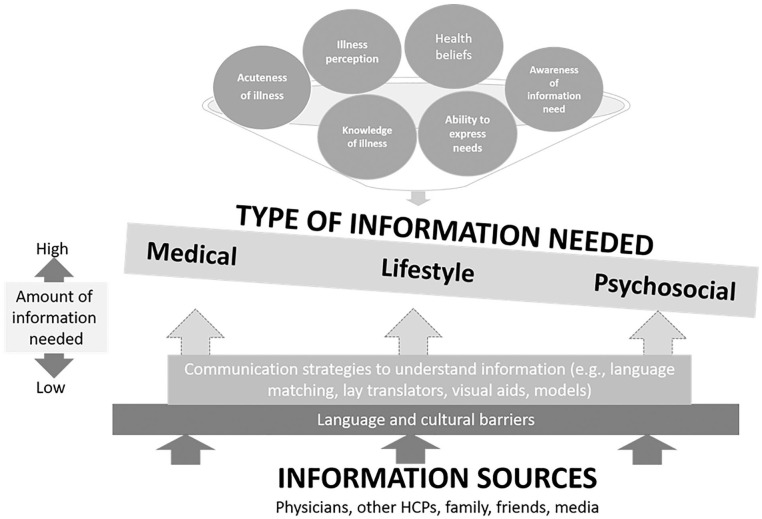
In Canada, people from culturally and linguistically diverse (CALD) backgrounds are at a greater risk of developing a chronic illness, and are more likely to experience adverse health effects and challenges in accessing high-quality care compared with Canadian-born individuals. This, in part, has been attributed to having inadequate access to information and resources needed to manage their illness(es). A qualitative descriptive design and inductive content analysis were used to explore the information needs of 24 CALD patients with chronic illnesses. Participants identified medical, lifestyle, and psychosocial information needs. How much information was needed depended on such antecedents as illness trajectory, severity, and perception. Most information needs remained unmet. A number of communication strategies were identified to bridge language barriers that go beyond translation and are based on effective health education strategies. Findings can help health care professionals better identify CALD patients' information needs and provide strategies that go beyond translation.
在加拿大,文化和语言背景多样化(CALD)的人群患慢性病的风险更高,与加拿大出生的人相比,他们更有可能经历不良的健康影响和在获得高质量医疗保健方面的挑战。部分原因是他们无法获得管理疾病所需的足够信息和资源。本研究采用定性描述设计和归纳内容分析法,探索了 24 名患有慢性病的文化和语言背景多样化患者的信息需求。参与者确定了医疗、生活方式和心理社会信息需求。需要多少信息取决于疾病轨迹、严重程度和认知等因素。大多数信息需求仍未得到满足。确定了许多沟通策略来弥合语言障碍,这些策略不仅限于翻译,而且还基于有效的健康教育策略。研究结果可以帮助医疗保健专业人员更好地识别文化和语言背景多样化患者的信息需求,并提供超越翻译的策略。