Hallie Ford Center for Healthy Children and Families, College of Public Health and Human Sciences, Oregon State University, Corvallis, OR, United States.
StatCon Consulting, Hayward, CA, United States.
J Med Internet Res. 2021 Oct 12;23(10):e27723. doi: 10.2196/27723.
Internet access is increasingly critical for adolescents with regard to obtaining health information and resources, participating in web-based health promotion, and communicating with health practitioners. However, past work demonstrates that access is not uniform among youth in the United States, with lower access found among groups with higher health-related needs. Population-level data yield important insights about access and internet use in the United States.
The aim of this study is to examine internet access and mode of access by social class and race and ethnicity among youth (aged 14-17 years) in the United States.
Using the Current Population Survey, we examined internet access, cell phone or smartphone access, and modes of connecting to the internet for adolescents in 2015 (unweighted N=6950; expanded weights N=17,103,547) and 2017 (unweighted N=6761; expanded weights N=17,379,728).
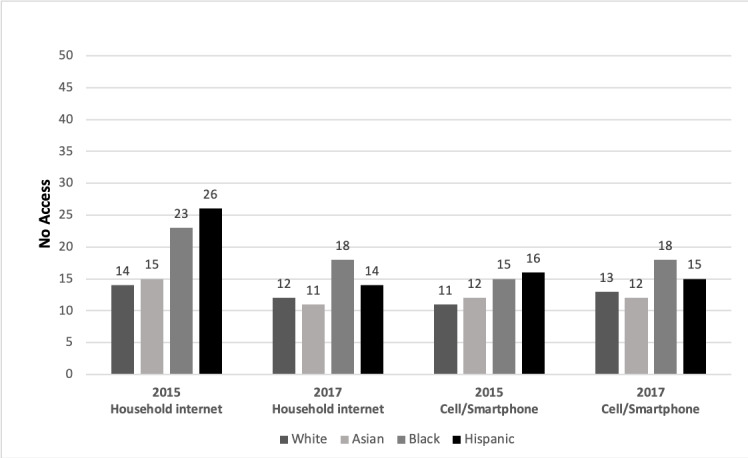
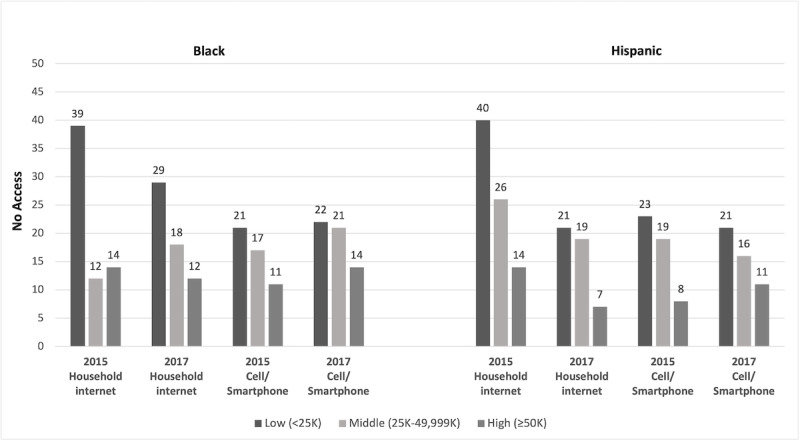
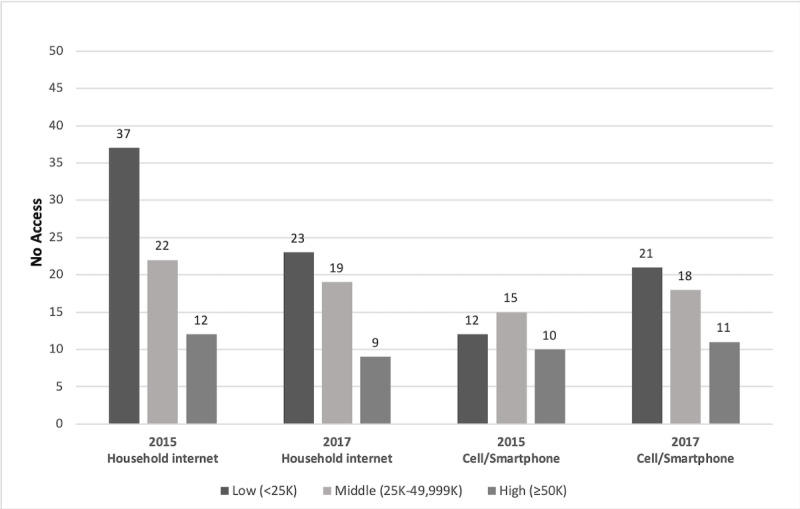
Internet access increased from 2015 to 2017, but socioeconomic status (SES) and racial and ethnic disparities remained. In 2017, the greatest disparities were found for youth in low-income households (no home access=23%) and for Black youth (no home access=18%) and Hispanic youth (no home access=14%). Low-income Black and Hispanic youth were the most likely to lack home internet access (no home access, low SES Black youth=29%; low SES Hispanic youth=21%). The mode of access (eg, from home and smartphone) and smartphone-only analyses also revealed disparities.
Without internet access, web-based dissemination of information, health promotion, and health care will not reach a significant segment of youth. Currently, SES and racial and ethnic disparities in access prolong health inequalities. Moreover, the economic impact of COVID-19 on Black, Hispanic, and low-income communities may lead to losses in internet access for youth that will further exacerbate disparities.
对于青少年来说,互联网接入对于获取健康信息和资源、参与基于网络的健康促进以及与健康从业者进行沟通变得越来越重要。然而,过去的研究表明,美国青少年的互联网接入并不统一,健康相关需求较高的群体接入率较低。人口水平的数据为美国的互联网接入和使用情况提供了重要的见解。
本研究旨在考察美国青少年(14-17 岁)的社会阶层、种族和民族与互联网接入和接入方式的关系。
我们使用当前人口调查数据,研究了 2015 年(未加权 N=6950;扩展权重 N=17103547)和 2017 年(未加权 N=6761;扩展权重 N=17379728)青少年的互联网接入、手机或智能手机接入以及上网方式。
互联网接入在 2015 年至 2017 年间有所增加,但社会经济地位(SES)和种族和族裔差异仍然存在。2017 年,低收入家庭的青少年(无家庭接入比例为 23%)和黑人和西班牙裔青少年(无家庭接入比例分别为 18%和 14%)差异最大。低收入的黑人和西班牙裔青少年最有可能没有家庭互联网接入(无家庭互联网接入,低收入黑人群体比例为 29%;低收入西班牙裔群体比例为 21%)。接入方式(如来自家庭和智能手机)和仅智能手机分析也揭示了差异。
如果没有互联网接入,基于网络的信息传播、健康促进和医疗保健将无法覆盖相当一部分青少年。目前,接入方面的社会经济地位和种族差异延长了健康不平等。此外,COVID-19 对黑人和西班牙裔以及低收入社区的经济影响可能导致青少年互联网接入的损失,这将进一步加剧差异。