School of Public Policy and Administration, Xi'an Jiaotong University, 28 Xianning West Road, Beilin District, Xi'an, 710049, China.
International Centre for Reproductive Health (ICRH), Department of Public Health and Primary Care, Faculty of Medicine and Health Sciences, Ghent University, C. Heymanslaan 10 UZ, 9000, Ghent, Belgium.
BMC Womens Health. 2021 Mar 20;21(1):116. doi: 10.1186/s12905-021-01260-1.
Women's cancers, represented by breast and gynecologic cancers, are emerging as a significant threat to women's health, while previous studies paid little attention to the spatial distribution of women's cancers. This study aims to conduct a spatio-temporal epidemiology analysis on breast, cervical and ovarian cancers in China, thus visualizing and comparing their epidemiologic trends and spatio-temporal changing patterns.
Data on the incidence and mortality of women's cancers between January 2010 and December 2015 were obtained from the National Cancer Registry Annual Report. Linear tests and bar charts were used to visualize and compare the epidemiologic trends. Two complementary spatial statistics (Moran's I statistics and Kulldorff's space-time scan statistics) were adopted to identify the spatial-temporal clusters.
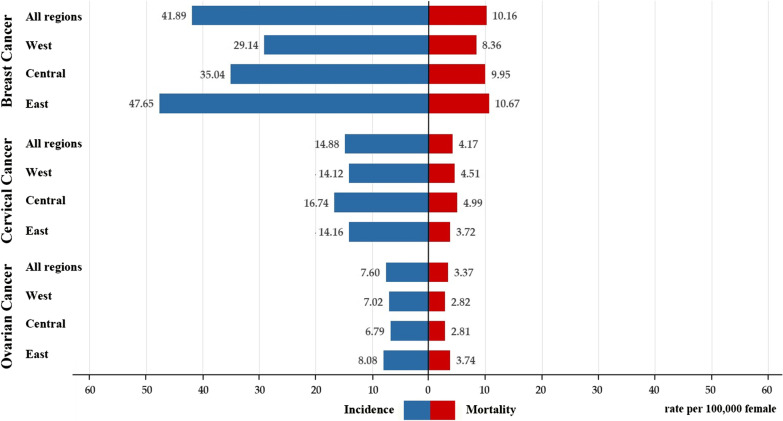
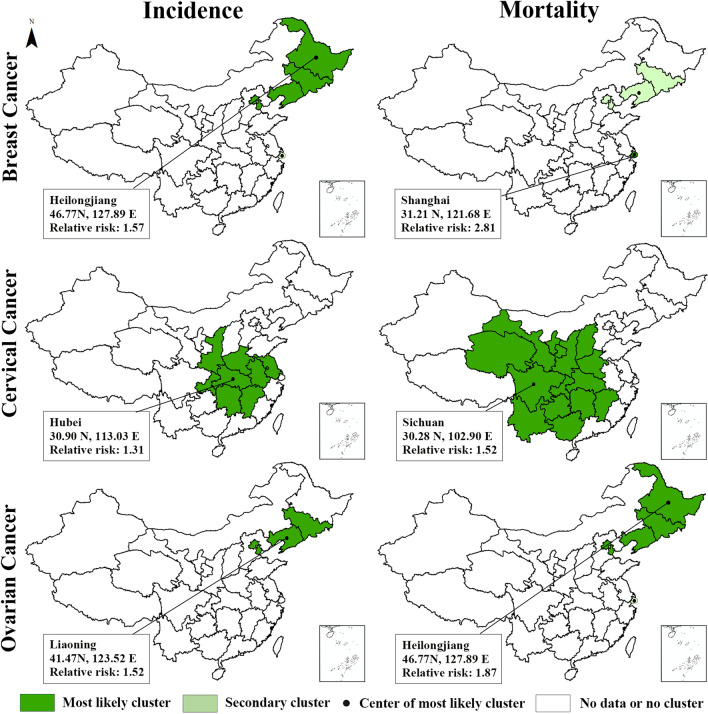
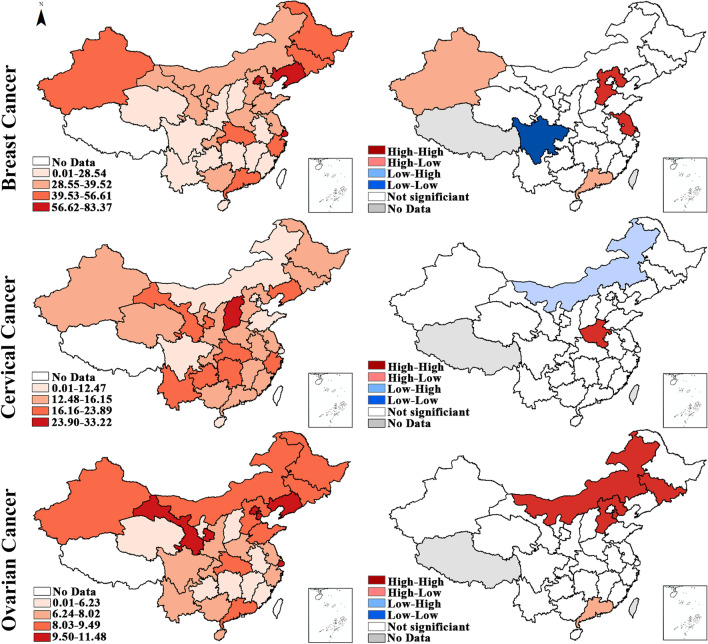
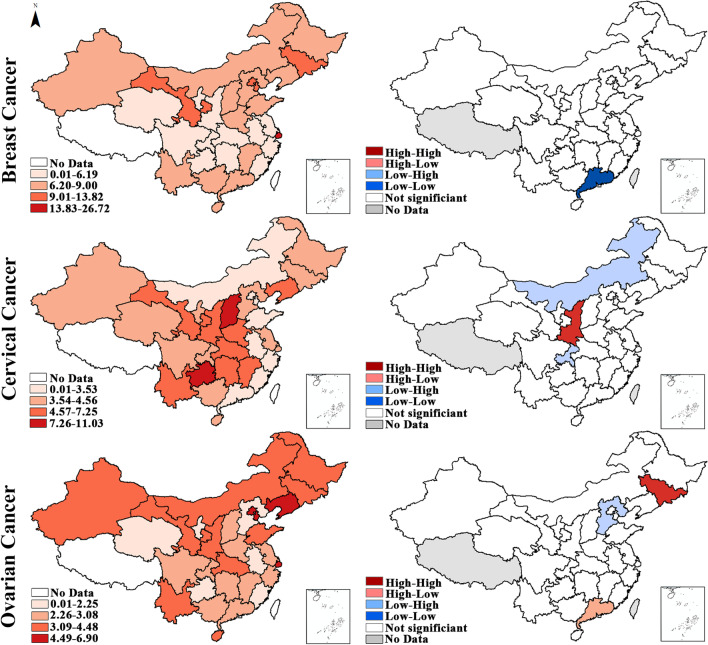
The results showed that the incidence and mortality of breast cancer displayed slow upward trends, while that of cervical cancer increase dramatically, and the mortality of ovarian cancer also showed a fast increasing trend. Significant differences were detected in incidence and mortality of breast, cervical and ovarian cancer across east, central and west China. The average incidence of breast cancer displayed a high-high cluster feature in part of north and east China, and the opposite traits occurred in southwest China. In the meantime, the average incidence and mortality of cervical cancer in central China revealed a high-high cluster feature, and that of ovarian cancer in northern China displayed a high-high cluster feature. Besides, the anomalous clusters were also detected based on the space-time scan statistics.
Regional differences were detected in the distribution of women's cancers in China. An effective response requires a package of coordinated actions that vary across localities regarding the spatio-temporal epidemics and local conditions.
以乳腺癌和妇科癌症为代表的女性癌症已成为女性健康的重大威胁,而以往的研究对女性癌症的空间分布关注甚少。本研究旨在对中国乳腺癌、宫颈癌和卵巢癌进行时空流行病学分析,从而可视化和比较其流行趋势和时空变化模式。
从国家癌症登记年度报告中获取 2010 年 1 月至 2015 年 12 月期间女性癌症的发病率和死亡率数据。采用线性检验和条形图可视化和比较流行趋势。采用两种互补的空间统计方法(Moran's I 统计量和 Kulldorff 的时空扫描统计量)来识别时空聚类。
结果表明,乳腺癌的发病率和死亡率呈缓慢上升趋势,宫颈癌的发病率急剧上升,卵巢癌的死亡率也呈快速上升趋势。中国东部、中部和西部地区乳腺癌、宫颈癌和卵巢癌的发病率和死亡率存在显著差异。乳腺癌的平均发病率在部分中国北部和东部地区呈现高-高聚类特征,而在西南部地区则呈现相反的特征。同时,中国中部地区宫颈癌的平均发病率和死亡率呈现高-高聚类特征,而中国北部地区卵巢癌的平均发病率和死亡率呈现高-高聚类特征。此外,时空扫描统计量还检测到异常聚类。
中国女性癌症的分布存在区域差异。有效的应对措施需要根据时空流行情况和当地情况,在不同地区采取一揽子协调行动。