Department of Electronics and Communication Engineering, National Institute of Technology, Rourkela 769008, India.
Department of Electronics and Communication Engineering, Aditya Institute of Technology and Management (A), Tekkali 532201, India.
Sensors (Basel). 2021 Oct 7;21(19):6652. doi: 10.3390/s21196652.
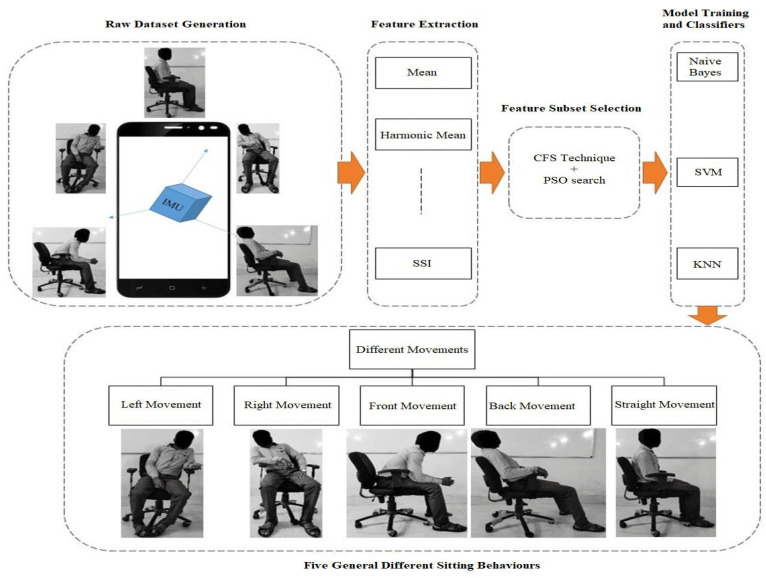
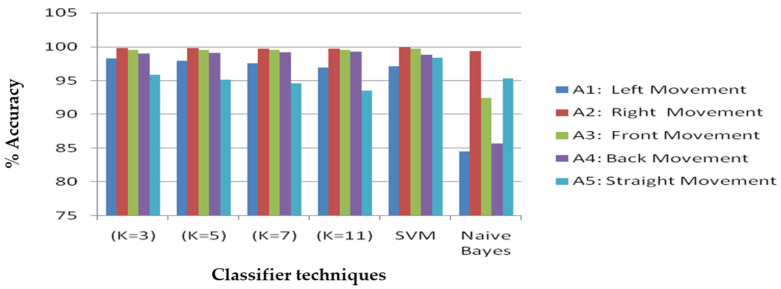
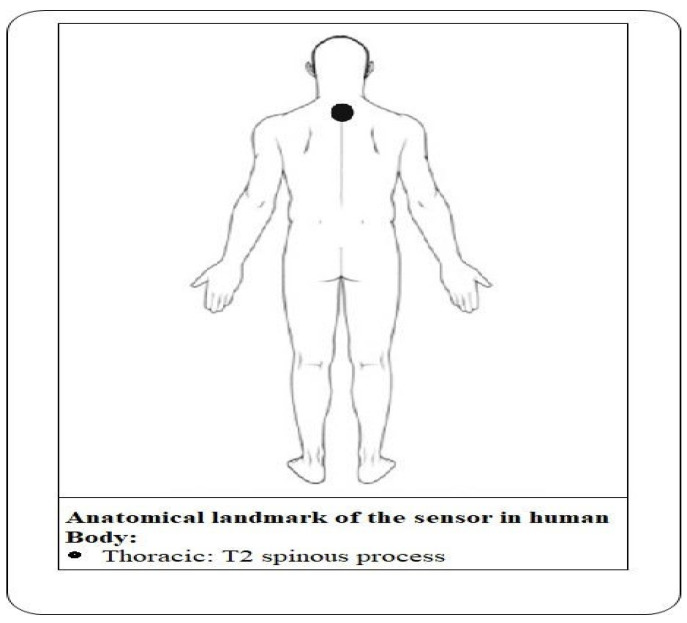
At present, people spend most of their time in passive rather than active mode. Sitting with computers for a long time may lead to unhealthy conditions like shoulder pain, numbness, headache, etc. To overcome this problem, human posture should be changed for particular intervals of time. This paper deals with using an inertial sensor built in the smartphone and can be used to overcome the unhealthy human sitting behaviors (HSBs) of the office worker. To monitor, six volunteers are considered within the age band of 26 ± 3 years, out of which four were male and two were female. Here, the inertial sensor is attached to the rear upper trunk of the body, and a dataset is generated for five different activities performed by the subjects while sitting in the chair in the office. Correlation-based feature selection (CFS) technique and particle swarm optimization (PSO) methods are jointly used to select feature vectors. The optimized features are fed to machine learning supervised classifiers such as naive Bayes, SVM, and KNN for recognition. Finally, the SVM classifier achieved 99.90% overall accuracy for different human sitting behaviors using an accelerometer, gyroscope, and magnetometer sensors.
目前,人们大部分时间都处于被动状态,而不是主动状态。长时间坐在电脑前可能会导致肩部疼痛、麻木、头痛等不健康的状况。为了解决这个问题,应该每隔一段时间改变一下人体的姿势。本文介绍了一种使用智能手机内置惯性传感器的方法,可以用来克服上班族不健康的坐姿行为。在这项研究中,考虑了 6 名年龄在 26±3 岁之间的志愿者,其中 4 名为男性,2 名为女性。在这里,惯性传感器被安装在身体的后上躯干上,为受试者在办公室的椅子上进行的 5 种不同活动生成了一个数据集。联合使用基于相关性的特征选择(CFS)技术和粒子群优化(PSO)方法来选择特征向量。然后将优化后的特征输入到机器学习监督分类器中,如朴素贝叶斯、SVM 和 KNN 进行识别。最后,使用加速度计、陀螺仪和磁力计传感器,SVM 分类器实现了 99.90%的总体识别准确率。