Program in Neurosciences, University of California, San Diego, La Jolla, CA, 92093, USA.
Department of Cognitive Science, University of California, San Diego, La Jolla, CA, 92093, USA.
Sci Rep. 2021 Oct 13;11(1):20374. doi: 10.1038/s41598-021-98864-2.
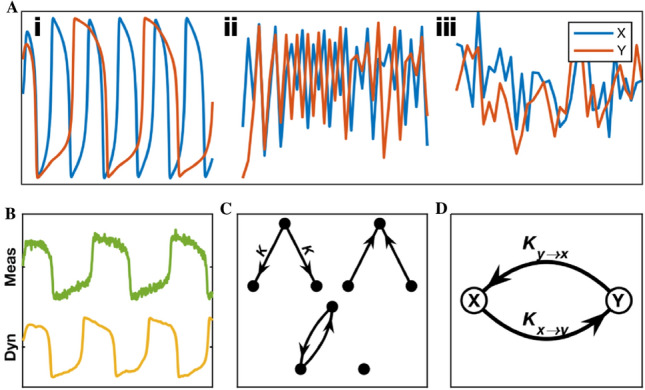
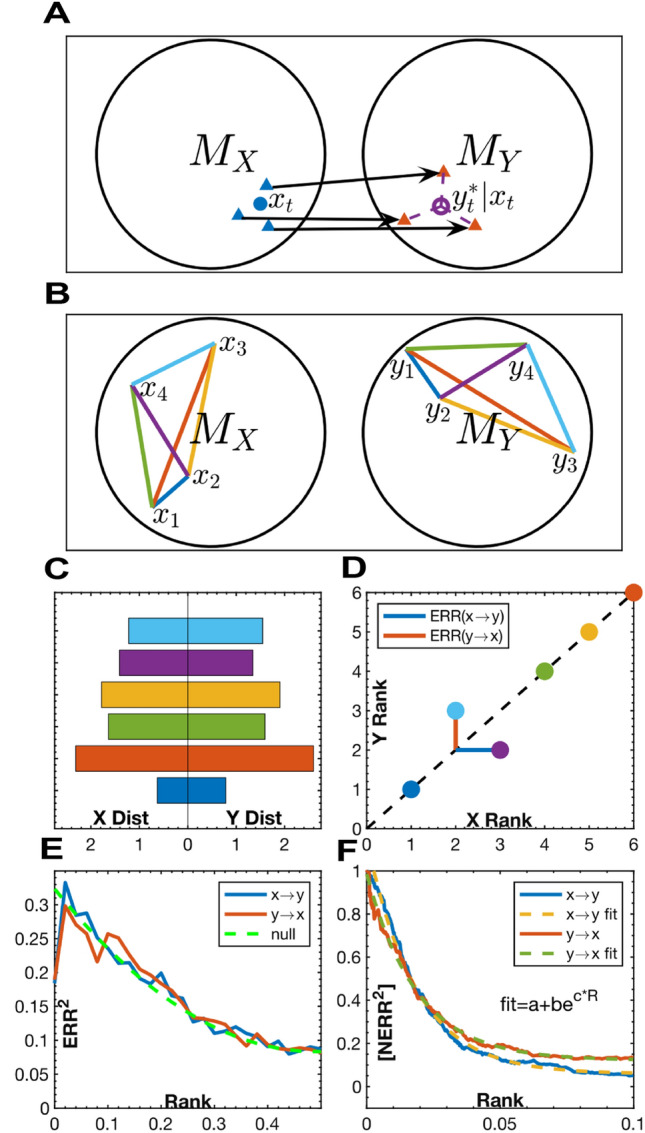
Natural systems exhibit diverse behavior generated by complex interactions between their constituent parts. To characterize these interactions, we introduce Convergent Cross Sorting (CCS), a novel algorithm based on convergent cross mapping (CCM) for estimating dynamic coupling from time series data. CCS extends CCM by using the relative ranking of distances within state-space reconstructions to improve the prior methods' performance at identifying the existence, relative strength, and directionality of coupling across a wide range of signal and noise characteristics. In particular, relative to CCM, CCS has a large performance advantage when analyzing very short time series data and data from continuous dynamical systems with synchronous behavior. This advantage allows CCS to better uncover the temporal and directional relationships within systems that undergo frequent and short-lived switches in dynamics, such as neural systems. In this paper, we validate CCS on simulated data and demonstrate its applicability to electrophysiological recordings from interacting brain regions.
自然系统表现出多样化的行为,这些行为是由其组成部分之间复杂的相互作用产生的。为了描述这些相互作用,我们引入了趋同交叉排序(CCS),这是一种基于趋同交叉映射(CCM)的新算法,用于从时间序列数据中估计动态耦合。CCS 通过使用状态空间重建中距离的相对排序来扩展 CCM,从而提高了先前方法在识别存在、相对强度和方向性方面的性能,这些方法适用于广泛的信号和噪声特征。特别是,与 CCM 相比,CCS 在分析非常短的时间序列数据和具有同步行为的连续动力系统的数据时具有很大的性能优势。这种优势使得 CCS 能够更好地揭示系统内部的时间和方向关系,这些系统经历频繁和短暂的动力学变化,例如神经系统。在本文中,我们在模拟数据上验证了 CCS,并展示了它在相互作用的脑区的电生理记录中的应用。