Chen Xiao-Yue, Chen Yi-Ying, Lin Willie, Chen Chien-Han, Wen Yu-Chieh, Hsiao Ta-Chih, Chou Hsiu-Chu, Chung Kian Fan, Chuang Hsiao-Chi
Graduate Institute of Medical Sciences, College of Medicine, Taipei Medical University, Taipei, Taiwan.
School of Respiratory Therapy, College of Medicine, Taipei Medical University, Taipei, Taiwan.
Front Med (Lausanne). 2021 Sep 27;8:713824. doi: 10.3389/fmed.2021.713824. eCollection 2021.
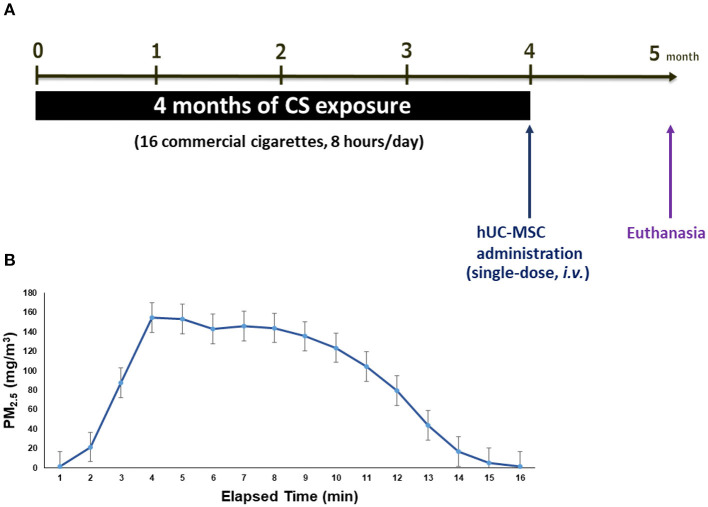
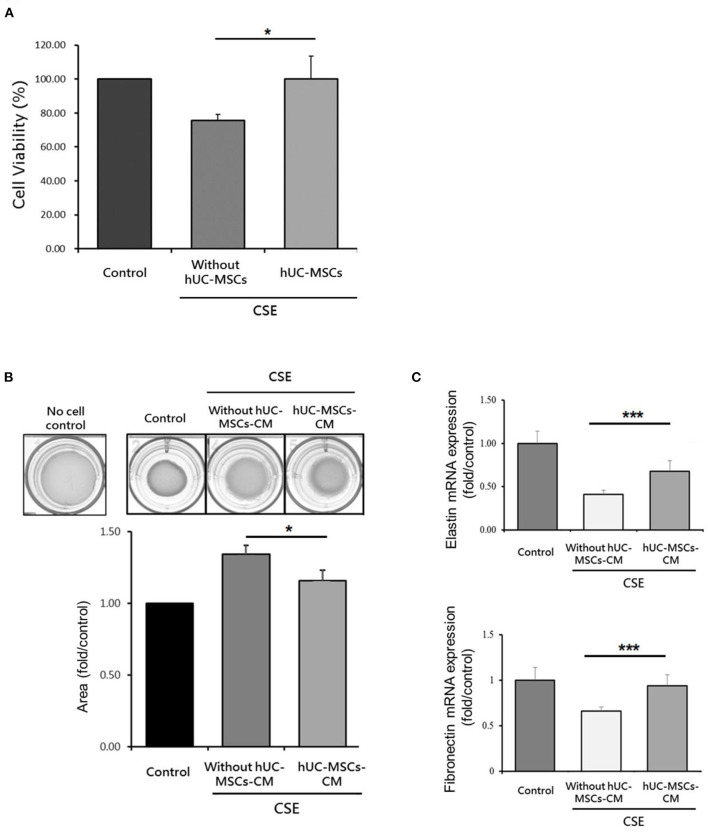
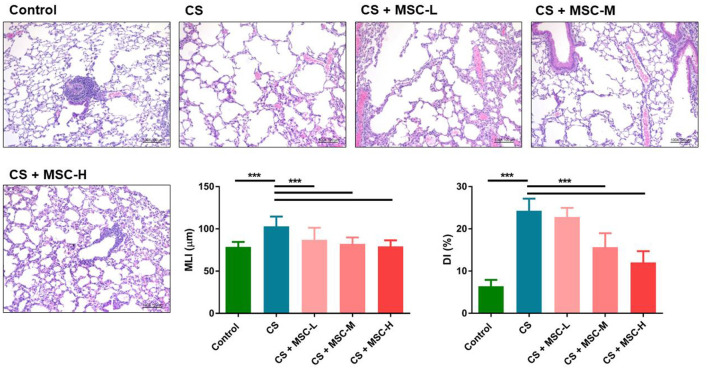
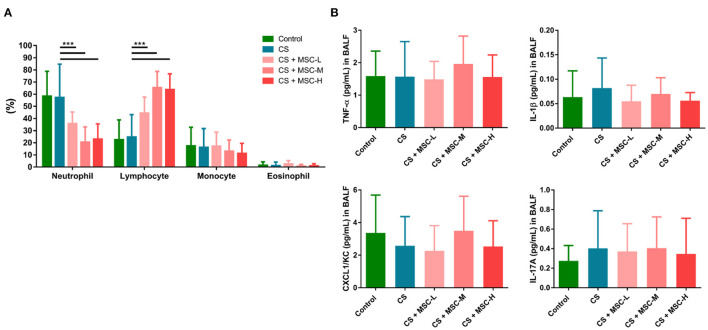
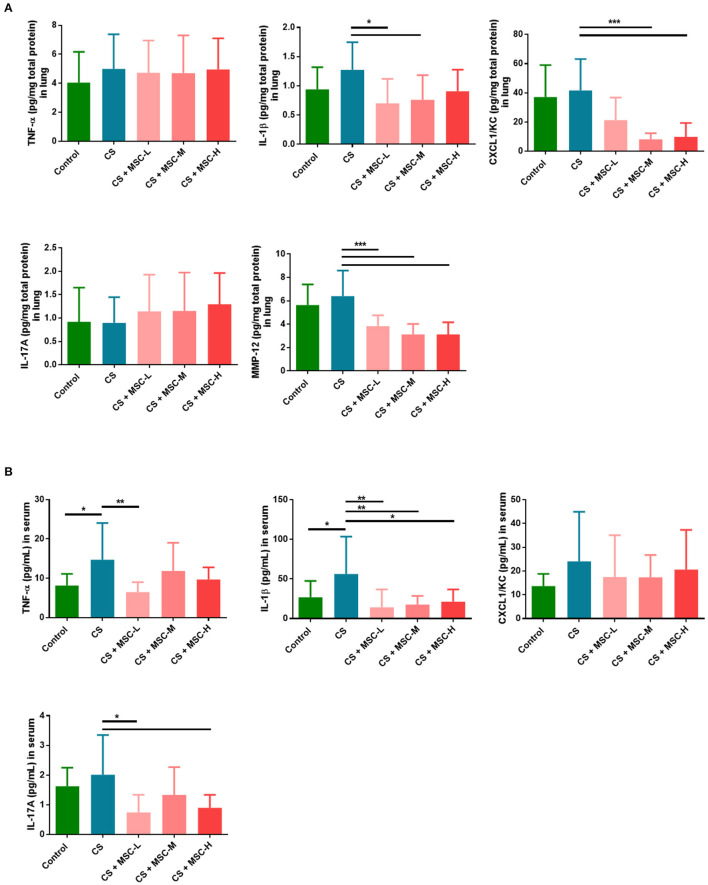
Human umbilical cord-derived mesenchymal stem cells (hUC-MSCs) were shown to have potential for immunoregulation and tissue repair. The objective of this study was to investigate the effects of hUC-MSCs on emphysema in chronic obstructive pulmonary disease (COPD). The C57BL/6JNarl mice were exposed to cigarette smoke (CS) for 4 months followed by administration of hUC-MSCs at 3 × 10 (low dose), 1 × 10 (medium dose), and 3 × 10 cells/kg body weight (high dose). The hUC-MSCs caused significant decreases in emphysema severity by measuring the mean linear intercept (MLI) and destructive index (DI). A decrease in neutrophils (%) and an increase in lymphocytes (%) in bronchoalveolar lavage fluid (BALF) were observed in emphysematous mice after hUC-MSC treatment. Lung levels of interleukin (IL)-1β, C-X-C motif chemokine ligand 1 (CXCL1)/keratinocyte chemoattractant (KC), and matrix metalloproteinase (MMP)-12 significantly decreased after hUC-MSC administration. Significant reductions in tumor necrosis factor (TNF)-α, IL-1β, and IL-17A in serum occurred after hUC-MSC administration. Notably, the cell viability of lung fibroblasts improved with hUC-MSCs after being treated with CS extract (CSE). Furthermore, the hUC-MSCs-conditioned medium (hUC-MSCs-CM) restored the contractile force, and increased messenger RNA expressions of elastin and fibronectin by lung fibroblasts. In conclusion, hUC-MSCs reduced inflammatory responses and emphysema severity in CS-induced emphysematous mice.
人脐带间充质干细胞(hUC-MSCs)已被证明具有免疫调节和组织修复的潜力。本研究的目的是探讨hUC-MSCs对慢性阻塞性肺疾病(COPD)肺气肿的影响。将C57BL/6JNarl小鼠暴露于香烟烟雾(CS)中4个月,随后分别以3×10(低剂量)、1×10(中剂量)和3×10个细胞/千克体重(高剂量)给予hUC-MSCs。通过测量平均线性截距(MLI)和破坏指数(DI),hUC-MSCs显著降低了肺气肿严重程度。hUC-MSC治疗后,在肺气肿小鼠的支气管肺泡灌洗液(BALF)中观察到中性粒细胞(%)减少,淋巴细胞(%)增加。给予hUC-MSCs后,肺组织中白细胞介素(IL)-1β、C-X-C基序趋化因子配体1(CXCL1)/角质形成细胞趋化因子(KC)和基质金属蛋白酶(MMP)-12的水平显著降低。给予hUC-MSCs后,血清中肿瘤坏死因子(TNF)-α、IL-1β和IL-17A显著降低。值得注意的是,用香烟烟雾提取物(CSE)处理后,hUC-MSCs提高了肺成纤维细胞的细胞活力。此外,hUC-MSCs条件培养基(hUC-MSCs-CM)恢复了收缩力,并增加了肺成纤维细胞中弹性蛋白和纤连蛋白的信使核糖核酸表达。总之,hUC-MSCs降低了CS诱导的肺气肿小鼠的炎症反应和肺气肿严重程度。