Maacha Selma, Sidahmed Heba, Jacob Shana, Gentilcore Giusy, Calzone Rita, Grivel Jean-Charles, Cugno Chiara
Deep Phenotyping Core, Sidra Medicine, Doha 26999, Qatar.
Advanced Cell Therapy Core, Sidra Medicine, Doha 26999, Qatar.
Stem Cells Int. 2020 Mar 9;2020:4356359. doi: 10.1155/2020/4356359. eCollection 2020.
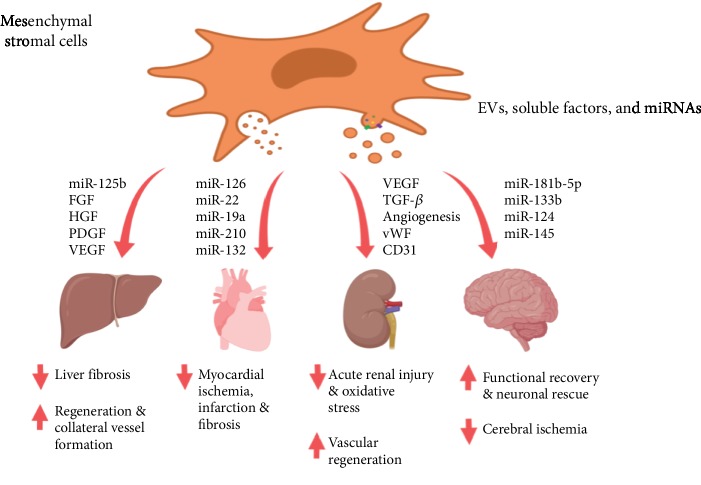
The role of the mesenchymal stromal cell- (MSC-) derived secretome is becoming increasingly intriguing from a clinical perspective due to its ability to stimulate endogenous tissue repair processes as well as its effective regulation of the immune system, mimicking the therapeutic effects produced by the MSCs. The secretome is a composite product secreted by MSC (in conditioned medium) and (in the extracellular milieu), consisting of a protein soluble fraction (mostly growth factors and cytokines) and a vesicular component, extracellular vesicles (EVs), which transfer proteins, lipids, and genetic material. MSC-derived secretome differs based on the tissue from which the MSCs are isolated and under specific conditions (e.g., preconditioning or priming) suggesting that clinical applications should be tailored by choosing the tissue of origin and a priming regimen to specifically correct a given pathology. MSC-derived secretome mediates beneficial angiogenic effects in a variety of tissue injury-related diseases. This supports the current effort to develop cell-free therapeutic products that bring both clinical benefits (reduced immunogenicity, persistence , and no genotoxicity associated with long-term cell cultures) and manufacturing advantages (reduced costs, availability of large quantities of off-the-shelf products, and lower regulatory burden). In the present review, we aim to give a comprehensive picture of the numerous components of the secretome produced by MSCs derived from the most common tissue sources for clinical use (e.g., AT, BM, and CB). We focus on the factors involved in the complex regulation of angiogenic processes.
从临床角度来看,间充质基质细胞(MSC)分泌组的作用正变得越来越引人关注,因为它能够刺激内源性组织修复过程,以及有效调节免疫系统,模拟MSC产生的治疗效果。分泌组是MSC在条件培养基和细胞外环境中分泌的复合产物,由蛋白质可溶性部分(主要是生长因子和细胞因子)和囊泡成分——细胞外囊泡(EVs)组成,EVs可转运蛋白质、脂质和遗传物质。基于分离MSC的组织以及特定条件(例如预处理或引发),MSC衍生的分泌组会有所不同,这表明临床应用应通过选择来源组织和引发方案来进行定制,以特异性纠正特定病理状况。MSC衍生的分泌组在多种与组织损伤相关的疾病中介导有益的血管生成作用。这支持了当前开发无细胞治疗产品的努力,这些产品既具有临床益处(降低免疫原性、持久性,且无与长期细胞培养相关的基因毒性)又具有生产优势(降低成本、可获得大量现成产品以及降低监管负担)。在本综述中,我们旨在全面介绍由临床使用的最常见组织来源(例如脂肪组织、骨髓和脐血)的MSC产生的分泌组的众多成分。我们关注参与血管生成过程复杂调节的因素。