Department of Statistics and Actuarial Science, University of Hong Kong, Hong Kong SAR, China.
Key Laboratory of Shaanxi Province for Craniofacial Precision Medicine Research, College of Stomatology, Xi'an Jiaotong University, Xi'an, China.
Front Public Health. 2021 Sep 28;9:729559. doi: 10.3389/fpubh.2021.729559. eCollection 2021.
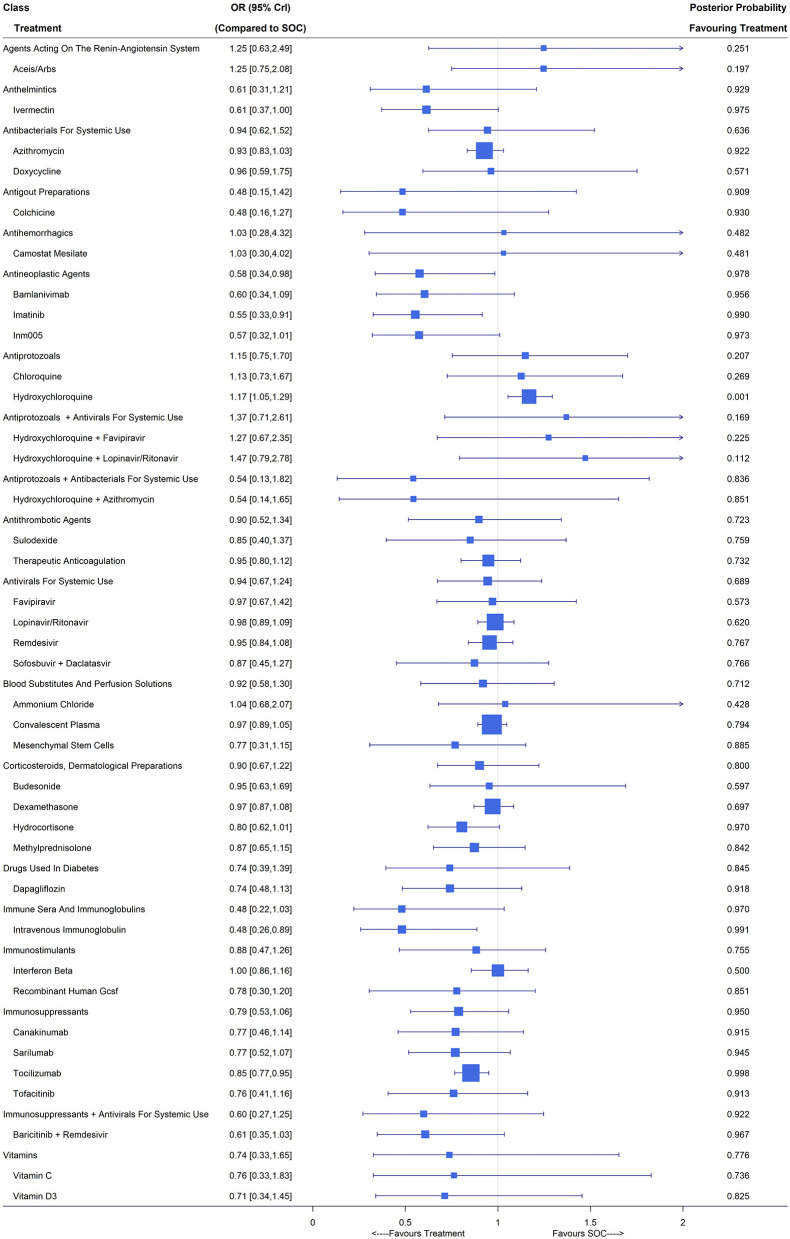
We provided a comprehensive evaluation of efficacy of available treatments for coronavirus disease 2019 (COVID-19). We searched for candidate COVID-19 studies in WHO COVID-19 Global Research Database up to August 19, 2021. Randomized controlled trials for suspected or confirmed COVID-19 patients published on peer-reviewed journals were included, regardless of demographic characteristics. Outcome measures included mortality, mechanical ventilation, hospital discharge and viral clearance. Bayesian network meta-analysis with fixed effects was conducted to estimate the effect sizes using posterior means and 95% equal-tailed credible intervals (CrIs). Odds ratio (OR) was used as the summary measure for treatment effect. Bayesian hierarchical models were used to estimate effect sizes of treatments grouped by the treatment classifications. We identified 222 eligible studies with a total of 102,950 patients. Compared with the standard of care, imatinib, intravenous immunoglobulin and tocilizumab led to lower risk of death; baricitinib plus remdesivir, colchicine, dexamethasone, recombinant human granulocyte colony stimulating factor and tocilizumab indicated lower occurrence of mechanical ventilation; tofacitinib, sarilumab, remdesivir, tocilizumab and baricitinib plus remdesivir increased the hospital discharge rate; convalescent plasma, ivermectin, ivermectin plus doxycycline, hydroxychloroquine, nitazoxanide and proxalutamide resulted in better viral clearance. From the treatment class level, we found that the use of antineoplastic agents was associated with fewer mortality cases, immunostimulants could reduce the risk of mechanical ventilation and immunosuppressants led to higher discharge rates. This network meta-analysis identified superiority of several COVID-19 treatments over the standard of care in terms of mortality, mechanical ventilation, hospital discharge and viral clearance. Tocilizumab showed its superiority compared with SOC on preventing severe outcomes such as death and mechanical ventilation as well as increasing the discharge rate, which might be an appropriate treatment for patients with severe or mild/moderate illness. We also found the clinical efficacy of antineoplastic agents, immunostimulants and immunosuppressants with respect to the endpoints of mortality, mechanical ventilation and discharge, which provides valuable information for the discovery of potential COVID-19 treatments.
我们对 2019 冠状病毒病(COVID-19)现有治疗方法的疗效进行了全面评估。我们在世界卫生组织 COVID-19 全球研究数据库中搜索了截至 2021 年 8 月 19 日的 COVID-19 候选研究。纳入了在同行评议期刊上发表的针对疑似或确诊 COVID-19 患者的随机对照试验,无论其人口统计学特征如何。结局指标包括死亡率、机械通气、出院和病毒清除。采用固定效应贝叶斯网络荟萃分析,使用后验均值和 95%等尾可信区间(CrI)估计效应大小。比值比(OR)用于表示治疗效果的汇总指标。采用贝叶斯层次模型估计按治疗分类分组的治疗效果大小。我们确定了 222 项符合条件的研究,共纳入 102950 名患者。与标准治疗相比,伊马替尼、静脉注射免疫球蛋白和托珠单抗降低了死亡风险;巴瑞替尼联合瑞德西韦、秋水仙碱、地塞米松、重组人粒细胞集落刺激因子和托珠单抗降低了机械通气的发生率;托法替尼、沙利鲁单抗、瑞德西韦、托珠单抗和巴瑞替尼联合瑞德西韦增加了出院率;恢复期血浆、伊维菌素、伊维菌素联合多西环素、羟氯喹、硝唑尼特和普罗芦卡胺改善了病毒清除。从治疗类别水平来看,我们发现抗肿瘤药物的使用与较低的死亡率相关,免疫刺激剂可以降低机械通气的风险,而免疫抑制剂则导致较高的出院率。这项网络荟萃分析发现,在死亡率、机械通气、出院和病毒清除方面,几种 COVID-19 治疗方法优于标准治疗。托珠单抗在预防死亡和机械通气等严重结局方面以及提高出院率方面优于 SOC,这可能是治疗重症或轻症/中度患者的一种合适治疗方法。我们还发现了抗肿瘤药物、免疫刺激剂和免疫抑制剂在死亡率、机械通气和出院方面的临床疗效,这为发现潜在的 COVID-19 治疗方法提供了有价值的信息。