Faculty of Science, Animal Genetics and Genome Evolutionary Laboratory (AGAGEL), Department of Genetics and Molecular Biology, Institute of Biological Sciences, University of Malaya, Kuala Lumpur, Malaysia.
Terra Aqua Laboratory, Centre for Research in Biotechnology for Agriculture (CEBAR), Research Management and Innovation Complex, University of Malaya, Kuala Lumpur, Malaysia.
PLoS One. 2021 Oct 15;16(10):e0258655. doi: 10.1371/journal.pone.0258655. eCollection 2021.
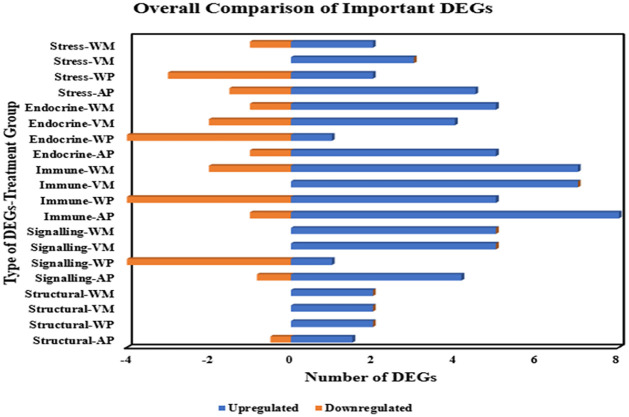
Diseases have remained the major issue for shrimp aquaculture industry for decades by which different shrimp species demonstrated alternative disease resistance or tolerance. However, there had been insufficient studies on the underlying host mechanisms of such phenomenon. Hence, in this study, the main objective involves gaining a deeper understanding into the functional importance of shrimp STAT gene from the aspects of expression, sequence, structure, and associated genes. STAT gene was selected primarily because of its vital signalling roles in stress, endocrine, and immune response. The differential gene expressions of Macrobrachium rosenbergii STAT (MrST) and Penaeus monodon STAT (PmST) under White Spot Syndrome Virus (WSSV) and Vibrio parahaemolyticus/VpAHPND infections were identified through qPCR analysis. Notably, during both pathogenic infections, MrST demonstrated significant gene expression down-regulations (during either early or later post-infection time points) whereas PmST showed only significant gene expression up-regulations. Important sequence conservation or divergence was highlighted through STAT sequence comparison especially amino acid alterations at 614 aa [K (Lysine) to E (Glutamic Acid)] and 629 aa [F (Phenylalanine) to V (Valine)] from PmST (AY327491.1) to PmST (disease tolerant strain). There were significant differences observed between in silico characterized structures of MrST and PmST proteins. Important functional differentially expressed genes (DEGs) in the aspects of stress, endocrine, immune, signalling, and structural were uncovered through comparative transcriptomic analysis. The DEGs associated with STAT functioning were identified including inositol 1,4,5-trisphosphate receptor, hsp90, caspase, ATP binding cassette transmembrane transporter, C-type Lectin, HMGB, ALF1, ALF3, superoxide dismutase, glutathione peroxidase, catalase, and TBK1. The main findings of this study are STAT differential gene expression patterns, sequence divergence, structural differences, and associated functional DEGs. These findings can be further utilized for shrimp health or host response diagnostic studies. STAT gene can also be proposed as a suitable candidate for future studies of shrimp innate immune enhancement.
几十年来,疾病一直是虾类养殖业的主要问题,不同的虾类表现出不同的疾病抗性或耐受性。然而,对于这种现象的潜在宿主机制的研究还不够充分。因此,在这项研究中,主要目标是从表达、序列、结构和相关基因等方面深入了解虾 STAT 基因的功能重要性。选择 STAT 基因主要是因为它在应激、内分泌和免疫反应中的重要信号作用。通过 qPCR 分析,确定了罗氏沼虾 STAT(MrST)和斑节对虾 STAT(PmST)在白斑综合征病毒(WSSV)和副溶血弧菌/VpAHPND 感染下的差异基因表达。值得注意的是,在这两种致病性感染中,MrST 表现出显著的基因表达下调(在感染后的早期或晚期),而 PmST 仅表现出显著的基因表达上调。通过 STAT 序列比较突出了重要的序列保守性或分化,特别是 PmST(AY327491.1)到 PmST(耐病株)中的 614 aa [K(赖氨酸)到 E(谷氨酸)]和 629 aa [F(苯丙氨酸)到 V(缬氨酸)]处的氨基酸改变。在 MrST 和 PmST 蛋白的计算表征结构之间观察到显著差异。通过比较转录组分析揭示了应激、内分泌、免疫、信号和结构方面的重要功能差异表达基因(DEGs)。确定了与 STAT 功能相关的 DEGs,包括肌醇 1,4,5-三磷酸受体、热休克蛋白 90、半胱天冬酶、ATP 结合盒跨膜转运蛋白、C 型凝集素、HMGB、ALF1、ALF3、超氧化物歧化酶、谷胱甘肽过氧化物酶、过氧化氢酶和 TBK1。本研究的主要发现是 STAT 差异基因表达模式、序列分化、结构差异和相关功能 DEGs。这些发现可进一步用于虾类健康或宿主反应诊断研究。STAT 基因也可以作为虾类先天免疫增强未来研究的合适候选基因。