Soo Tze Chiew Christie, Devadas Sridevi, Mohamed Din Mohamed Shariff, Bhassu Subha
1Department of Genetics and Molecular Biology, Institute of Biological Sciences, Faculty of Science, University of Malaya, 50603 Kuala Lumpur, Malaysia.
Selangor Fisheries Biosecurity Centre, Department of Fisheries, Malaysia, KLIA, 63000 Sepang, Selangor Malaysia.
Gut Pathog. 2019 Jul 26;11:39. doi: 10.1186/s13099-019-0319-4. eCollection 2019.
is the second most widely cultured marine shrimp species in the global shrimp aquaculture industry. However, the growth of production has been constantly impaired by disease outbreaks. Recently, there is a lethal bacterial infection, known as acute hepatopancreatic necrosis disease (AHPND) caused by AHPND strain ( ), which led to mass mortalities in . Unfortunately, there is still insufficient knowledge about the underlying immune response of upon AHPND infection. The present study aims to provide an insight into the antibacterial immune response elicited by hepatopancreas towards AHPND infection.
We have employed high-throughput RNA-Seq technology to uncover the transcriptome changes of hepatopancreas when challenged with . The shrimps were challenged with through immersion method with dissected hepatopancreas samples for the control group (APm-CTL) and treatment group at 3 (APm-T3), 6 (APm-T6), and 24 (APm-T24) hours post-AHPND infection sent for RNA-Seq. The transcriptome de novo assembly and Unigene expression determination were conducted using Trinity, Tgicl, Bowtie2, and RSEM software. The differentially expressed transcripts were functionally annotated mainly through COG, GO, and KEGG databases.
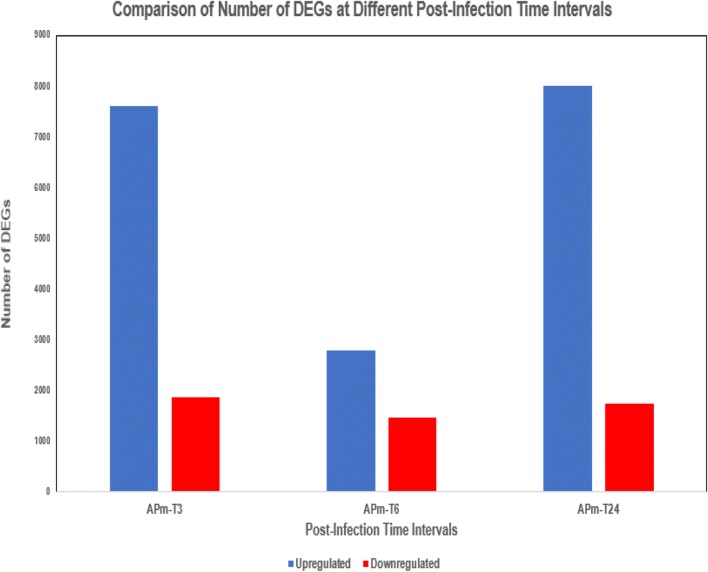
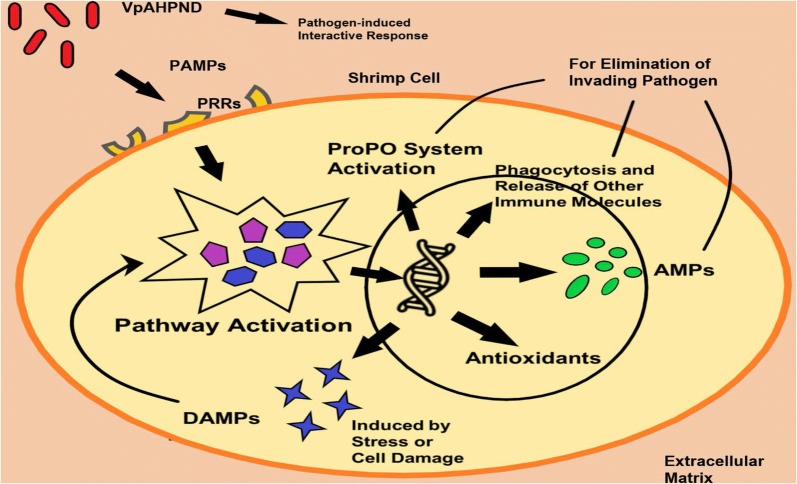
The sequencing reads generated were filtered to obtain 312.77 Mb clean reads and assembled into 48662 Unigenes. Based on the DEGs pattern identified, it is inferred that the PAMPs carried by or associated toxins are capable of activating PRRs, which leads to subsequent pathway activation, transcriptional modification, and antibacterial responses (Phagocytosis, AMPs, proPO system). DAMPs are released in response to cell stress or damage to further activate the sequential immune responses. The comprehensive interactions between , chitin, GbpA, mucin, chitinase, and chitin deacetylase were postulated to be involved in bacterial colonization or antibacterial response.
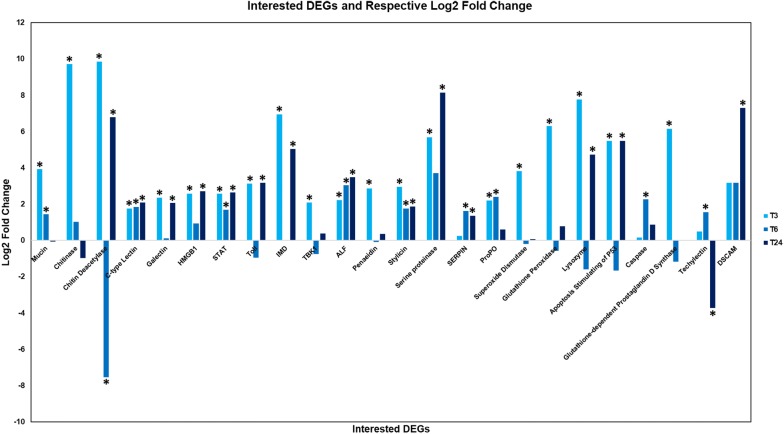
The outcomes of this research correlate the different stages of immune response to different time points of AHPND infection. This finding supports the development of biomarkers for the detection of early stages of colonization in through host immune expression changes. The potential genes to be utilized as biomarkers include but not limited to C-type lectin, HMGB1, IMD, ALF, serine proteinase, and DSCAM.
[虾的品种名称]是全球对虾养殖业中养殖范围第二广泛的海洋虾类品种。然而,其产量增长一直受到疾病爆发的持续影响。最近,出现了一种由[AHPND菌株名称]引起的致命细菌感染,即急性肝胰腺坏死病(AHPND),导致[虾的品种名称]大量死亡。不幸的是,关于[虾的品种名称]在感染AHPND后的潜在免疫反应仍知之甚少。本研究旨在深入了解[虾的品种名称]肝胰腺针对AHPND感染引发的抗菌免疫反应。
我们采用高通量RNA测序技术,以揭示[虾的品种名称]肝胰腺在受到[AHPND菌株名称]攻击时的转录组变化。通过浸泡法用[AHPND菌株名称]对虾进行攻击,对照组(APm - CTL)以及在AHPND感染后3小时(APm - T3)、6小时(APm - T6)和24小时(APm - T24)的处理组的对虾解剖后取肝胰腺样本用于RNA测序。使用Trinity、Tgicl、Bowtie2和RSEM软件进行转录组从头组装和单基因表达测定。差异表达的转录本主要通过COG、GO和KEGG数据库进行功能注释。
生成的测序读数经过过滤,获得312.77兆字节的干净读数,并组装成48662个单基因。基于所确定的差异表达基因模式,推测[AHPND菌株名称]携带的病原体相关分子模式或相关毒素能够激活模式识别受体,从而导致后续途径激活、转录修饰和抗菌反应(吞噬作用、抗菌肽、酚氧化酶原系统)。损伤相关分子模式会因细胞应激或损伤而释放,以进一步激活后续免疫反应。推测[AHPND菌株名称]、几丁质、GbpA、粘蛋白、几丁质酶和几丁质脱乙酰酶之间的综合相互作用参与细菌定植或抗菌反应。
本研究结果将[虾的品种名称]免疫反应的不同阶段与AHPND感染的不同时间点相关联。这一发现支持通过宿主免疫表达变化开发用于检测[虾的品种名称]中[AHPND菌株名称]定植早期阶段的生物标志物。可用作生物标志物的潜在基因包括但不限于C型凝集素、HMGB1、IMD、ALF、丝氨酸蛋白酶和DSCAM。