Institute of Biodiversity, Animal Health & Comparative Medicine, College of Medical, Veterinary & Life Sciences, University of Glasgow, Glasgow, UK.
Scottish Centre for Ecology and the Natural Environment, University of Glasgow, Glasgow, UK.
J Evol Biol. 2021 Dec;34(12):1954-1969. doi: 10.1111/jeb.13948. Epub 2021 Oct 26.
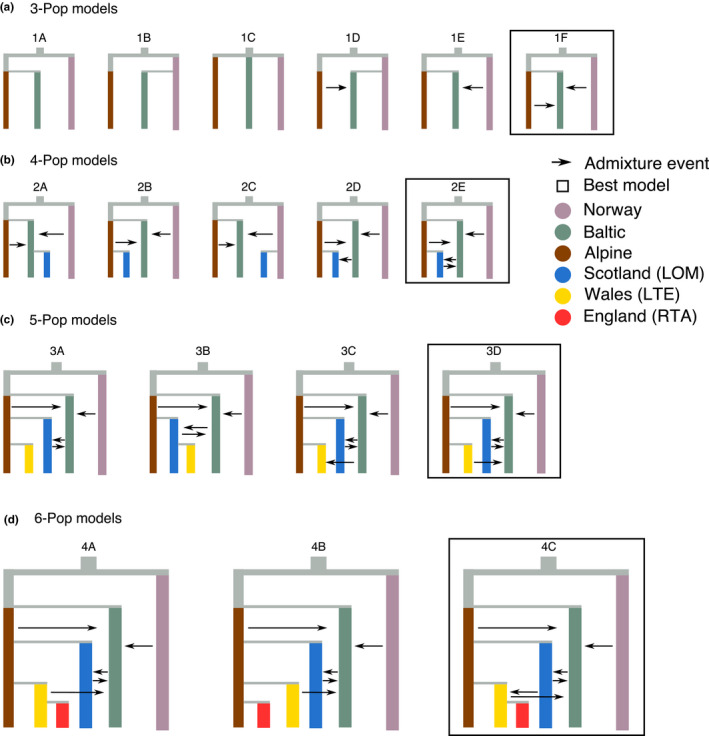
Pleistocene glaciations dramatically affected species distribution in regions that were impacted by ice cover and subsequent postglacial range expansion impacted contemporary biodiversity in complex ways. The European whitefish, Coregonus lavaretus, is a widely distributed salmonid fish species on mainland Europe, but in Britain it has only seven native populations, all of which are found on the western extremes of the island. The origins and colonization routes of the species into Britain are unknown but likely contributed to contemporary genetic patterns and regional uniqueness. Here, we used up to 25,751 genome-wide polymorphic loci to reconstruct the history and to discern the demographic and evolutionary forces underpinning divergence between British populations. Overall, we found lower genetic diversity in Scottish populations but high differentiation (F = 0.433-0.712) from the English/Welsh and other European populations. Differentiation was elevated genome-wide rather than in particular genomic regions. Demographic modelling supported a postglacial colonization into western Scotland from northern refugia and a separate colonization route for the English/Welsh populations from southern refugia, with these two groups having been separated for more than ca. 50 Ky. We found cyto-nuclear discordance at a European scale, with the Scottish populations clustering closely with Baltic population in the mtDNA analysis but not in the nuclear data, and with the Norwegian and Alpine populations displaying the same mtDNA haplotype but being distantly related in the nuclear tree. These findings suggest that neutral processes, primarily drift and regionally distinct pre-glacial evolutionary histories, are important drivers of genomic divergence in British populations of European whitefish. This sheds new light on the establishment of the native British freshwater fauna after the last glacial maximum.
更新世冰川作用剧烈影响了受冰盖影响的地区的物种分布,随后的冰后期范围扩张以复杂的方式影响了当代生物多样性。欧洲白鱼(Coregonus lavaretus)是欧洲大陆广泛分布的鲑鱼物种,但在英国只有七个本土种群,它们都分布在岛屿的西部极端地区。该物种进入英国的起源和殖民路线尚不清楚,但可能导致了当代遗传模式和区域独特性。在这里,我们使用了多达 25751 个全基因组多态性位点来重建历史,并辨别支撑英国种群之间分歧的人口和进化力量。总体而言,我们发现苏格兰种群的遗传多样性较低,但与英格兰/威尔士和其他欧洲种群的分化程度较高(F = 0.433-0.712)。分化是在全基因组范围内而不是在特定的基因组区域内升高的。人口统计学模型支持了从北方避难所到苏格兰西部的冰后期殖民,以及从南方避难所到英格兰/威尔士人口的单独殖民路线,这两个群体已经分开了大约 50 千年。我们在欧洲范围内发现了细胞-核不一致,在 mtDNA 分析中,苏格兰种群与波罗的海种群聚类紧密,但在核数据中则没有,而挪威和阿尔卑斯山种群则显示出相同的 mtDNA 单倍型,但在核树上的亲缘关系较远。这些发现表明,中性过程,主要是漂变和区域独特的前冰期进化历史,是英国欧洲白鱼种群基因组分化的重要驱动因素。这为末次冰盛期后英国本土淡水动物群的建立提供了新的视角。