Health and Biosecurity, Commonwealth Scientific and Industrial Research Organisation, Canberra, Australia.
The University of Melbourne, Melbourne, Australia.
Sci Rep. 2021 Oct 15;11(1):20512. doi: 10.1038/s41598-021-98667-5.
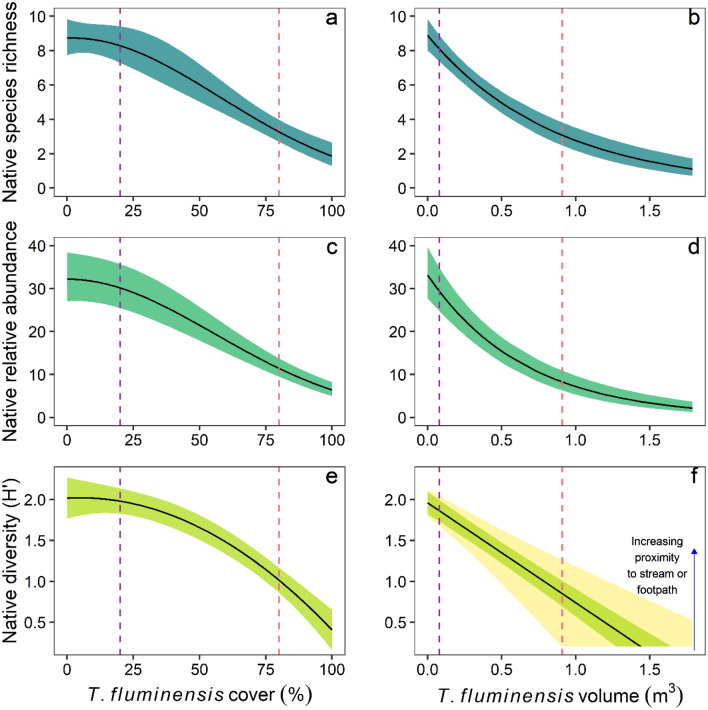
Impacts of invasive species are often difficult to quantify, meaning that many invaders are prioritised for management without robust, contextual evidence of impact. Most impact studies for invasive plants compare heavily invaded with non-invaded sites, revealing little about abundance-impact relationships. We examined effects of increasing cover and volume of the non-native herbaceous groundcover Tradescantia fluminensis on a temperate rainforest community of southern Australia. We hypothesised that there would be critical thresholds in T. fluminensis abundance, below which the native plant community would not be significantly impacted, but above which the community's condition would degrade markedly. We modelled the abundance-impact relationship from 83 plots that varied in T. fluminensis abundance and landscape context and found the responses of almost all native plant indicators to invasion were non-linear. Native species richness, abundance and diversity exhibited negative exponential relationships with increasing T. fluminensis volume, but negative threshold relationships with increasing T. fluminensis cover. In the latter case, all metrics were relatively stable until cover reached between 20 and 30%, after which each decreased linearly, with a 50% decline occurring at 75-80% invader cover. Few growth forms (notably shrubs and climbers) exhibited such thresholds, with most exhibiting negative exponential relationships. Tradescantia fluminensis biomass increased dramatically at > 80% cover, with few native species able to persist at such high levels of invasion. Landscape context had almost no influence on native communities, or the abundance-impact relationships between T. fluminensis and the plant community metrics. Our results suggest that the diversity of native rainforest community can be maintained where T. fluminensis is present at moderate-to-low cover levels.
入侵物种的影响往往难以量化,这意味着许多入侵物种在没有强有力的、有背景证据表明其产生影响的情况下,就被优先管理。大多数关于入侵植物的影响研究都是将重度入侵与非入侵地点进行比较,很少揭示丰度与影响之间的关系。我们研究了非本地草本地被植物紫露草(Tradescantia fluminensis)的覆盖度和体积增加对澳大利亚南部温带雨林群落的影响。我们假设,在紫露草丰度存在临界阈值,低于该阈值,本地植物群落不会受到显著影响,但高于该阈值,群落的状况将明显恶化。我们从 83 个不同紫露草丰度和景观背景的样方中建立了丰度-影响关系模型,发现几乎所有本地植物指标对入侵的响应都是非线性的。本地物种丰富度、丰度和多样性与紫露草体积呈负指数关系,但与紫露草盖度呈负阈值关系。在后一种情况下,所有指标在盖度达到 20-30%之前相对稳定,之后每种指标都呈线性下降,当入侵覆盖率达到 50-80%时,每种指标都会下降 50%。很少有生长形式(尤其是灌木和藤本植物)表现出这种阈值,大多数表现出负指数关系。当紫露草的盖度超过 80%时,其生物量会显著增加,很少有本地物种能够在如此高的入侵水平下存活。景观背景对本地群落几乎没有影响,也没有对紫露草与植物群落指标之间的丰度-影响关系产生影响。我们的结果表明,只要紫露草的覆盖度处于中低水平,本地雨林群落的多样性就可以得到维持。