Dean Scott N, Alvarez Jerome Anthony E, Zabetakis Dan, Walper Scott A, Malanoski Anthony P
US Naval Research Laboratory, Center for Bio/Molecular Science and Engineering, Washington, DC, United States.
STEM Student Employment Program, US Naval Research Laboratory, Center for Bio/Molecular Science and Engineering, Washington, DC, United States.
Front Microbiol. 2021 Sep 30;12:725727. doi: 10.3389/fmicb.2021.725727. eCollection 2021.
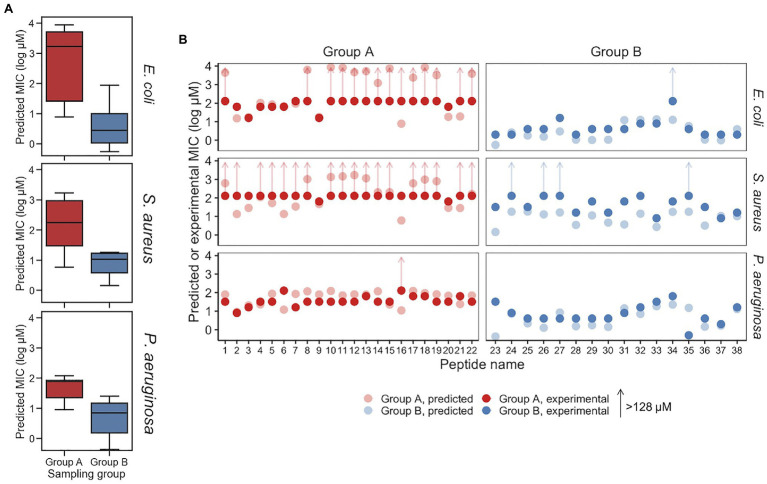
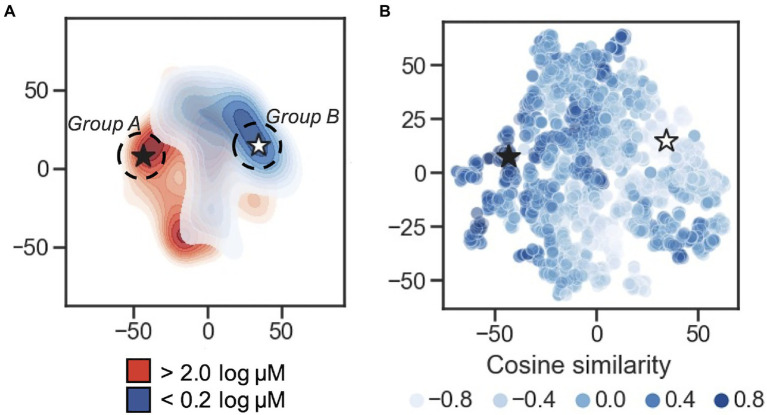
New methods for antimicrobial design are critical for combating pathogenic bacteria in the post-antibiotic era. Fortunately, competition within complex communities has led to the natural evolution of antimicrobial peptide (AMP) sequences that have promising bactericidal properties. Unfortunately, the identification, characterization, and production of AMPs can prove complex and time consuming. Here, we report a peptide generation framework, PepVAE, based around variational autoencoder (VAE) and antimicrobial activity prediction models for designing novel AMPs using only sequences and experimental minimum inhibitory concentration (MIC) data as input. Sampling from distinct regions of the learned latent space allows for controllable generation of new AMP sequences with minimal input parameters. Extensive analysis of the PepVAE-generated sequences paired with antimicrobial activity prediction models supports this modular design framework as a promising system for development of novel AMPs, demonstrating controlled production of AMPs with experimental validation of predicted antimicrobial activity.
在抗生素后时代,新型抗菌设计方法对于对抗病原菌至关重要。幸运的是,复杂群落中的竞争导致了具有良好杀菌特性的抗菌肽(AMP)序列的自然进化。不幸的是,AMP的鉴定、表征和生产可能会很复杂且耗时。在此,我们报告了一个肽生成框架PepVAE,它基于变分自编码器(VAE)和抗菌活性预测模型,仅使用序列和实验最小抑菌浓度(MIC)数据作为输入来设计新型AMP。从学习到的潜在空间的不同区域进行采样,可以在输入参数最少的情况下可控地生成新的AMP序列。对PepVAE生成的序列与抗菌活性预测模型进行的广泛分析支持了这个模块化设计框架,认为它是开发新型AMP的一个有前景的系统,展示了通过预测抗菌活性的实验验证实现AMP的可控生产。