Chen Shengwei, Zhang Yi, Niu Xueting, Mohyuddin Sahar Ghulam, Wen Jiayin, Bao Minglong, Yu Tianyue, Wu Lianyun, Hu Canyin, Yong Yanhong, Liu Xiaoxi, Abd El-Aty A M, Ju Xianghong
Department of Veterinary Medicine, Guangdong Ocean University, Zhanjiang, China.
Shenzhen Institute of Guangdong Ocean University, Shenzhen, China.
Front Nutr. 2021 Oct 1;8:748118. doi: 10.3389/fnut.2021.748118. eCollection 2021.
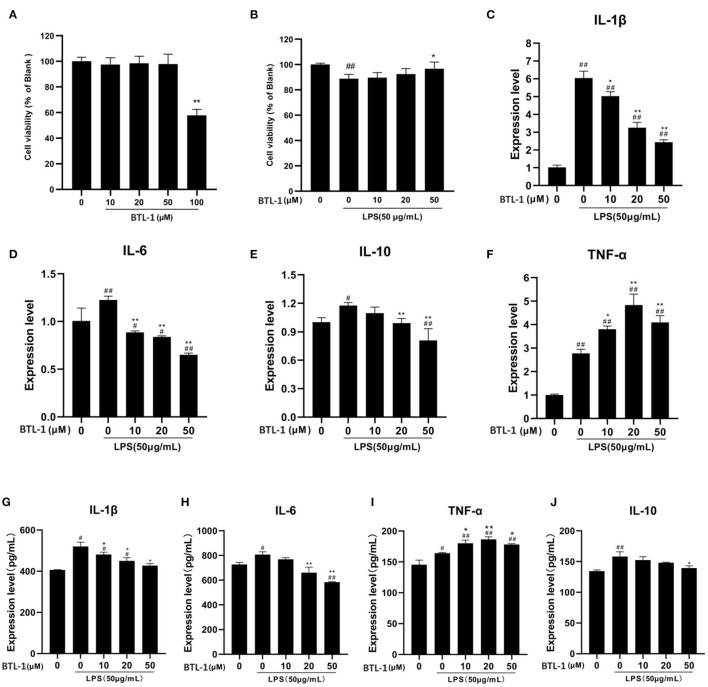
Herein, we assessed the anti-inflammatory and intestinal barrier protective effects of butyrolactone-I (BTL-1), derived from the coral-derived endophytic fungus (), using the LPS-induced IPEC-J2 inflammation model and the DSS-induced IBD model in mice. In IPEC-J2 cells, pretreatment with BTL-I significantly inhibited TLR4/NF-κB signaling pathway and JNK phosphorylation, resulting in the decrease of IL-1β and IL-6 expression. Interestingly, BTL-1 pretreatment activated the phosphorylation of ERK and P38, which significantly enhanced the expression of TNF-α. Meanwhile, BTL-1 pretreatment upregulated tight junction protein expression (ZO-1, occludin, and claudin-1) and maintained intestinal barrier and intestinal permeability integrity. In mice, BTL-1 significantly alleviated the intestinal inflammatory response induced by DSS, inhibited TLR4/NF-κB signaling pathway, and MAPK signaling pathway, thus reducing the production of IL-1, IL-6, and TNF-α. Further, the expression of tight junction proteins (ZO-1, occludin, and claudin-1) was upregulated in BTL-1 administrated mice. Therefore, it has been suggested that butyrolactone-I alleviates inflammatory responses in LPS-stimulated IPEC-J2 and DSS-induced murine colitis by TLR4/NF-κB and MAPK signal pathway. Thereby, BTL-1 might potentially be used as an ocean drug to prevent intestinal bowel disease.
在此,我们使用脂多糖(LPS)诱导的IPEC-J2炎症模型和葡聚糖硫酸钠(DSS)诱导的小鼠炎症性肠病(IBD)模型,评估了源自珊瑚内生真菌的丁内酯-I(BTL-1)的抗炎和肠道屏障保护作用。在IPEC-J2细胞中,用BTL-I预处理可显著抑制TLR4/NF-κB信号通路和JNK磷酸化,导致IL-1β和IL-6表达降低。有趣的是,BTL-1预处理激活了ERK和P38的磷酸化,显著增强了TNF-α的表达。同时,BTL-1预处理上调了紧密连接蛋白的表达(ZO-1、闭合蛋白和Claudin-1),维持了肠道屏障和肠道通透性的完整性。在小鼠中,BTL-1显著减轻了DSS诱导的肠道炎症反应,抑制了TLR4/NF-κB信号通路和MAPK信号通路,从而减少了IL-1、IL-6和TNF-α的产生。此外,在给予BTL-1的小鼠中,紧密连接蛋白(ZO-1、闭合蛋白和Claudin-1)的表达上调。因此,有人认为丁内酯-I通过TLR4/NF-κB和MAPK信号通路减轻LPS刺激的IPEC-J2和DSS诱导的小鼠结肠炎中的炎症反应。因此,BTL-1可能有潜力用作预防肠道疾病的海洋药物。