Al-Atta Ayman, Kuzemczak Michał, Alkhalil Mohammad
Cardiothoracic Centre, Freeman Hospital, Newcastle upon Tyne, Newcastle, UK.
Department of Medical Rescue, Chair of Emergency Medicine, Poznan University of Medical Sciences, Poznań, Poland.
Brain Circ. 2021 Aug 27;7(3):187-193. doi: 10.4103/bc.bc_24_21. eCollection 2021 Jul-Sep.
Inflammation is increasingly recognized as a target to reduce residual cardiovascular risk. Colchicine is an anti-inflammatory drug that was associated with improved cardiovascular outcomes. However, its effect on stroke reduction was not consistent across studies. Therefore, the aim of this study-level meta-analysis was to evaluate the influence of colchicine on stroke in patients with coronary artery disease (CAD).
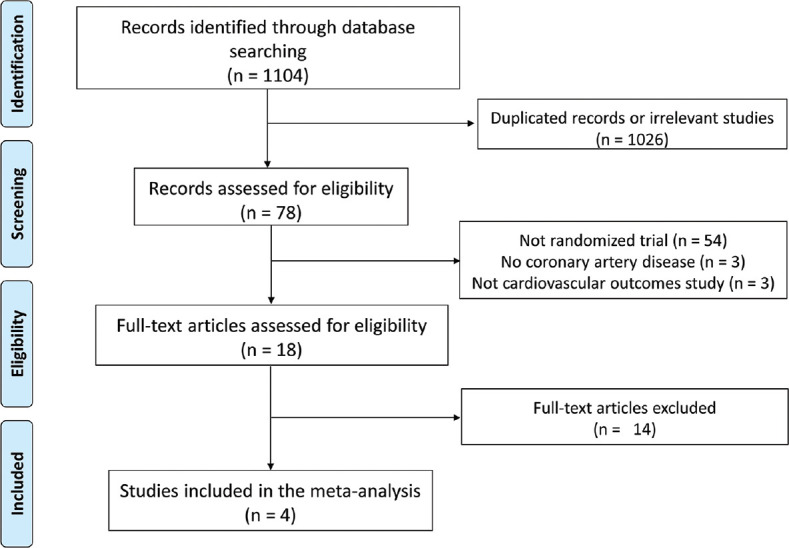
Electronic databases were searched through October 2020, to identify randomized controlled trials using colchicine in patients with CAD. The incidence of clinical endpoints such as stroke, death, myocardial infarction (MI), study-defined major adverse cardiovascular events (MACE), and atrial fibrillation (AF) was compared between colchicine and placebo groups.
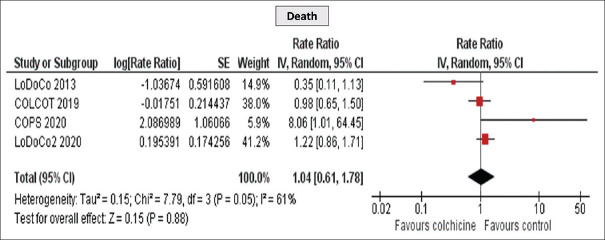
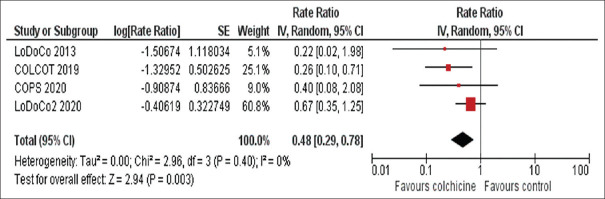
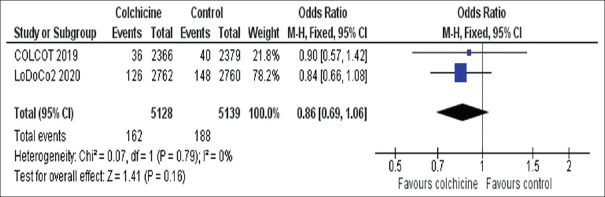
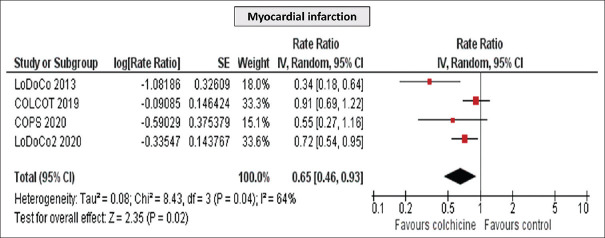
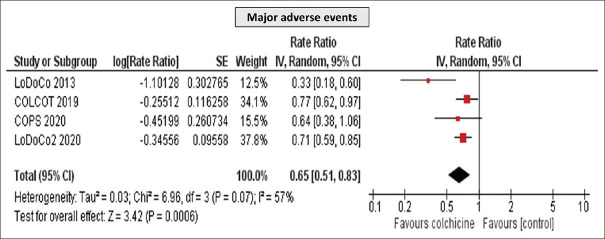
A total number of 11,594 (5,806 in the colchicine arm) patients from 4 eligible studies were included in the final analysis. Stroke incidence was lower in the colchicine arm compared to placebo (rate ratio [RR] 0.48 [95% confidence interval [CI], 0.29-0.78], = 0.003) whereby no significant difference was observed in the incidence of AF (odds ratio [OR] 0.86 [95% CI, 0.69-1.06], = 0.16). Furthermore, a significant effect of colchicine on MACE [RR 0.65 (95% CI, 0.51-0.83), = 0.0006] and MI (RR 0.65 (95% CI, 0.54-0.95], = 0.02) was detected, with no influence on all-cause mortality (RR 1.04 [95% CI, 0.61-1.78], = 0.88).
This meta-analysis confirms a significant influence of colchicine on stroke in CAD patients. Despite its neutral effect on AF occurrence, other mechanisms related to plaque stabilization are plausible. The concept seems to be supported by contemporaneous MI reduction and posits that anti-inflammatory properties of colchicine may translate into a reduction of stroke risk.
炎症越来越被认为是降低心血管残留风险的一个靶点。秋水仙碱是一种抗炎药物,与改善心血管结局相关。然而,其在降低中风方面的效果在各研究中并不一致。因此,本研究水平的荟萃分析旨在评估秋水仙碱对冠状动脉疾病(CAD)患者中风的影响。
检索截至2020年10月的电子数据库,以识别在CAD患者中使用秋水仙碱的随机对照试验。比较秋水仙碱组和安慰剂组中风、死亡、心肌梗死(MI)、研究定义的主要不良心血管事件(MACE)和心房颤动(AF)等临床终点的发生率。
最终分析纳入了来自4项符合条件研究的总共11594名患者(秋水仙碱组5806名)。与安慰剂相比,秋水仙碱组的中风发生率较低(率比[RR]0.48[95%置信区间[CI],0.29 - 0.78],P = 0.003),而AF发生率未观察到显著差异(优势比[OR]0.86[95%CI,0.69 - 1.06],P = 0.16)。此外,检测到秋水仙碱对MACE[RR 0.65(95%CI,0.51 - 0.83),P = 0.0006]和MI(RR 0.65(95%CI,0.54 - 0.95],P = 0.02)有显著影响,对全因死亡率无影响(RR 1.04[95%CI,0.61 - 1.78],P = 0.88)。
这项荟萃分析证实了秋水仙碱对CAD患者中风有显著影响。尽管其对AF发生无影响,但与斑块稳定相关的其他机制似乎是合理的。这一概念似乎得到了同期MI降低的支持,并假定秋水仙碱的抗炎特性可能转化为中风风险的降低。