School of Medicine, University of St. Andrews, KY16 9TF, UK.
Usher Institute, The University of Edinburgh, Edinburgh, EH8 9YL, UK.
J R Soc Med. 2022 Jan;115(1):22-30. doi: 10.1177/01410768211051715. Epub 2021 Oct 21.
We investigated the association between multimorbidity among patients hospitalised with COVID-19 and their subsequent risk of mortality. We also explored the interaction between the presence of multimorbidity and the requirement for an individual to shield due to the presence of specific conditions and its association with mortality.
We created a cohort of patients hospitalised in Scotland due to COVID-19 during the first wave (between 28 February 2020 and 22 September 2020) of the pandemic. We identified the level of multimorbidity for the patient on admission and used logistic regression to analyse the association between multimorbidity and risk of mortality among patients hospitalised with COVID-19.
Scotland, UK.
Patients hospitalised due to COVID-19.
Mortality as recorded on National Records of Scotland death certificate and being coded for COVID-19 on the death certificate or death within 28 days of a positive COVID-19 test.
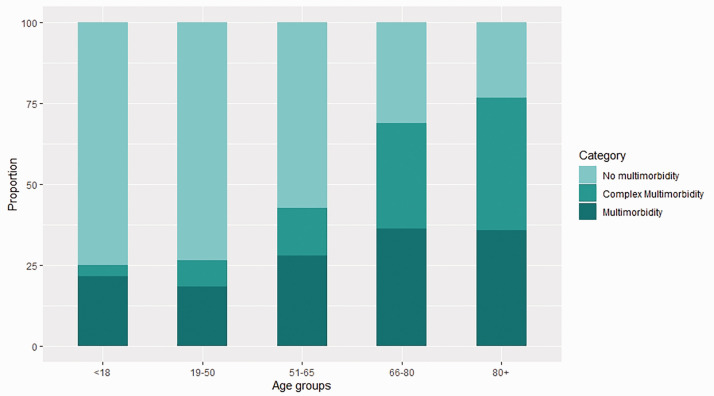
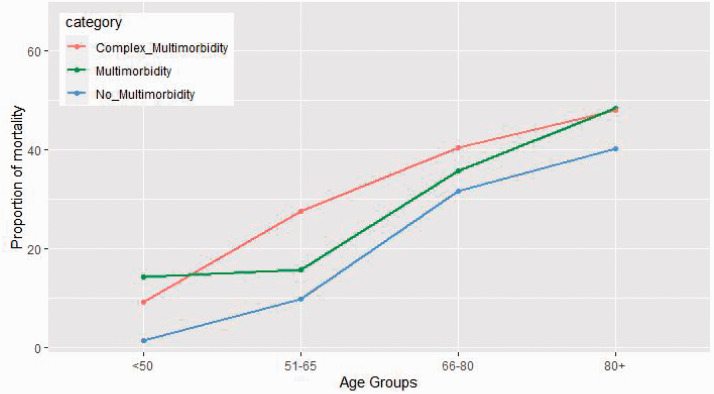
Almost 58% of patients admitted to the hospital due to COVID-19 had multimorbidity. Adjusting for confounding factors of age, sex, social class and presence in the shielding group, multimorbidity was significantly associated with mortality (adjusted odds ratio 1.48, 95%CI 1.26-1.75). The presence of multimorbidity and presence in the shielding patients list were independently associated with mortality but there was no multiplicative effect of having both (adjusted odds ratio 0.91, 95%CI 0.64-1.29).
Multimorbidity is an independent risk factor of mortality among individuals who were hospitalised due to COVID-19. Individuals with multimorbidity could be prioritised when making preventive policies, for example, by expanding shielding advice to this group and prioritising them for vaccination.
我们研究了 COVID-19 住院患者的多种合并症与随后死亡率之间的关系。我们还探讨了合并症的存在与因特定情况需要隔离的个体之间的相互作用及其与死亡率的关系。
我们创建了一个在 COVID-19 大流行第一波期间(2020 年 2 月 28 日至 2020 年 9 月 22 日)在苏格兰因 COVID-19 住院的患者队列。我们确定了入院时患者的合并症水平,并使用逻辑回归分析了 COVID-19 住院患者的合并症与死亡率之间的关系。
英国苏格兰。
因 COVID-19 住院的患者。
苏格兰国家记录中的死亡记录记录的死亡率,并在死亡证明上编码为 COVID-19 或在 COVID-19 检测呈阳性后 28 天内死亡。
近 58%因 COVID-19 住院的患者患有多种合并症。在调整年龄、性别、社会阶层和是否处于隔离组等混杂因素后,合并症与死亡率显著相关(调整后的优势比 1.48,95%CI 1.26-1.75)。合并症的存在和在隔离患者名单中的存在与死亡率独立相关,但两者同时存在没有相乘效应(调整后的优势比 0.91,95%CI 0.64-1.29)。
合并症是 COVID-19 住院患者死亡的独立危险因素。患有多种合并症的个体可以在制定预防政策时优先考虑,例如,将隔离建议扩大到这一群体,并优先为他们接种疫苗。