Institute of Bioelectronic Medicine, The Feinstein Institutes for Medical Research, Northwell Health, 350 Community Drive, Manhasset, NY, 11030, USA.
Donald and Barbara Zucker School of Medicine at Hofstra/Northwell, 350 Community Drive, Manhasset, NY, 11030, USA.
Mol Med. 2021 Oct 21;27(1):133. doi: 10.1186/s10020-021-00380-6.
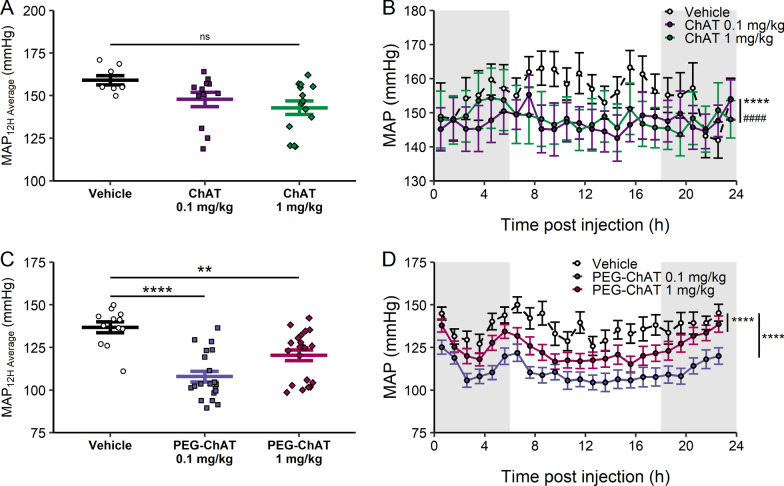
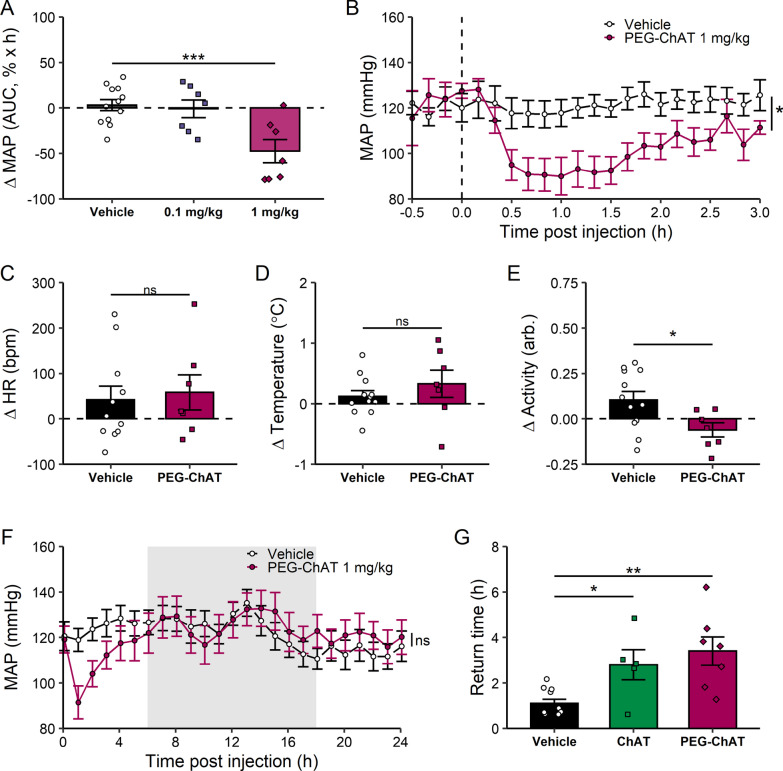
Acetylcholine (ACh) decreases blood pressure by stimulating endothelium nitric oxide-dependent vasodilation in resistance arterioles. Normal plasma contains choline acetyltransferase (ChAT) and its biosynthetic product ACh at appreciable concentrations to potentially act upon the endothelium to affect blood pressure. Recently we discovered a T-cell subset expressing ChAT (T), whereby genetic ablation of ChAT in these cells produces hypertension, indicating that production of ACh by T regulates blood pressure. Accordingly, we reasoned that increasing systemic ChAT concentrations might induce vasodilation and reduce blood pressure. To evaluate this possibility, recombinant ChAT was administered intraperitoneally to mice having angiotensin II-induced hypertension. This intervention significantly and dose-dependently decreased mean arterial pressure. ChAT-mediated attenuation of blood pressure was reversed by administration of the nitric oxide synthesis blocker L-nitro arginine methyl ester, indicating ChAT administration decreases blood pressure by stimulating nitic oxide dependent vasodilation, consistent with an effect of ACh on the endothelium. To prolong the half life of circulating ChAT, the molecule was modified by covalently attaching repeating units of polyethylene glycol (PEG), resulting in enzymatically active PEG-ChAT. Administration of PEG-ChAT to hypertensive mice decreased mean arterial pressure with a longer response duration when compared to ChAT. Together these findings suggest further studies are warranted on the role of ChAT in hypertension.
乙酰胆碱(ACh)通过刺激阻力小动脉内皮一氧化氮依赖性血管舒张来降低血压。正常血浆中含有相当浓度的胆碱乙酰转移酶(ChAT)及其生物合成产物 ACh,可能作用于内皮细胞来影响血压。最近,我们发现了一个表达 ChAT(T 细胞)的 T 细胞亚群,这些细胞中的 ChAT 基因缺失会导致高血压,表明 T 细胞产生的 ACh 可调节血压。因此,我们推测增加系统 ChAT 浓度可能会引起血管舒张并降低血压。为了评估这种可能性,我们将重组 ChAT 腹膜内给予患有血管紧张素 II 诱导性高血压的小鼠。这种干预显著且呈剂量依赖性地降低了平均动脉压。给予一氧化氮合酶抑制剂 L-硝基精氨酸甲酯后,ChAT 介导的血压降低作用被逆转,表明 ChAT 通过刺激一氧化氮依赖的血管舒张来降低血压,这与 ACh 对内皮的作用一致。为了延长循环 ChAT 的半衰期,通过共价连接重复的聚乙二醇(PEG)单元来修饰该分子,从而产生具有酶活性的 PEG-ChAT。与 ChAT 相比,给予 PEG-ChAT 可降低高血压小鼠的平均动脉压,且作用持续时间更长。这些发现表明,需要进一步研究 ChAT 在高血压中的作用。