Shanghai Institute of Hematology, State Key Laboratory of Medical Genomics, National Research Center for Translational Medicine at Shanghai, Ruijin Hospital Affiliated to Shanghai Jiao Tong University School of Medicine, Shanghai, 200025, China.
J Hematol Oncol. 2021 Oct 21;14(1):173. doi: 10.1186/s13045-021-01187-y.
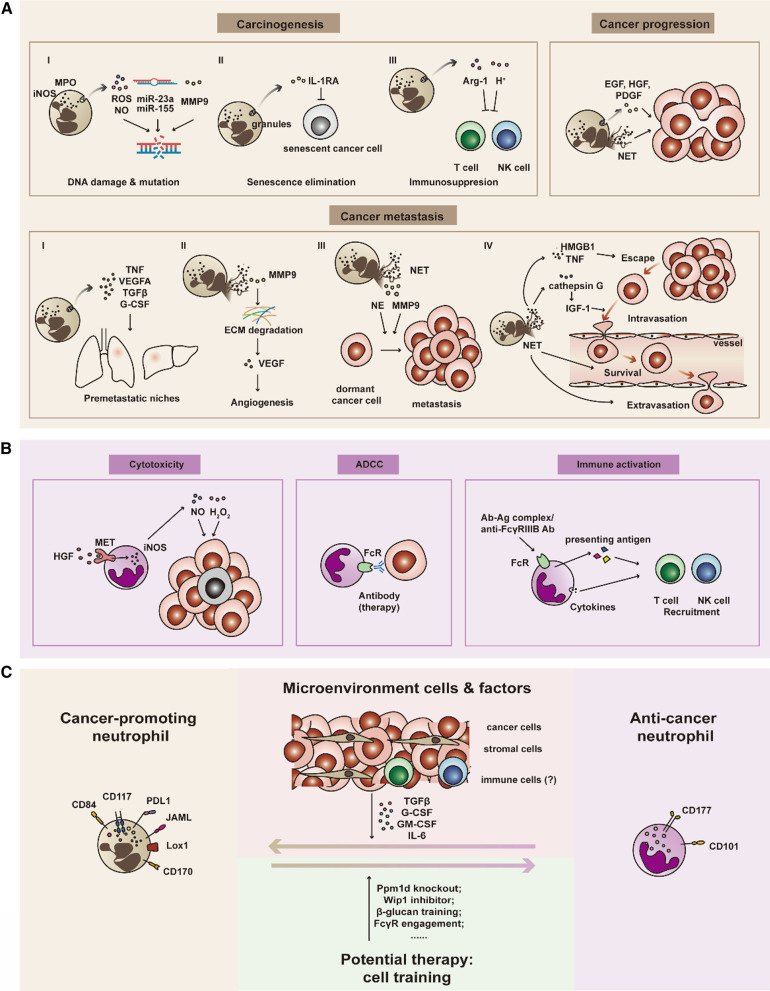
In recent years, neutrophils have attracted increasing attention because of their cancer-promoting effects. An elevated neutrophil-to-lymphocyte ratio is considered a prognostic indicator for patients with cancer. Neutrophils are no longer regarded as innate immune cells with a single function, let alone bystanders in the pathological process of cancer. Their diversity and plasticity are being increasingly recognized. This review summarizes previous studies assessing the roles and mechanisms of neutrophils in cancer initiation, progression, metastasis and relapse. Although the findings are controversial, the fact that neutrophils play a dual role in promoting and suppressing cancer is undeniable. The plasticity of neutrophils allows them to adapt to different cancer microenvironments and exert different effects on cancer. Given the findings from our own research, we propose a reasonable hypothesis that neutrophils may be reprogrammed into a cancer-promoting state in the cancer microenvironment. This new perspective indicates that neutrophil reprogramming in the course of cancer treatment is a problem worthy of attention. Preventing or reversing the reprogramming of neutrophils may be a potential strategy for adjuvant cancer therapy.
近年来,由于中性粒细胞具有促进癌症的作用,因此引起了越来越多的关注。升高的中性粒细胞与淋巴细胞比值被认为是癌症患者的预后指标。中性粒细胞不再被认为是具有单一功能的固有免疫细胞,更不是癌症病理过程中的旁观者。它们的多样性和可塑性正日益得到认可。本综述总结了以前评估中性粒细胞在癌症起始、进展、转移和复发中的作用和机制的研究。尽管这些发现存在争议,但中性粒细胞在促进和抑制癌症方面发挥双重作用这一事实是不可否认的。中性粒细胞的可塑性使它们能够适应不同的癌症微环境,并对癌症产生不同的影响。基于我们自己的研究结果,我们提出了一个合理的假设,即在癌症微环境中,中性粒细胞可能被重新编程为促进癌症的状态。这一新观点表明,在癌症治疗过程中中性粒细胞的重新编程是一个值得关注的问题。预防或逆转中性粒细胞的重新编程可能是辅助癌症治疗的一种潜在策略。