Zhang Shannon S, Nagasaka Misako
Department of Medicine, University of California Irvine School of Medicine, Orange, CA, USA.
Chao Family Comprehensive Cancer Center, Orange, CA, USA.
Lung Cancer (Auckl). 2021 Oct 7;12:115-122. doi: 10.2147/LCTT.S334623. eCollection 2021.
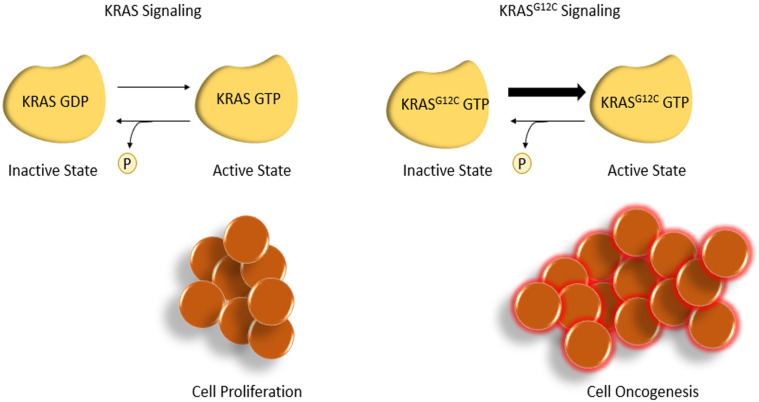
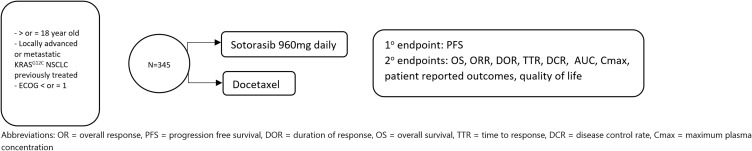
Mutations in codon 12 of have been identified in 13% of non-small cell lung cancer patients. Developing targeted therapies against mutation has proven to be challenging due to the abundance of GTP in the cytoplasm, rapid hydrolysis of GTP, and difficulty designing small molecules to achieve sufficient concentration for inhibition. Based on promising results in both preclinical and clinical trials, sotorasib, a novel inhibitor, was given conditional approval by the FDA in May 2021. The Phase I portion of the clinical trial produced 32% confirmed response with 56% of patients with stable disease. About 91.2% of patients who received the highest dose of 960mg daily achieved disease control. The Phase II portion, which used 960mg daily dosing resulted in 37.1% of patients with confirmed response and 80.6% of patients with disease control. Both phase I and phase II had similar progression-free survival, in 6.3 months and 6.8 months, respectively. In both phases, grade 4 adverse events occurred in only one patient. The most common adverse events were elevations in LFTs, which down-trended upon dose reduction and steroid treatment. While the conditional approval of sotorasib was a major breakthrough for those patients harboring mutations, resistance mutations to sotorasib are increasingly common. Many proposals have been made to address this, such as the use of combination therapy for synthetic lethality, which are producing encouraging results. Here, we explore in further detail the development of sotorasib, its efficacy, mechanism of resistance, and strategies to overcome these resistances.
在13%的非小细胞肺癌患者中已发现 密码子12的突变。由于细胞质中GTP含量丰富、GTP快速水解以及难以设计出能达到足够浓度以抑制 的小分子,开发针对 突变的靶向治疗已被证明具有挑战性。基于临床前和临床试验的 promising results,新型 抑制剂索托拉西布于2021年5月获得美国食品药品监督管理局的有条件批准。该临床试验的I期部分产生了32%的确认缓解率,56%的患者病情稳定。接受每日960mg最高剂量的患者中约91.2%实现了疾病控制。II期部分采用每日960mg给药,37.1%的患者有确认缓解,80.6%的患者病情得到控制。I期和II期的无进展生存期相似,分别为6.3个月和6.8个月。在两个阶段中,仅1例患者出现4级不良事件。最常见的不良事件是肝功能检查指标升高,在减量和类固醇治疗后呈下降趋势。虽然索托拉西布的有条件批准对那些携带 突变的患者来说是一个重大突破,但对索托拉西布的耐药突变越来越常见。已经提出了许多解决方案,例如使用联合疗法实现合成致死,这些方案正在产生令人鼓舞的结果。在此,我们将更详细地探讨索托拉西布的研发、其疗效、耐药机制以及克服这些耐药性的策略。